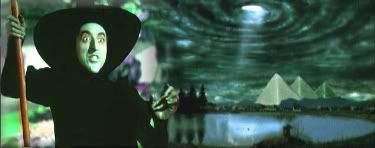
The Wizard of Oz

Moderators: Elvis, DrVolin, Jeff

Postby Perelandra » Sat Apr 11, 2009 12:23 am

Hugh Manatee Wins wrote:Children can't tell fact from fiction until around age 5 or 6.
It is a literal world until then and the stories about large things with teeth getting at little weak things is extremely personal and terrifying.

This was addressed by Dorothy Bluch in her 1978 book, 'So the Witch Won't Eat Me: Fantasy and the Child's Fear of Infanticide.' Most of Bluch's focus is on parent-child relations but does include a chapter called 'Mighty Mouse: The Birth and Death of a Defensive Fantasy.'

Point being, if you wanted to imprint power dominance and love of weapons on a toddler with media, you could do it with children's TV and movies that terrify the child before age 6 or 7.

A witch with flying monkeys would be a nasty image.
But then so are many many others.

Thank you, Hugh. I would add that "the stories about large things with teeth getting at little weak things (that) are extremely personal and terrifying", parentheses mine, have always been with us. It's nature and it is terrifying sometimes. Man has always made stories to cope with life.

However, I do agree that a line needs to be drawn and corporations are not capable of doing so. I very much agree with a lot of your thoughts. I'm of the opinion that 90-some, maybe 100% of the media marketed to children is insidiously or jaw-droppingly vile, in some way. Progress, hah.
User avatar
Perelandra
 
Posts: 1648
Joined: Thu Feb 28, 2008 7:12 pm
Blog: View Blog (0)

Postby compared2what? » Sat Apr 11, 2009 4:51 am

justdrew wrote:Is the Oz series one of the first to build this kind of alternate reality world? If not what are some earlier examples? Maybe things like Dante, Greek mythology, Celtic mythology, etc. Is this one of the first attempts at a modern (secular?) mythology?


Well....The short answer is "No, it's not." But fwiw, I'm just categorically excluding all pre-Christian examples on the grounds that prior to that, the distinction between sacred and secular art would be a false -- or at least, a false-ish -- one in historical terms. Except for arguably some ambiguity wrt 10th century works like Beowulf, maybe. But I'm not sure. Because (a) I don't remember if anyone does argue that; and (b) periodicity is always kind of problematic that way, owing to the incredibly annoying persistence with which developments in different areas of life and society simply fucking refuse to all reach critical mass at the exact same time.

But there were numerous works of fundamentally secular fantasy-genre literature in post-Christian, almost-Western-Europe beginning at least in the 11th century. Starting, notably, with stuff like Arthurian romances and/or tales of courtly love and running straight through to the late Renaissance/early modern era, as in, for example, A Midsummer Night's Dream.

Also, in case no one's already said it, the movie and the books have very little in common with one another that goes any deeper than the parts of their surfaces that are, you know, identical. Plus, the movie is among the greatest works of art in any medium in the entire 20th century, whereas the books are just very good children's books. So you can't really transfer properties that are only present in the books to the movie as if both were just different parts of the same whole. They're not. They're freestanding and discrete entities that just happen to be isomorphic in some regards.

Also, I wish to contribute this.
User avatar
compared2what?
 
Posts: 8383
Joined: Sun Oct 21, 2007 6:31 am
Blog: View Blog (0)

Postby lightningBugout » Sat Apr 11, 2009 5:04 am

http://en.wikipedia.org/wiki/Paracosm wrote:Paracosm
From Wikipedia, the free encyclopedia
Jump to: navigation, search
This article does not cite any references or sources. Please help improve this article by adding citations to reliable sources (ideally, using inline citations). Unsourced material may be challenged and removed. (February 2008)

A paracosm is an imagined, detailed fantasy world invented by a child or perhaps an adult, involving humans and/or animals, or perhaps even fantasy or alien creations. Often having its own geography, history, and language, it is an experience that continues over a long period of time: months or even years.

The concept was first described by a researcher for the BBC, Robert Silvey, with later research by British psychiatrist Stephen A. MacKeith, and British psychologist David Cohen.[citation needed]

Silvey & MacKeith published The Paracosm: a special form of fantasy in 1988, and Cohen & MacKeith published The Development of Imagination: The Private Worlds of Childhood in 1991.

Examples of paracosms are "Gondal", "Angria" and "Gaaldine," the fantasy worlds created and written about in childhood by Emily, Anne, and Charlotte Brontë, and their brother Branwell. Another example is "Borovnia," the fantasy world created by Juliet Hulme and Pauline Parker, as portrayed in the film Heavenly Creatures.
"What's robbing a bank compared with founding a bank?" Bertolt Brecht
User avatar
lightningBugout
 
Posts: 2515
Joined: Mon Jun 16, 2008 3:34 am
Blog: View Blog (0)

Postby justdrew » Thu Apr 23, 2009 1:08 am

paracosm - great word, thanks, I hadn't run into that before.

justdrew wrote:Is the Oz series one of the first to build this kind of alternate reality world?


not exactly the same thing but interesting:

http://en.wikipedia.org/wiki/Darwin_Among_the_Machines
http://en.wikipedia.org/wiki/Erewhon
http://en.wikipedia.org/wiki/News_from_Nowhere
User avatar
justdrew
 
Posts: 11966
Joined: Tue May 24, 2005 7:57 pm
Location: unknown
Blog: View Blog (11)

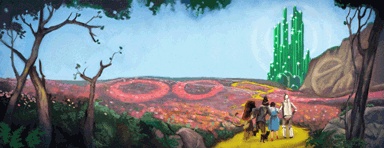
71st Anniversary

Postby MinM » Thu Aug 12, 2010 3:05 pm

Earth-704509
User avatar
MinM
 
Posts: 3288
Joined: Wed Jun 04, 2008 2:16 pm
Location: Mont Saint-Michel
Blog: View Blog (0)

Re:

Postby brainpanhandler » Mon Jan 14, 2013 3:46 pm

compared2what? wrote:Also, in case no one's already said it, the movie and the books have very little in common with one another that goes any deeper than the parts of their surfaces that are, you know, identical. Plus, the movie is among the greatest works of art in any medium in the entire 20th century, whereas the books are just very good children's books. So you can't really transfer properties that are only present in the books to the movie as if both were just different parts of the same whole. They're not. They're freestanding and discrete entities that just happen to be isomorphic in some regards.


INTRODUCTION.


Folk lore, legends, myths and fairy tales have fol-
lowed childhood through the ages, for every healthy
youngster has a wholesome and instinctive love for stories
fantastic, marvelous and manifestly unreal. The winged
fairies of Grimm and Andersen have brought more happi-
ness to childish hearts than all other human creations.

Yet the old-time fairy tale, having served for genera-
tions, may now be classed as "historical" in the children's
library; for the time has come for a series of newer "won-
der tales" in which the stereotyped genie, dwarf and fairy
are eliminated, together with all the horrible and blood-
curdling incident devised by their authors to point a
fearsome moral to each tale. Modern education includes
morality; therefore the modern child
seeks only entertainment in its wonder-
tales and gladly dispenses with all dis-
agreeable incident.

Having this thought in mind, the
story of 'The Wonderful Wizard of
Oz" was written solely to pleasure
children of today. It aspires to being
a modernized fairy tale, in which the
wonderment and joy are retained and the
heart-aches and nightmares are left out.

L. Frank Baum.

Chicago, April, 1900.

http://archive.org/stream/wonderfulwiza ... a_djvu.txt


"Nothing in all the world is more dangerous than sincere ignorance and conscientious stupidity." - Martin Luther King Jr.
User avatar
brainpanhandler
 
Posts: 5124
Joined: Fri Dec 29, 2006 9:38 pm
Blog: View Blog (0)

Previous

Return to General Discussion

Who is online

Users browsing this forum: No registered users and 19 guests