Friday, June 27, 2014
Long live darkness in Egypt

The headline reads: The President (of Egypt) decides to ration electricity.
Moderators: Elvis, DrVolin, Jeff

You realize that the "headline" is made up, right? It's a cartoon. Nobody's rationing anything, we still get to waste electricity as much as we want, if we're so inclined.American Cut-and-Paste wrote:The headline reads: The President (of Egypt) decides to ration electricity.
It's typically pathetic, but AD is pretty sure that what he lacks in quality can be made up for with quantity. Which is odd because when every cut-and-paste of his to the RI message board(TM), reeks of a weird sense of discrimination, it would seem to compromise his ability to successfully push his 'message'.How pathetic is that, when even this is used by assholes to attack us and to demonize our extremely popular president.

Believe it or not, so am I. It's ironic but so appropriate. So many people were saying/warning: "The revolution will not be televised." The fact that the one in January 2011 was, (and how!) should have been a clue. Now that a real revolution is in progress, it's happening behind a wall of obfuscation and lies.Sounder wrote:Boy, I'm glad this thread is still called Al Jazeera coverage of Egypt's growing revolution.
Thank you, and thank everybody who genuinely wishes good things for the Egyptian people, and for all people. Or at least respects them.Sounder wrote:Thanks Alice for keeping it real, and here is to wishes of good fortune to all the Egyptian people.
The problem with lying about verifiable things is that others can produce evidence that contradicts it. So it's best to stick with anonymous sources talking about secret places about which you can make up whatever you want.American Dream » Sun Jun 29, 2014 7:35 pm wrote:http://www.theguardian.com/world/2014/jun/22/disappeared-egyptians-torture-secret-military-prison
Egypt’s secret prison: ‘disappeared’ face torture in Azouli military jail
Guardian interviews with former detainees reveal up to 400 Egyptians being held without judicial oversight amid wider crackdown on human rights
Patrick Kingsley in Ismailia
The Guardian, Sunday 22 June 2014
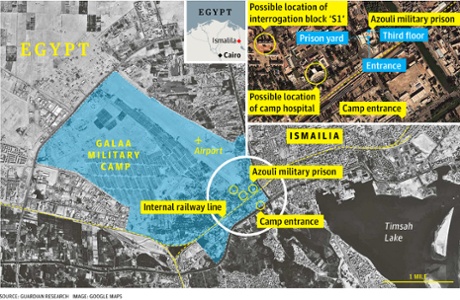
Map showing the Galaa military camp in Ismalila and the location of the Azouli military prison within it. The S1 block, which detainees describe as an interrogation block, is a few minutes drive from the jail
Hundreds of “disappeared” Egyptians are being tortured and held outside of judicial oversight in a secret military prison, according to Guardian interviews with former inmates, lawyers, rights activists and families of missing persons.
They are among at least 16,000 political prisoners arrested since last summer’s regime change. But what sets Azouli’s prisoners apart is the way they are held outside of Egypt’s legal system, in circumstances that allow their jailers to act without fear of even hypothetical consequences.
“Officially, you aren’t there,” said Ayman, a middle-aged man who was brought to Azouli towards the end of 2013, and one of only a few to later be released.
“It isn’t like normal prisons. There is no documentation that says you are there. If you die at Azouli, no one would know.”
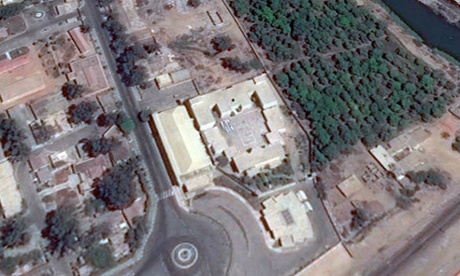
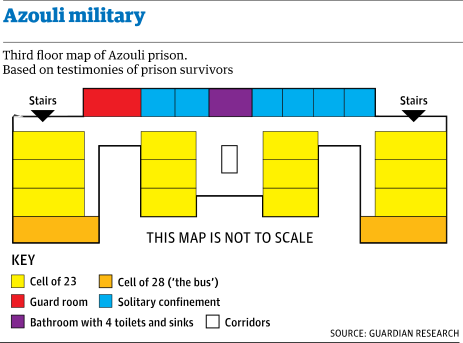
Azouli prison cannot be seen by civilians. It lies inside a vast military camp – the sprawling headquarters of Egypt’s second field army at Ismailia, a city 62 miles north-east of Cairo – but hundreds are nevertheless all too aware of its third and highest floor, where the detainees are held in cramped cells.
Where did the figure of 16,000 come from? The same place that Abdel-Moneim Aboul-Fotouh's 21,000 came from, and the same place that Gigi Ibrahim, of the Revolutionary Socialists, got 41,000. I wonder where the Guardian's "independent estimate" came from. Nobody ever tells us. What the hell, who's counting? Why not say 1 million? Say whatever you want. When one guy is arrested, his family puts on a big show, screaming and wailing for the cameras. His mother tells us earnestly what a good boy he was, and Al-Jazeera makes him a star. But 16,000, or 21,000 or 41,000 (depending on who you ask) "disappear", and... no families. No names. No faces. Just anonymous "sources" and "lawyers" and "activists" in the Guardian, except for one:According to the interior ministry, at least 16,000 Egyptians have been arrested for political reasons since July 2013, though one independent estimate suggests the figure may be as high as 41,000.
Ah, finally a name: Ahmed Helmy, of the Muslim Brotherhood, a frequent guest on Al-Jazeera, where he says whatever suits his Qatari paymasters. So, you've got this tall edifice resting on the word of anonymous individuals and one Muslim Brotherhood lawyer. And this edifice is the claim that there are at least 16,000 "political prisoners".According to Ahmed Helmy, a lawyer who represents former Azouli prisoners, many detainees are tortured by military intelligence until they memorise specific confessions to acts of terrorism. Then they are transferred to state security offices where they are asked to repeat these confessions to a police prosecutor. Other detainees from civilian jails confirm meeting Azouli prisoners at this stage in their incarceration.
Do tell: how and when did Mr. Elmessiry conduct this "extensive investigation"? Where are the results of this "extensive investigation"? Or is this "extensive investigation" a fiction solely for the purpose of giving this gentleman credibility that he has not otherwise earned?“The issue is that many of those at Azouli are arrested randomly or with very little evidence, and then the intelligence services use torture to find out whether they are actually involved in violence,” said Mohamed Elmessiry, Egypt researcher for Amnesty International, who has led an extensive investigation into Azouli.
Not surprisingly, Mohamed Elmessiry is a liar. Morsy was arrested under a warrant from the Prosecutor-General's office, based on the evidence (his first trial was for the murder of peaceful demonstrators, who were brought into the presidential palace by Brotherhood thugs under the personal supervision of Morsy's officials, and were tortured and killed inside the presidential palace while Morsy was present. This happened after Morsy had first ordered the Interior Minister to "get rid of them", and been refused, then ordered the Chief of the Presidential Guard, and also been refused. Both asked Morsi to give them orders in writing, which he would not do. The Interior Minister was fired for refusing the order).Last weekend, Badr Abdelatty, a Foreign Ministry spokesperson, told reporters that the former president would “have full rights to a free and fair trial” and that he would “be charged on criminal charges before his normal judge according to the Egyptian penal code.” However, rights groups say that because Morsi was initially denied a lawyer while being interrogated and investigated during his detention, this promise has not been fulfilled.
Morsi’s legal team also told Amnesty International that they were not given access to the full 7,000 page case file until the end of October. Mohamed El Messiry, an Egyptian spokesperson for Amnesty, said Morsi’s detention and the charges leveled against him are politically motivated. “The fact that he didn’t have access to lawyers and therefore the means to defend himself during the preparation of the case,” El Messiry said, “means there is no fairness to the trial. A person should be entitled to lawyers and informed of his rights.” Link
This is hilarious: it's taken from a famous scene from a movie, The Yacoubian Building. A young man whose dream is to become a police officer has his application rejected by the police academy. He joins a terrorist group and is arrested. In jail, he's blindfolded and tortured by an anonymous police officer whom he can only identify by the distinctive sound of his lighter, which he keeps "flicking...on and off for several minutes before asking a series of questions..." After his release, one day he hears that unique sound, and is able to identify his torturer. At the end of the film, he murders the officer, and gets killed in the process.When Khaled was first called, on his first full day at Azouli, he remembers the unnerving sound of an officer silently flicking his lighter on and off for several minutes before asking a series of questions about the organisation of protests.
“And then the torture started,” Khaled recalled. “It started with electric shocks in every place in my body. [The officer] called the military policemen and told them: ‘Take off his clothes.’ They took me out of the room. I took everything off apart from my boxers. They said: ‘Make yourself totally naked.’ I said no. The officer said: ‘Bring him in.’
“I started to give him some names. He felt I had lied, so he ordered the soldiers to make me totally naked. The electric shocks were in every place in my body, especially the most sensitive areas – my lips, the places with nerves. Behind the ear and lips. Under the shoulders.”
No student was given 17-year jail-terms for demonstrating on campus. No protesters were handed life sentences for blocking roads. Pure lies, but what the hell.The death sentences were the latest in a series of draconian court decisions, including students being given 17-year jail-terms for demonstrating on campus and protesters handed life sentences for blocking roads while policemen walk free for murder.
As I've mentioned before, the law is less restrictive than those of the US, Germany, the UK, etc., but these "activists" don't want ANY law regulating ANY demonstrations, even if these violate the rights of other citizens, or involve vandalism, destruction of property, or incitement to violence. Some of them, including Alaa' Abdel-Fatah, have even explicitly said that their aim is to collapse the state. Abdel-Fatah is actually currently free, which I for one find very surprising.** Ahmed Maher is charged with receiving illegal funds from a foreign state in exchange for espionage and acts of sabotage. The evidence against him includes film footage of him breaking into government buildings, committing acts of vandalism and theft, and audio recordings of him boasting of his crimes to his co-conspirators, among other things.Three leftist activists – Mahienour el-Masry, Ahmed Maher and Alaa Abd El Fatah – who helped organise the protests that led to the fall of Mubarak – were jailed three years later under a new law that allows the government to stop its opponents mobilising in public.
There is not a single "detainee" that is "uncharged". All arrests are based on evidence presented to the General-Prosecutor's Office, which issues a warrant for the suspect's arrest, at which time they are charged. Those making the accusations about "detainees" held without charge have been repeatedly asked to substantiate their claims, which they have consistently failed to do. But who's listening?But many detainees remain uncharged after months in jail, with judges renewing their detentions en masse every 45 days – a situation that rights campaigners say amounts to arbitrary detention.
 [This is a roundup of news articles and other materials circulating on Egypt and reflects a wide variety of opinions. It does not reflect the views of the Egypt Page Editors or of Jadaliyya. You may send your own recommendations for inclusion in each week's roundup to egypt@jadaliyya.com by Sunday night of every week.] Egypt’s Secret Prison: ‘Disappeared’ Face Torture in Azouli Military Jail Partick Kingsley “interviews former detainees reveal up to four hundred Egyptians being held without judicial oversight amid wider crackdown on human rights.” Blog: The "Court" Lina Attalah writes on the court session of twenty-three detainees who are charged with ...
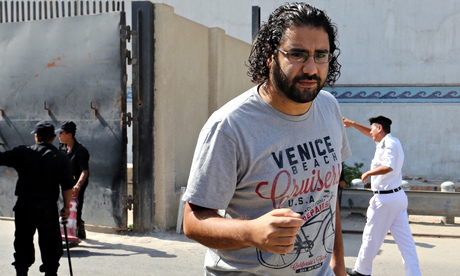
 Alaa Abdel-Fatah was not standing outside the courtroom. He was arrested in a cafe where he was hanging around with his friends after failing to show up for his trial. He seems to believe that he is above the law, maybe because of his extreme popularity in the US media and with US administration officials. On his recent visit to Cairo, one of John Kerry's main demands was for President Sisi to grant Abdel-Fattah "a presidential pardon". That's a stupid request, because presidential pardons can't be granted until after there's been a trial and conviction and all appeals have been exhausted. Also, why would President Sisi pardon Alaa Abdel-Fattah? As a special favor to the Obama administration? Really?American Cut-and-Paste wrote:Two weeks ago, June 11, Egyptian blogger and on-line activist Alaa Abdel Fattah was sentenced to 15 years in jail by an Egyptian court. His crime? He was part of a Nov. 26, 2013 peaceful demonstration in front of the Egyptian Shura council protesting a proposed constitutional provision allowing military trials for civilians. His trial was held at a police station and he and 23 other defendants in his case weren’t allowed to be present. They were all sentenced in absentia as they stood outside the courtroom.
Fattah is one of the world’s best-known Internet activists; he’s given interviews to so many countries he’s like a United Nations of sound-bites. That makes even more brazen the farcical trial and nightmarish sentence handed down. It also makes clear how far governments will go in implementing the blueprint for Internet repression that is being followed, in one way or the other, world-wide.
..But the popular blogger has been much more than a source of information and interviews. He’s a revolutionary activist and, possibly most dreaded, a “techie”. He has spent the last period of time alternating between his blog and the training of Egyptian young people in the important tasks of coding, running servers and developing websites..


American Dream » Fri Jun 27, 2014 2:38 pm wrote: http://angryarab.blogspot.com/2014/06/l ... egypt.html
Friday, June 27, 2014
Long live darkness in Egypt
The headline reads: The President (of Egypt) decides to ration electricity.
http://fpif.org/clueless-cairo/An Army as Immovable as the Pyramids
Ever since 1952, when a group of nationalist military officers ended the pro-British monarchy, Egypt’s army has been in the driver’s seat. From Gamal Abdul Nasser to Hosni Mubarak, its rulers were military commanders. And if, in February 2011, a majority of the members of the Supreme Council of the Armed Forces (SCAF) abandoned Mubarak, it was only to stop him from passing the presidency on to his son Gamal on his 83rd birthday. The neoliberal policies pursued by the Mubarak government at the behest of that businessman son from 2004 onward made SCAF fear that the military’s stake in the public sector of the economy and its extensive public-private partnerships would be doomed.
Fattened on the patronage of successive military presidents, Egypt’s military-industrial complex had grown enormously. Its contribution to the gross domestic product (GDP), though a state secret, could be as high as 40%, unparalleled in the region. The chief executives of 55 of Egypt’s largest companies, contributing a third of that GDP, are former generals.
Working with the interior ministry, which controls the national police force, paramilitary units, and the civilian intelligence agencies, SCAF (headed by General Abdel Fattah el-Sisi, doubling as the defense minister) would later orchestrate the protest movement against popularly elected President Muhammad Morsi of the Muslim Brotherhood. That campaign reached its crescendo on June 30, 2013. Three days later, SCAF toppled Morsi and has held him in prison ever since.
The generals carried out their coup at a moment when, according to the Washington-based Pew Research Center, 63% of Egyptians had a favorable view of the Muslim Brotherhood, 52% approved of the Brotherhood-affiliated Freedom and Justice Party, and 53% backed Morsi, who had won the presidency a year earlier with 52% of the vote.
Washington Misses the Plot
Remarkably, Obama administration officials failed to grasp that the generals, in conjunction with Interior Minister Muhammad Ibrahim, were the prime movers behind the Tamarod (Arabic for “rebellion”) campaign launched on April 22, 2013. Egyptians were urged to sign a petition addressed to Morsi that was both simplistic and populist. “Because security has not returned, because the poor have no place, because I have no dignity in my own country…” read the text in part, “we don’t want you anymore,” and it called for an early presidential election. In little over two months, the organizers claimed that they had amassed 22.1 million signatures, amounting to 85% of those who had participated in the presidential election of 2012. Where those millions of individually signed petitions were being stored was never made public, nor did any independent organization verify their existence or numbers.
As the Tamarod campaign gained momentum, the interior ministry’s secret police infiltrated it, as did former Mubarak supporters, while elements of the police state of the Mubarak era were revived. Reports that cronies of the toppled president were providing the funding for the campaign began to circulate. The nationwide offices of the Free Egyptians – a party founded by Naguib Sawiria, a businessman close to Mubarak and worth $2.5 billion – were opened to Tamarod organizers. Sawiria also paid for a promotional music video that was played repeatedly on OnTV, a television channel he had founded. In addition, he let his newspaper, Al Masry al Youm, be used as a vehicle for the campaign.
In the run-up to the mass demonstration in Cairo’s iconic Tahrir Square on June 30th, the first anniversary of Morsi’s rule, power cuts became more frequent and fuel shortages acute. As policemen mysteriously disappeared from the streets, the crime rate soared. All of this stoked anti-Morsi feelings and was apparently orchestrated with military precision by those who plotted the coup.
Yet another lie. The actual figure is 1.8% One side-effect of the US' domination of Egypt since the mid- to late 1970s was the unprecedented gutting of Egypt's arms manufacturing industries, and the privatization of military-owned firms. A good example is the strategically important cement industry, which in the 1950s and 60s was mostly a public sector industry. The factories were "privatized" under Mubarak, and sold for a fraction of their value to Egyptian businessmen who just happened to have very close ties to the US. The Egyptian businessmen, in turn, sold them to foreign-owned multinationals for a massive profit. This was the pattern for the most important public sector firms, including those that were important to the military industries and to national security. The purpose was to render Egypt militarily and economically crippled and dependent on the US, which in turn is committed to a policy of ensuring that all Arab states combined do not achieve strategic/military parity with Israel. This long-standing policy was written into law in 2007, and named the US policy of ensuring Israel's "Qualitative Military Edge." In practice, this has meant that US' near-total hegemony over the region has for decades allowed Israel to do pretty much whatever it wants to us.American Cut-and-Paste wrote:Fattened on the patronage of successive military presidents, Egypt’s military-industrial complex had grown enormously. Its contribution to the gross domestic product (GDP), though a state secret, could be as high as 40%, unparalleled in the region. The chief executives of 55 of Egypt’s largest companies, contributing a third of that GDP, are former generals.
As for the claim that the "chief executives of 55 of Egypt’s largest companies, contributing a third of that GDP, are former generals," that may or may not be true. What is true is that former generals are in great demand throughout the private sector, because of their reputation for discipline, excellent technical training and skills, honesty and capacity for leadership. Retired generals can be found heading not only Egyptian corporations, but also foreign corporations operating in Egypt and the Middle East, and Africa.Number six on the list of weapon exporters is Israel. Israel may be the sixth weapon exporter in the world, but it is the largest arms exporter in per capita terms. Indeed, while the U.S. has the largest military-industrial complex in the world, Israel has the largest proportion of its economy dedicated to the military-industrial complex.
A good way to estimate the size of the military-industrial complex is to compare the proportions of public expenditure on defense. According to SIPRI, the Stockholm International Peace Research Institute, Israel spends 8.4 percent of its GDP on defense, putting it in the third place worldwide, and almost twice as much as the U.S., which is seventh place in the world.
But SIPRI's data doesn't take into account the massive investment of natural resources, especially land and labor, which are used by the Israeli army, police, and prison systems without payment. Approximately half of the territory of Israel is controlled directly or indirectly by the army, and about half of the Israeli citizens serve in the army without salary for one to three years. If those facts are taken into account, it becomes clear that Israel is the world's most militarized state.
It should be emphasized that the arms industry is built upon reciprocal purchases. Arms deals are often two-sided, meaning that when one country sells military equipment to a second country, the second country is expected to buy something from the first. This tradition intensifies the arms proliferation and creates an unnecessary stockpiling of arms by countries who are at peace.
The problem is that where the army's outfitted with new shiny toys, generals and politicians sometimes develop the urge to try them out and go on the offensive. The arms trade is therefore a hazard to peace and to security for all residents of all countries.
Because of the massive investment of resources on security and the army, Israel suffers from high levels of poverty and crumbling social services. The current Israeli government debated the urgent need to cut military expenditures and eventually approved some minor cuts to the defense budget. But the Israeli system allows the Ministry of Defense to keep the revenue from arms sales and use them to further boost its own budget. Therefore, despite the government's efforts, the actual budget of the Israeli Ministry of Defense is expected to grow, although the Israeli Ministry repeatedly exceeds its budget. In 2012, it spent about one and a half billion dollars more than the budget approved by the Israeli parliament, the Knesset.
The U.S. continues to give Israel military aid to the tune of $3 billion every year, with plans to expand aid to $4 billion annually. The aid ensures high profits for the U.S. arms companies. The U.S. also buys military equipment from Israel in reciprocal deals, contributing to the Israeli military-industrial complex.
More importantly, when the U.S. shows its support for Israel, it also legitimizes Israel's use of force. Israel intensifies the violence in the Middle East and contributes to sales of the arms industry worldwide.
The massive investments in the military-industrial complex causes immeasurable suffering, injury, and death to the Palestinians living under Israeli occupation, it puts Israel in a state of deep socioeconomic crisis, and it costs U.S. taxpayers billions of dollars that could have been used to provide much-needed services in the U.S. But on the other hand, it creates profit for the arms companies. Lockheed Martin had a profit in 2012 of over $4.4 billion. Boeing had a profit of $3.9 billion that year. LinkBARACK OBAMA, U.S. PRESIDENT: Four years ago, I stood before you and said that "Israel's security is sacrosanct. It is non-negotiable." That belief has guided my actions as president. The fact is, my administration's commitment to Israel's security has been unprecedented. Our military and intelligence cooperation has never been closer. Our joint exercises and training have never been more robust. Despite a tough budget environment, our security assistance has increased every single year. We are investing in new capabilities. We're providing Israel with more advanced technology--the types of products and systems that only go to our closest friends and allies. And make no mistake: we will do what it takes to preserve Israel's qualitative military edge--because Israel must always have the ability to defend itself, by itself, against any threat.
I can't tell you how much I appreciate the head's up from you and Sounder. I was beginning to feel like a sucker, wasting my time and energy on a futile and asinine "dialogue" with Mr. Cut-and-Paste. It's like being stuck in an elevator with a malicious robot. It's good to know that there are actual humans here, and that they're interested.bluenoseclaret » Mon Jun 30, 2014 11:05 pm wrote:AlicetheKurious....
I would like to say Thank You for the years of postings by you.
It would almost be nigh impossible to appreciate/understand the events in Egypt without your posts.
Good luck.
