Top 100 Science-Fiction, Fantasy Books

Moderators: Elvis, DrVolin, Jeff

Re: Top 100 Science-Fiction, Fantasy Books

Postby JackRiddler » Mon Jan 23, 2012 4:59 pm

This has happened before! It will happen again! You are the harbinger of death, Kara Thrace. End of line.

To wit:
viewtopic.php?f=40&t=14599
We meet at the borders of our being, we dream something of each others reality. - Harvey of R.I.

To Justice my maker from on high did incline:
I am by virtue of its might divine,
The highest Wisdom and the first Love.

TopSecret WallSt. Iraq & more
User avatar
JackRiddler
 
Posts: 16007
Joined: Wed Jan 02, 2008 2:59 pm
Location: New York City
Blog: View Blog (0)

Re: Top 100 Science-Fiction, Fantasy Books

Postby Jeff » Mon Jan 23, 2012 7:32 pm

JackRiddler wrote:This has happened before! It will happen again!

Could it happen again, in the future? Where you and I are going to spend the rest of our lives? I find the future interesting, because future events such as these will affect us in the future.

Image


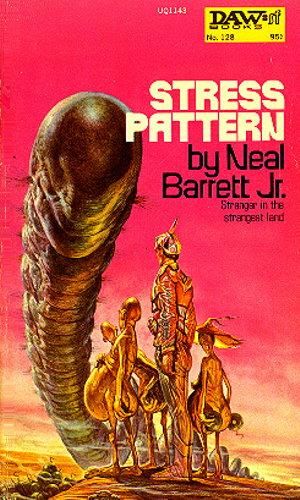
Something I just dug out of a basement box - dammit, I remember when I could actually shelve things - that I remember little about, other than that I found it original and provocative, and enjoyed it tremendously:

Image

(I have a lot of those yellow-spined Daw titles in boxes downstairs.)

From here:

Forgotten Book: Stress Pattern by Neal Barrett, Jr.

Neal Barrett, Jr. is a close friend of mine. I want to make that clear up front. I have known him for 30+ years and he is very dear to me. No one cheered more for him when the Science Fiction Writers of America named him their most recent Author Emeritus. It is amazing to me that he does not have a shelf full of Hugos, Nebulas and World Fantasy Awards. His novels are an amazing conglomeration of wry humor, weird aliens, and illogical contradictions.

STRESS PATTERN is where Neal Barrett, Jr. made the change from interesting writer to full-fledged lunatic. College professor Andrew Gavin is launched from his cruise liner onto a world that he has not identified. He is soon deprived of everything except the clothes on his back. No food, no water, no hope. So he wanders and a piqcaresque journey of Jack Vance-ian complexity begins.

Andrew meets a group of aliens who have no real ambitions or curiosity. They travel in giant worms which act as subway system. No place has a name. Things are either “here” if they are “here” or “there” if they are not. They do not reason so much as react.

He later meets traders who rarely even talk. He meets a tribe that lives in trees. He has a child (or “new person”) without benefit of sex who resembles a former airhead student.

Overall impressions of this novel

A very odd book with totally alien cultures and illogical events following each other. Andrew wanders because it is what people do and not what the aliens do or expect. He questions everything and is astounded when he is greeted with ignorance or apathy. This is the beginning of Barrett’s most fun period. He followed this with a four novel fantasy series featuring the brave pig Aldair in his high fantasy quest to save his beloved piglet princess. If you like odd alien cultures, Jack Vance or Stanislaw Lem, you should really enjoy this one.
User avatar
Jeff
Site Admin
 
Posts: 11134
Joined: Fri Oct 20, 2000 8:01 pm
Blog: View Blog (0)

Re: Top 100 Science-Fiction, Fantasy Books

Postby Harvey » Tue Jan 24, 2012 6:09 pm

As promised, John Crowley and Johnathan Carrol.

Image

Thinking back over novels which were such a delight that I can't imagine not having read them, Little Big by John Crowley is such a one but a very special one. It inhabits you as you read it. It becomes part of the weave and weft of your life. Or it did mine. In short it became for me one of those special novels that finds you at the right time; some others for me were Cryptonomicon, The Way We Live Now, Vanity Fair, Humboldts Gift, Karoo, Foucault's Pendulum, The Discovery of Heaven.

John Crowley's unheralded masterpiece The Guardian


Away with the fairiesLittle, Big receives a long overdue revival

This spring sees the publication of a 25th anniversary edition of a book first published in 1981. Which, of course, would put the book in the public domain for 28 years, but that isn't a mistake. It's typical of the quirky charm, ethereal atmosphere and somewhat blurred reality of John Crowley's ambitious novel Little, Big, one of the most under-rated classics of recent years.

Little, Big is one of those sprawling, dream-like fantasy novels that has very British sensibilities but, paradoxically, it takes the Americans to do really well. Into this category I'd also put Mark Helprin's fantastical history of a mythical early 20th-century New York, Winter's Tale.

Like a One Hundred Years of Solitude set in New England, Little, Big spans several generations of the Drinkwater family and their relationship with the world of faerie. The concept is rescued from tweeness by author Crowley's dazzling feats of aerobatics with the English language, which at first – especially in my tightly-typeset Methuen edition – take a bit of getting used to but, ultimately, draw you in and trap you with their beauty, not unlike the fabled world of faery itself.

The esteemed literary critic Harold Bloom called Little, Big "a neglected masterpiece. The closest achievement we have to the Alice stories of Lewis Carroll", and the vast novel does have an almost soporific, Wonderland quality to it – best read on lazy days in dappled sunshine.

When I first read Little, Big, many years ago, I didn't know anything about the author and, this being the land before the internet, didn't bother to find out. Such is the timeless quality of the writing, I think I subconsciously assumed the book was the product of some other epoch, before mine, and the author was long gone to dust.

I was a little surprised, then, to realise only recently that Crowley was actually born in 1942 and not only still going strong, but blogging healthily as well. His online journal isn't, as I'd imagined, the ponderous musings of a man with one foot in the faerie lands, but an entertaining romp about getting busted for speeding in Massachusetts and linking to salon.com.

Although the recipient of a World Fantasy award for best novel, Little, Big, in its silver jubilee year (give or take), is not being trumpeted by the publishing mainstream. Instead, the marking of its anniversary falls to the tiny Incunabula press of Seattle, which is releasing several editions of the book this spring.

The company has worked closely with Crowley to come up with an ultimate edition more fitting with his original vision; the company's website says that the first publication of the book, while sumptuous, was not quite right: "Its sensibility is late Victorian, whereas Crowley's design conception for the book has always been art nouveau."

Also slightly unorthodox is the way in which the new edition of Little, Big is being produced – as a subscription-only edition, with fans putting their money up front.

Incunabala's Ron Drummond says: "This is actually a very traditional approach. In 1795, the 24-year-old Beethoven convinced hundreds of aristocratic fans of his piano playing to subscribe in advance to the publication of his official compositional debut: the Three Piano Trios, Opus 1. They bought copies up front, from which monies were then used to pay for the engraving and printing of the trios."

It would be nice if Little, Big could get a wider audience so many years down the line, and I'm sure its otherworldly feel and journey from indistinct past to potential, dystopian future would find a ready market today. But, perhaps, like the world of faerie which Crowley so expertly unveils, Little, Big is at its best when only half-glimpsed by the busy waking world.


Which leads us directly to Jonathan Carroll. Voice of Our Shadow was another such, but I've loved just about everything Carroll wrote so far:

Image

Voice of our Shadow by Jonathan Carroll Link

The protagonist of this story is Joe Lennox, and in the first part of this book he tells us about a childhood spent in the shadow of his charismatic and unruly older brother, and about the guilt he still feels regarding the accident that killed him at age sixteen. Now let us fast forward about ten years. Joe is a moderately successful writer living in Vienna. His first published short story, based on some of the experiences of his brother and his equally rebellious best friend, has been adapted into a very successful play. Joe is not exactly unhappy, but he is lonely.

Then one day he meets Paul and India Tate. They’re an American couple in their early forties who turn out to be the exact kind of friends Joe has been looking for his whole life. Everything is perfect for a few months, but things take a tragic turn when it becomes undeniable that Joe and India are falling in love.

As you may have gathered, the fantasy elements of this story are subtle – in fact, they are barely visible at all until a little over halfway through the book. But from the very start, there is a faint strangeness to the story – the mood is a little unsettling, and you realize that the world you’re seeing through Joe’s eyes is haunted and unique.

Jonathan Carroll is a wonderful writer. He lures you into the story and does not let go until the very end. I couldn't put this book down, and once I did put it down, because it was over, I wanted to go back and start reading it all over again. Voice of our Shadow is an odd and memorable book about love and longing, regret and guilt, and the past catching up with you even when you think you'd left it safely behind.

This book has an unforgettable ending, one of those that can be read in several ways, all of which are chilling. Once you get to the end, you realize that the book will never be the same again. You can’t read it twice in the same manner. Everything gains a new significance. The more I think about this story – and I have been doing that a great deal for the past 24 hours – the more I realize how well everything fits together, how brilliant and eerie the whole thing is.

Voice of our Shadow reminded me a little of a more subtle Heart-Shaped Box (Heart-Shaped Box is creepy as you read it, but Voice of our Shadow only becomes so in retrospect). I guess that what I mean is mostly that both are stories in which the supernatural plays an important role, but that at their core are about people and their secrets and the toll they take on their emotional lives.

Voice of our Shadow is a love story, a ghost story, and a deliciously strange and unique book. I highly recommend it.

And while we spoke of many things, fools and kings
This he said to me
"The greatest thing
You'll ever learn
Is just to love
And be loved
In return"


Eden Ahbez
User avatar
Harvey
 
Posts: 4221
Joined: Mon May 09, 2011 4:49 am
Blog: View Blog (20)

Re: Top 100 Science-Fiction, Fantasy Books

Postby Handsome B. Wonderful » Tue May 08, 2012 6:29 pm

Can anyone recommend some good SF reads? I'll list my favourite books to give you an idea of what I'm looking for.
Rendezvous with Rama by Arthur C. Clarke
Manifold: Space by Stephen Baxter
Kingdom of Cages by Sarah Zettel
Fire Upon the Deep by Vernor Vinge
Spider Star by Mike Brotherton
Accelerando by Charles Stross
Isaac Asimov's robot books (Caves of Steel, Naked Sun, Robots of Dawn, Robots and Empire)
Basically I like books that deal with deep space, (space opera, I believe is the term), hard science. I'm thinking of getting Leviathan Wakes by James Corey.
Stuff like that. Your recommendations would be most helpful. :bigsmile
Born we are the same, within the silence, indifference be Thy name
Torn we walk alone, we sleep in silent shades
The grandeur fades, the meaning never known- 'Born' Nevermore
User avatar
Handsome B. Wonderful
 
Posts: 279
Joined: Wed Jun 10, 2009 12:36 pm
Location: Canada
Blog: View Blog (0)

Re: Top 100 Science-Fiction, Fantasy Books

Postby MayDay » Tue May 08, 2012 8:08 pm

Image
* Culture
* Books
* China Miéville

Embassytown by China Miéville – review

China Mieville's Embassytown creates a world in which language and reality are indistinguishable. Photograph: Sarah Lee for the Guardian

"You taught me language," says Caliban in The Tempest, "and my profit on't/ Is, I know how to curse." As Caliban knows to his disadvantage, language is a species of exchange, a transaction in which you might hope to turn a profit as well as a phrase. With the implicit curse they deliver in and on an acquired tongue, the lines also suggest how language and power go together on Prospero's island, and remind us how quickly an exchange of words between colonist and colonised can give way to an exchange of fire.


China Miéville's impressive new novel also deals with the unpredictable potencies of language, and of fictional language in particular. Its science-fiction setting has a lot in common with Prospero's realm, rising out of imagination as an unearthly place transformed by the rough magic of exceptional speech. In some ways, it's a place that Shakespeare's sorcerer might recognise, filled with strange beings, political intrigue, stirrings of revolution, and powerful voices echoing in its unbreathable air.

After the darkly comic departure of 2010's Kraken, Embassytown returns to some of the preoccupations of Miéville's seven prior well-received novels: urban division, reflections and doublings, subjugation and propaganda. In his last but one – The City & the City – the two titular cities coexisted in identical space, kept apart by the careful indoctrination of each one's citizens to ignore the inhabitants and urban fabric of the other. It was a brilliant, Borgesian idea, but it was also a good metaphor for Miéville's writing, in which there's usually more going on than meets the eye.

Embassytown perches on Arieka, a planet at the edge of known space, within a larger city that is home to the indigenous Ariekei, known to the human colonists as "Hosts". Humans have long since left Earth, spreading across the universe as "homo diaspora" and travelling light years through an omnipresent sub-space dimension they call the "Immer". Over time, humanity and the Ariekei have developed and sustained good relations, establishing a barter economy around the living biotechnology that the Hosts "farm" elsewhere on the planet's surface.

Though he delights in conjuring an HR Gigerish vocabulary for the organic-mechanical "flesh-matter" of alien architecture and technology, Miéville remains shrewdly vague on the subject of alien anatomy: the closest he gets is a description of the Ariekei as "insect-horse-coral-fan things". But he has imagined them brilliantly and compels us to do the same. They seem to have a wing that hears and a wing that manipulates. They seem to have a number of eye stalks. Most importantly for the novel, they have two mouths which simultaneously speak "Language", a sign-system in which the truth of the world and speech itself are, in some profound way, indistinguishable. "For Hosts, speech was thought. … Without Language for things that didn't exist, they could hardly think them, they were vaguer by far than dreams." Copying the Hosts' doubleness, the colonists have bred sets of cloned "doppels" linked by genetics, chemistry and implanted biotechnology, and trained them to speak the double-voiced Language. Able at last to communicate, they make a surprising discovery: the Hosts, whose words are inseparable from their world, cannot lie.

The Ariekei, for their part, find human lies fascinating. Seeking to expand their range of expression, they persuade a few willing humans to perform memorable actions that they can then speak as similes. They organise contests in which truth-bound Hosts attempt to master the art of deception, calling them "Festivals of Lies" or – in one appealing if incongruous turn of phrase – "eisteddfods of mendacity".

The narrator of Embassytown, Avice, is one of the few trained pilots who crew the ships plying the trade routes through the Immer. As if to demonstrate the inculcated assumptions of a familiar vocabulary, the opening sections of the novel fire off a bewildering volley of neologisms: miabs and corvids, trids and turingware. Miéville doesn't gloss these: born in Embassytown, Avice is naturally familiar with its jargon, in which the "Immer" and its shadow – normal space, the "manchmal" – are only the basics. Lexically, there are enough glimpses of familiarity to prevent any protracted confusion ("Immer" and "manchmal", for instance, are clever borrowings of the German for "always" and "sometimes") but the disorientation, surely, is part of the appeal. Holding out against the disastrous temptations of the sci-fi info-dump, Miéville opts for a slow accretion of detail and implication until a universe coheres. By the time Avice recalls her first nausea-inducing "Immersion", we have a good idea how it feels to be thrown suddenly into an unfamiliar world.

The originality of Embassytown arises partly from its fusion of two traditions in which the complicity of language and power has been examined and worked through with particular urgency. The first, of course, is science fiction, and here Miéville earns his place in the long line of politically oriented writers – Orwell, Burgess, Delany, Lessing – who have made art out of the divide between their own language and an imagined idiom. The other is post-colonial fiction, with its reformations and repudiations of the languages imposed by foreign power. In this sense, Embassytown plays out as a novel of metropolitan-colonial conflict, holding out the hope that language might not serve only as a tool of oppression, but be reclaimed as the instrument that makes resistance possible.

Lies, after all, have their uses, as a character in Embassytown realises while listening to a Host struggling to tell one: "It's training itself into untruth … using these weird constructions so it can say something true." To read fiction is, in some measure, to take those true untruths for granted, which makes it a paradoxical pleasure to come across a novel that reminds us so ingeniously and enjoyably of the conditions of fiction, and of the power that fictional language retains to shape and reshape our transactions with the world.
User avatar
MayDay
 
Posts: 350
Joined: Tue Jan 24, 2012 7:30 pm
Blog: View Blog (0)

Re: Top 100 Science-Fiction, Fantasy Books

Postby MayDay » Tue May 08, 2012 8:24 pm

Image
Image
User avatar
MayDay
 
Posts: 350
Joined: Tue Jan 24, 2012 7:30 pm
Blog: View Blog (0)

Re: Top 100 Science-Fiction, Fantasy Books

Postby justdrew » Wed May 09, 2012 1:28 am

Handsome B. Wonderful wrote:Can anyone recommend some good SF reads? I'll list my favourite books to give you an idea of what I'm looking for.
Rendezvous with Rama by Arthur C. Clarke
Manifold: Space by Stephen Baxter
Kingdom of Cages by Sarah Zettel
Fire Upon the Deep by Vernor Vinge
Spider Star by Mike Brotherton
Accelerando by Charles Stross
Isaac Asimov's robot books (Caves of Steel, Naked Sun, Robots of Dawn, Robots and Empire)
Basically I like books that deal with deep space, (space opera, I believe is the term), hard science. I'm thinking of getting Leviathan Wakes by James Corey.
Stuff like that. Your recommendations would be most helpful. :bigsmile


good as it gets:
http://en.wikipedia.org/wiki/The_Chanur_novels
don't read too far ahead on the wiki or you'll be in spoiler territory.

http://en.wikipedia.org/wiki/Warren_Norwood#The_Windhover_Tapes
which may have some general RI interest as well

http://en.wikipedia.org/wiki/The_Mote_in_God%27s_Eye

Heck, the whole Ringworld series from Niven would be right up your alley, and then you can go back and explore the rest of his Known Space universe too.
By 1964 there were 1.5 million mobile phone users in the US
User avatar
justdrew
 
Posts: 11966
Joined: Tue May 24, 2005 7:57 pm
Location: unknown
Blog: View Blog (11)

Re: Top 100 Science-Fiction, Fantasy Books

Postby Handsome B. Wonderful » Wed May 09, 2012 6:48 pm

The Mote in God's Eye sounds really interesting. Think I'll check out your suggestions justdrew. Thanks.
Born we are the same, within the silence, indifference be Thy name
Torn we walk alone, we sleep in silent shades
The grandeur fades, the meaning never known- 'Born' Nevermore
User avatar
Handsome B. Wonderful
 
Posts: 279
Joined: Wed Jun 10, 2009 12:36 pm
Location: Canada
Blog: View Blog (0)

Previous

Return to General Discussion

Who is online

Users browsing this forum: No registered users and 16 guests