Out-of-place artifact
 Posted: Wed Nov 21, 2007 5:45 pm
While googling on sweet tooth's MOTM, I came across the Wiki on out-of-place artifact, thought I would start a separate thread on it.
Wiki:
http://en.wikipedia.org/wiki/OOPArt
An out-of-place artifact (OOPArt) is a term coined by American zoologist Ivan T. Sanderson for a historical, archaeological or palaeontological object found in a very unusual or seemingly impossible location. The term covers a wide variety of objects, ranging from material studied by mainstream science, such as the Iron pillar in Delhi, to so-called 'forbidden archaeology' that is far outside the mainstream.
While occasional discoveries, such as the Antikythera mechanism, have forced scientists to reassess the technology of ancient civilization, most believe cases of OOPArt to be the result of mistaken interpretation or wishful thinking. Supporters regard them as evidence that mainstream science is overlooking huge areas of knowledge, either willfully or through ignorance.
OOPArts are often of interest to creationists and others who seek evidence that may refute the theory of evolution; they are also used to support religious descriptions of pre-history, ancient astronaut theories, or the notion of vanished civilizations that possessed knowledge or technology more advanced than our own. Many writers or researchers who question or challenge conventional views of human history have used purported OOPArts to bolster their arguments.[1]
OOPArt-type objects are also a common plot device in science fiction.....
.....Alleged OOParts
[edit] Artifacts alleged to come from recognized cultures, recovered in unexpected places
The Kensington Runestone purported to be a 14th century Viking artifact found in North America.
The Piri Reis map made by the Turkish admiral Piri Reis from a diverse range of sources; it supposedly contains an accurate map of Antarctica.
Tecaxic-Calixtlahuaca head - terracotta head found in Mexico that some say is of Roman origin.
The Fuente Magna, discovered in Bolivia. Ceramic bowl with writing in alleged Sumerian cuneiform.
The Gympie Pyramid in Queensland, Australia - said by some to be evidence that the Inca were in Australia before the Europeans.
The Saqqara Bird in Egypt, discovered in a tomb, claimed to be a 7-inch model of a flying machine.
[edit] Artifacts allegedly produced by unknown cultures or societies
The Baghdad Battery, dating from between 250 BC and 250 AD.
The Baigong Pipes, unexplained pipes found in a cave in China.
The Coso artifact, containing a spark plug from the 1920s.
The Crystal skulls claimed to have been found at Lubaantun, in Yucatan and in Belize.
The Dorchester Pot, Massachusetts, United States.
The Dendera Lamps, engraved into a relief in a temple dedicated to Hathor, Egyptian Goddess of the Milky Way.
The dropa stones, also known as the Bayan Kara Ula Disks; supposedly found near Nimu in the Chinese region of Sichuan, and claimed to be 12,000 years old.
The Iron Man (Eiserne Mann), dating to the 13th century.
The Lake Winnipesaukee mystery stone
The Wolfsegg Iron, a cubical block of metal in coal found in Austria.
[edit] Artifacts alleged to predate humanity
The Acambaro figures, from Acámbaro, Mexico, some of which are in the apparent form of dinosaurs.
The Ica stones, Peru, allegedly depicting anachronistic images such as dinosaurs and modern medical procedures.
The Kingoodie hammer, Scotland, dated from 460 to 360 million years ago.
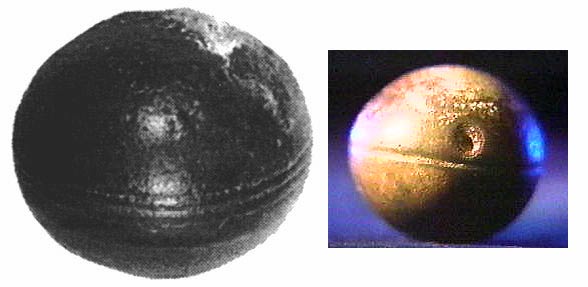
The Klerksdorp Spheres, South Africa, dated 2.8 billion years ago - their regular shapes lead to claims that they were artificially created.
The mortar and pestle (or molcajete) set discovered in Table Mountain (near Jamestown, California), in a gravel deposit which a documentary version of Forbidden Archaeology claimed to be 55 million years old. [2]
[edit] Validated cases
The Maine Penny found in Blue Hill, Maine. An 11th century Norse coin found in an American Indian shell midden. Over 20,000 objects were found over a 15-year period at the Goddard site in Blue Hill. The sole OOPArt was the coin.[3][4] One hypothesis is that it may have been brought to the site from a Viking settlement in Newfoundland, not by Norsemen but by seagoing Indians.
The Iron pillar in India, dating around to AD 423.
The Antikythera mechanism, a geared device manufactured ca. 100 BCE, believed to be a device for predicting the motion of the sun, moon and planets i.e. an orrery.
Tablets and artifacts discovered in Glozel, France in the 1920s and '30s, some of which were inscribed with an unknown, undecyphered alphabet.
[edit] See also
Anachronism
Ancient astronaut theories
Charles Fort, researcher of anomalous phenomena
Fortean Times
Wiki:
http://en.wikipedia.org/wiki/OOPArt
An out-of-place artifact (OOPArt) is a term coined by American zoologist Ivan T. Sanderson for a historical, archaeological or palaeontological object found in a very unusual or seemingly impossible location. The term covers a wide variety of objects, ranging from material studied by mainstream science, such as the Iron pillar in Delhi, to so-called 'forbidden archaeology' that is far outside the mainstream.
While occasional discoveries, such as the Antikythera mechanism, have forced scientists to reassess the technology of ancient civilization, most believe cases of OOPArt to be the result of mistaken interpretation or wishful thinking. Supporters regard them as evidence that mainstream science is overlooking huge areas of knowledge, either willfully or through ignorance.
OOPArts are often of interest to creationists and others who seek evidence that may refute the theory of evolution; they are also used to support religious descriptions of pre-history, ancient astronaut theories, or the notion of vanished civilizations that possessed knowledge or technology more advanced than our own. Many writers or researchers who question or challenge conventional views of human history have used purported OOPArts to bolster their arguments.[1]
OOPArt-type objects are also a common plot device in science fiction.....
.....Alleged OOParts
[edit] Artifacts alleged to come from recognized cultures, recovered in unexpected places
The Kensington Runestone purported to be a 14th century Viking artifact found in North America.
The Piri Reis map made by the Turkish admiral Piri Reis from a diverse range of sources; it supposedly contains an accurate map of Antarctica.
Tecaxic-Calixtlahuaca head - terracotta head found in Mexico that some say is of Roman origin.
The Fuente Magna, discovered in Bolivia. Ceramic bowl with writing in alleged Sumerian cuneiform.
The Gympie Pyramid in Queensland, Australia - said by some to be evidence that the Inca were in Australia before the Europeans.
The Saqqara Bird in Egypt, discovered in a tomb, claimed to be a 7-inch model of a flying machine.
[edit] Artifacts allegedly produced by unknown cultures or societies
The Baghdad Battery, dating from between 250 BC and 250 AD.
The Baigong Pipes, unexplained pipes found in a cave in China.
The Coso artifact, containing a spark plug from the 1920s.
The Crystal skulls claimed to have been found at Lubaantun, in Yucatan and in Belize.
The Dorchester Pot, Massachusetts, United States.
The Dendera Lamps, engraved into a relief in a temple dedicated to Hathor, Egyptian Goddess of the Milky Way.
The dropa stones, also known as the Bayan Kara Ula Disks; supposedly found near Nimu in the Chinese region of Sichuan, and claimed to be 12,000 years old.
The Iron Man (Eiserne Mann), dating to the 13th century.
The Lake Winnipesaukee mystery stone
The Wolfsegg Iron, a cubical block of metal in coal found in Austria.
[edit] Artifacts alleged to predate humanity
The Acambaro figures, from Acámbaro, Mexico, some of which are in the apparent form of dinosaurs.
The Ica stones, Peru, allegedly depicting anachronistic images such as dinosaurs and modern medical procedures.
The Kingoodie hammer, Scotland, dated from 460 to 360 million years ago.
The Klerksdorp Spheres, South Africa, dated 2.8 billion years ago - their regular shapes lead to claims that they were artificially created.
The mortar and pestle (or molcajete) set discovered in Table Mountain (near Jamestown, California), in a gravel deposit which a documentary version of Forbidden Archaeology claimed to be 55 million years old. [2]
[edit] Validated cases
The Maine Penny found in Blue Hill, Maine. An 11th century Norse coin found in an American Indian shell midden. Over 20,000 objects were found over a 15-year period at the Goddard site in Blue Hill. The sole OOPArt was the coin.[3][4] One hypothesis is that it may have been brought to the site from a Viking settlement in Newfoundland, not by Norsemen but by seagoing Indians.
The Iron pillar in India, dating around to AD 423.
The Antikythera mechanism, a geared device manufactured ca. 100 BCE, believed to be a device for predicting the motion of the sun, moon and planets i.e. an orrery.
Tablets and artifacts discovered in Glozel, France in the 1920s and '30s, some of which were inscribed with an unknown, undecyphered alphabet.
[edit] See also
Anachronism
Ancient astronaut theories
Charles Fort, researcher of anomalous phenomena
Fortean Times