It's likely that the NSA data center in Utah has that. If you read between the lines on Bamford's post about the new data center, you'd be wondering how in the fuck you would process yottabytes or make breakthroughs against current crypto protocols. The chip isn't faster than supercomputers per se, but it can work on problems that would take supercomputers very long stretches of time to compute.
If you wanted to speculate, they could build something like Wolfram Alpha or Watson, except related to intelligence analysis and closer to artificial general intelligence, if not the real deal.
This is riding an exponential curve like most of IT technology and they've solved some problems for scaling, so quantum technology will likely be on the consumer market in 5 years or less.
Oh AES, we barely knew thee. Edit: Or maybe not, depending on the architecture of the computer. The D-wave isn't a general architecture system, it's designed for optimization, the Travelling salesman problem:
http://en.wikipedia.org/wiki/Travelling ... an_problem
And it still appears to compute with a good deal of noise. IBM has made attempts on Shor's algorithm, but it remains to be seen if it would be practical with the amount of data the NSA has.
http://www.kurzweilai.net/lockheed-mart ... ing-system
Lockheed Martin Corporation has agreed to purchase the first D-Wave One quantum computing system from D-Wave Systems Inc., according to D-Wave spokesperson Ann Gibbon.
Lockheed Martin plans to use this “quantum annealing processor” for some of Lockheed Martin’s “most challenging computation problems,” according to a D-Wave statement.
D-Wave computing systems address combinatorial optimization problems.that are “hard for traditional methods to solve in a cost-effective amount of time.”
These include software verification and validation, financial risk analysis, affinity mapping and sentiment analysis, object recognition in images, medical imaging classification, compressed sensing, and bioinformatics.
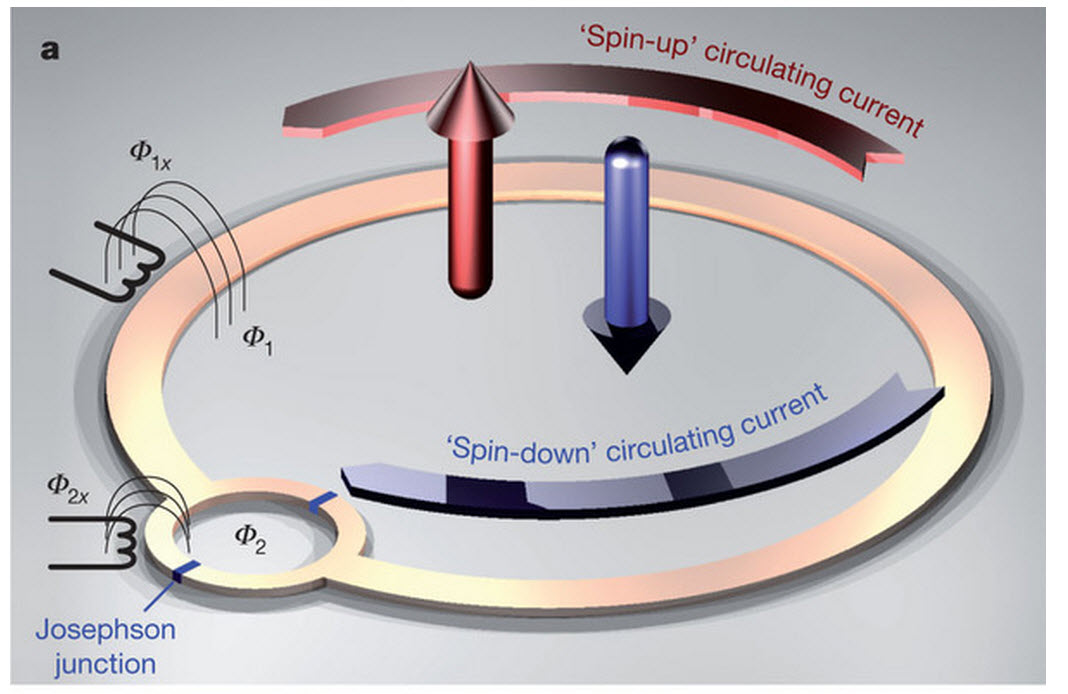
It's being used in other fields as well, for instance to solve the infamous protein folding issue:http://www.eetimes.com/electronics-news ... to-silicon
LONDON – Quantum computing has been brought a step closer to mass production by a research team led by scientists from the University of Bristol that has made a transition from using glass to silicon.
The Bristol team has been demonstrating quantum photonic effects in glass waveguides for a number of years but the use of a silicon chip to demonstrate photonic quantum mechanical effects such as superposition and entanglement, has the advantage of being a match to contemporary high volume manufacturing methods, the team claimed.
This could allow the creation of hybrid circuits that mix conventional electronic and photonic circuitry with a quantum circuit for applications such as secure communications.
edit:http://nextbigfuture.com/2012/08/dwave- ... -used.html
A team of Harvard University researchers, led by Professor Alan Aspuru-Guzik, have used Dwave's adiabatic quantum computer to solve a protein folding problem. The researchers ran instances of a lattice protein folding model, known as the Miyazawa-Jernigan model, on a D-Wave One quantum computer.
The research used 81 qubits and got the correct answer 13 times out of 10,000. However these kinds of problems usually have simple verification to determine the quality of the answer. So it cut down the search space from a huge number to 10,000. Dwave has been working on a 512 qubit chip for the last 10 months. The adiabatic chip does not have predetermined speed up amounts based on more qubits and depends upon what is being solved but in general the larger number of qubits will translate into better speed and larger problems that can be solved. I interviewed the CTO of Dwave Systems (Geordie Rose back in Dec, 2011). Usually the system is not yet faster than regular supercomputers (and often not faster than a desktop computer) for the 128 qubit chip but could be for some problems with the 512 qubit chip and should definitely be faster for many problems with an anticipated 2048 qubit chip. However, the Dwave system can run other kinds of algorithms and solutions which can do things that regular computers cannot. The system was used by Google to train image recognition systems to remove outliers in an automated way.
We already have an open source program to infer mathematical patterns from data. Another interesting trend for the next 5 years, combine sensor nets with unsupervised learning algorithms, combined with the ability to crack current cryptography standards, to watch everything everywhere. A system like that could record, monitor, process data and formulate concepts beyond any level we can imagine.
http://creativemachines.cornell.edu/eureqa
http://page.mi.fu-berlin.de/rojas/neural/chapter/K5.pdf
http://www.ics.uci.edu/~dsm/ics280senso ... /chong.pdf
edit 2:
Here's a comment from a PhD candidate in Physics on the D-Wave computer, though it mentions the older version:
There is a lot of back and forth because of previous hyped up claims, it may or may not be possible to implement a more general architecture with less noise.http://www.quora.com/Computer-Security/ ... to-systems
Wave's quantum computer is an adiabatic quantum computer designed to solve optimization problems, not perform universal computations. It's architecture is not compatible with running algorithms based on the circuit model, which include all the fabled cryptography beating algorithms based on fast factoring (Shor's algorithm).
In any case, as Michael points out, 128 qubits is certainly not enough to decrypt traditional cryptosystem and there is some dispute about exactly how "quantum" their computer really is, although their Nature paper has alleviated some of these concerns. At this point, D-Wave's computer is more relevant as a proof of principle than as an actual computational device. Lockheed Martin probably bought theirs to insure they will be on the ground floor if this thing takes off.