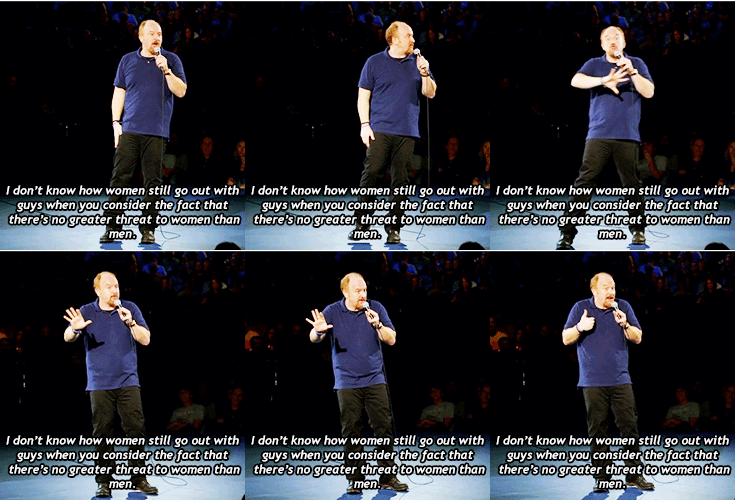
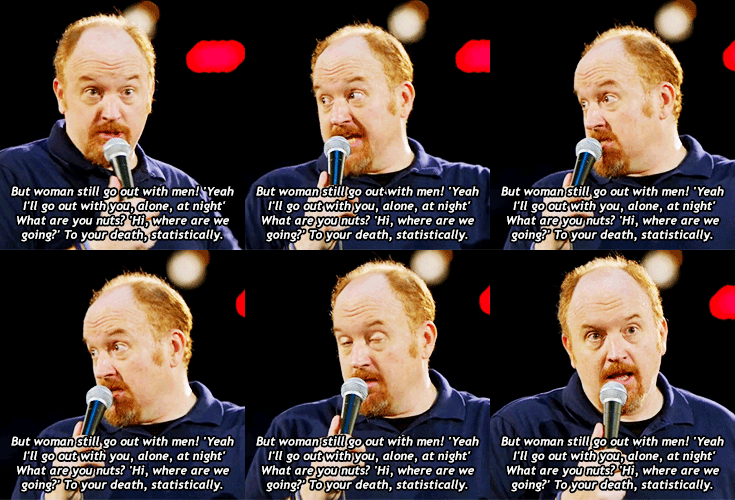
The author said after consulting with several zoologists and primatologists that an analogue of child sexual abuse was not found in any other primate.
i would suggest that you stick to the case in question,
Between yourself and Nordic, your claims have expanded into the general vilification of men, anyone who raises questions, and now the human species as a whole. This exemplifies the fuzzy-headedness that concerned me in the first place.
For a brief moment i would like to replace emotional projection with biology.
Male coercion of females for sex is widespread in the animal kingdom. Because it is linked overwhelmingly with reproductive success, it means that males of all ages force or harass females into sexual acts who are of reproductive age.
Hypothetically, in humans for example, this would mean girls of 13/14 plus, roughly. Human female fertility peaks in the early to mid twenties and then declines, meaning that the period from puberty to mid 20s is peak fertility.
For hundreds of thousands of years, if not millions, men have had sex with women of the ages we now consider to be underage.
Whilst it may be true to say that we have evolved to consider this behaviour exploitative and damaging, it is also true to say that this mindset has existed for no more than 4 generations and mostly in the 'West'.
Proclaiming that there is something wrong with a man for finding a 16 year old girl attractive might feel right ethically, but it is wrong from the perspective of human evolutionary biology.
Proclaiming that finding a 16 year old girl attractive suggests the tendency towards raping a 7 year old girl is stupid, reckless bullshit.
(as for claiming that an artist that demonstrates neurotic behaviour exposes a tendency towards child molesting, the stupidity is so immense i cannot fathom it)
Turning men into an enemy of women and children is destructive and ignorant.
Expressing shame for being born with a certain set of chromasones is worthless and ridiculous.
Proclaiming that the species is fucked up or sick is also destructive and ignorant.
Stick to attacking the behaviour of child abuse and exposing the perpertrators (mostly men i know) and the networks of protection.
for the record regarding the bullshit above about how deranged humans are ...
Sexual coercion in animal societies, T. H. CLUTTON-BROCK & G. A. PARKER, (Anim. Behav., 1995, 49, 1345–1365)
In a variety of animal species, individual males pursue females and, if they can catch them, restrain them and force them to copulate
For example, in wild orangutans, Pongo pygmaeus, most copulations by subadult males and almost half of all copu- lations by adult males occur after fierce female resistance has been violently overcome by the male (Mitani 1985).
Similar cases of forced copu- lation have been observed in other vertebrates (McKinney et al. 1983; Emlen & Wrege 1986; Westneat et al. 1990) as well as in invertebrates (e.g. Thornhill 1980; Arnqvist 1989).
Fallow bucks, Dama dama, for example, persistently court and attempt to mate with females that initially reject their advances (Clutton-Brock et al. 1988).
in northern elephant seals, Mirounga angustirostris, where males may be up to eight times the weight of females, females run a risk of being crushed by the male (Le Boeuf & Mesnick 1991; Mesnick & Le Boeuf 1991).
In sea otters, Enhydra lutris, males hold mating partners by the nose with their teeth or claws, often injur- ing them and, sometimes, drowning them during mating (Mestel 1994).
At least one in a thousand female elephant seals that leave the (comparative) safety of the harems of dominant bulls are killed by non-territorial males (Mesnick & Le Boeuf 1991).
Female ducks are sometimes drowned by competing males (McKinney et al. 1983), while female lechwe, Kobus leche, and fallow deer may be killed in fights between males (Clutton-Brock et al. 1992; J. M. Fryxell, personal communication).
In some animals, males punish females that refuse to associate with them, or that associate with other males, with various forms of physical viol- ence (Smuts 1986b; Westneat et al. 1990; Smuts & Smuts 1993).
Male hamadryas baboons, Papio hamadryas, that defend harems will initially threaten females that stray with an eyebrow flash, but if they fail to return immediately will bite them on the neck (Kummer 1968).
Goodall (1986) describes how male chimpanzees, Pan troglodytes, will repeatedly attack females in the early stages of consort formation until they become more cooperative and follow the male closely.
In most of the social primates that live in multi-male groups, males sometimes attack females that reject their attempts to mate, hitting or biting them (Nadler 1982, 1988; Nadler & Miller 1982; Smuts & Smuts 1993).
Male Japanese macaques, Macaca fuscata, that show aggression to females during the mating season were signifi- cantly more likely to mate than males that did not (Enomoto 1981).
Detailed studies of captive lowland gorillas, Gorilla gorilla, suggested that females learned to present (for copulation) more frequently to more aggressive males, thereby reducing the frequency with which they were attacked.
It is clear that all three forms of male coercion (forced copulation, harassment and intimidation) are common in animal societies and that they can be expected to evolve to a point where they have appreciable costs to both sexes.
Forced copulation is obviously restricted to species where males are capable of catching and restraining females; harassment is ubiquitous though, in some cases, territorial males can protect females from its consequences; and, like reciprocal altruism, intimidation may be restricted to species where males and females form stable social groups, with the effect that individuals encounter each other in successive reproductive attempts.