Re: The Limits of Science
Posted: Wed Sep 01, 2021 8:53 pm
.
Apparently 'nanoparticles' and 'nanotech' are used relatively interchangeably, at least in certain articles on the topic.
See the following examples:
https://www.cas.org/resource/blog/under ... 9-vaccines
https://www.statnews.com/2020/12/01/how ... ines-work/
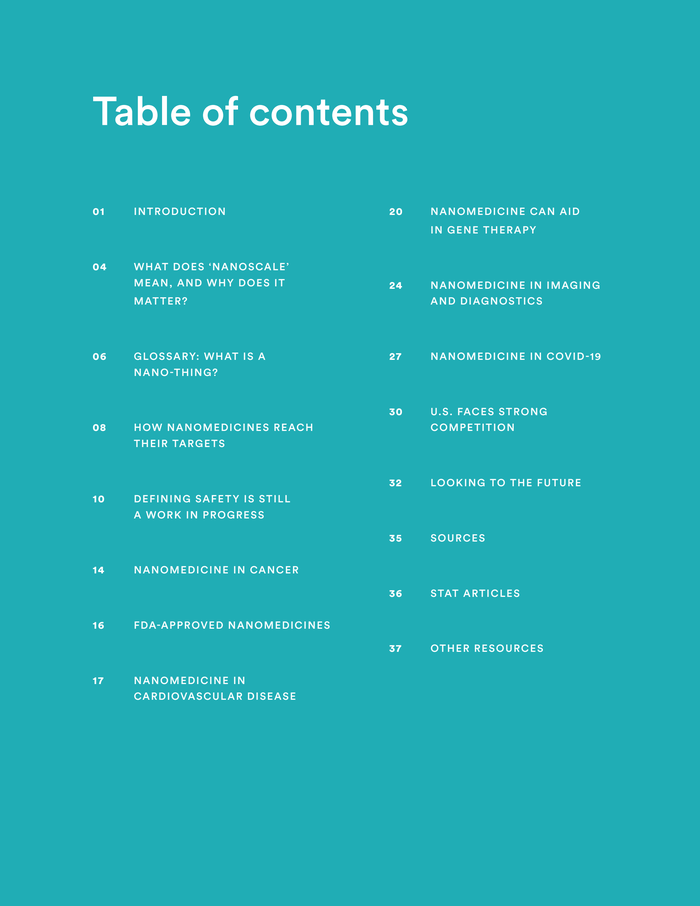
https://reports.statnews.com/products/n ... 3260367975
And this piece here will surely inspire cyberpunk nerds to climax in their plaid shorts:
Wonder if there's any black budget advancements not referenced here? We won't know.
DrEvil » Wed Sep 01, 2021 12:58 pm wrote:They didn't. They're all around you and always have been. Nanoparticle just means "any particle small enough to be measured in nanometers", including natural things like the thousands of tons of interplanetary dust hitting the planet every year. You're probably breathing nanoparticles right now.p.s. how did nanoparticles ever escape from the lab in the first place?
Edit: if you meant man-made nanoparticles: we put them in all kinds of stuff, like paint.
Extra edit: if you meant tiny computers/machines used for possibly nefarious purposes (which would be nanotech, not nanoparticles), they're not real beyond primitive prototypes.
Apparently 'nanoparticles' and 'nanotech' are used relatively interchangeably, at least in certain articles on the topic.
See the following examples:
https://www.cas.org/resource/blog/under ... 9-vaccines
And:Understanding the nanotechnology in COVID-19 vaccines
Lipid nanoparticles are a vital component of the Pfizer/BioNTech and Moderna mRNA COVID-19 vaccines, playing a key role in protecting and transporting the mRNA effectively to the right place in cells. They are next generation liposomes that use nanotechnology and are well suited to stable and efficient delivery of various therapeutics.
Although mRNA vaccines have received much global interest as they are a new type of drug, lipid nanoparticles have held a recognised position in the mainstream of drug delivery systems (DDS) since the discovery of liposomes in the 1960s. Let us take a closer look at what liposomes are, their evolution and potential for use in other industries.
...
https://www.statnews.com/2020/12/01/how ... ines-work/
And:How nanotechnology helps mRNA Covid-19 vaccines work
While the first two Covid-19 vaccines relying on messenger RNA technology speed toward regulatory approval in the U.S., it’s worth remembering the vehicle that gets them where they need to go in the body.
Lipid nanoparticles are the fatty molecular envelopes that help strands of mRNA — the genetic messenger for making DNA code into proteins — evade the body’s biological gatekeepers and reach their target cell without being degraded. They are enabling some of the most advanced technologies being used in vaccines and drugs.
...
Nanomedicine is crucial to delivering mRNA vaccines, but it is also key in reformulating existing drugs and formulating new ones to treat Covid-19 patients, the new report explains. Before Covid-19 spread around the globe, mRNA vaccines were in the early stages of development in biotech companies, and nanotechnology was central to their efforts.
https://reports.statnews.com/products/n ... 3260367975
And this piece here will surely inspire cyberpunk nerds to climax in their plaid shorts:
Here's the paper referenced in the above snippet:The truth about nano robots and why they are not in our vaccines — yet
In a paper published in the journal Nature Materials, researchers from The Ohio State University – led by former engineering doctoral student Chao-Min Huang – unveiled new software they call MagicDNA.
The software helps researchers design ways to take tiny strands of DNA and combine them into complex structures with parts like rotors and hinges that can move and complete a variety of tasks, including drug delivery.
....
https://www.nature.com/articles/s41563-021-00978-5Published: 19 April 2021
Integrated computer-aided engineering and design for DNA assemblies
Abstract
Recently, DNA has been used to make nanodevices for a myriad of applications across fields including medicine, nanomanufacturing, synthetic biology, biosensing and biophysics. However, current DNA nanodevices rely primarily on geometric design, and it remains challenging to rationally design functional properties such as force-response or actuation behaviour. Here we report an iterative design pipeline for DNA assemblies that integrates computer-aided engineering based on coarse-grained molecular dynamics with a versatile computer-aided design approach that combines top-down automation with bottom-up control over geometry. This intuitive framework allows for rapid construction of large, multicomponent assemblies from three-dimensional models with finer control over the geometrical, mechanical and dynamical properties of the DNA structures in an automated manner. This approach expands the scope of structural complexity and enhances mechanical and dynamic design of DNA assemblies.
Wonder if there's any black budget advancements not referenced here? We won't know.