Pentagon is researching gene editing, Internet of Bodies & AI to enhance human performance: RAND
A new superhuman era of transhumanism: US Defense & Intelligence communities may forever alter what it means to be human: perspective
Tim Hinchliffe
9 months ago
The Pentagon is investigating how to fundamentally alter what it means to be human, funding research into creating super humans that are smarter, faster, and stronger through human performance enhancement.
The US Defense and Intelligence communities are on the cusp of ushering in a new era of transhumanism by funding research into gene editing, artificial intelligence, and the Internet of Bodies (IoB) to enhance human performance.
If successful, these “people” would have the potential to never tire and think smarter, move faster, jump higher, see farther, hear better, hit harder, live longer, adapt stronger, and calculate quicker than any other human being on the planet.
A Pentagon-sponsored RAND report published today outlines the technological potentials of this controversial transhumanist research, which includes potentially “adding reptilian genes that provide the ability to see in infrared,” and “making humans stronger, more intelligent, or more adapted to extreme environments.”
According to the RAND report, “Technological Approaches to Human Performance Enhancement,” modalities for human performance enhancement (HPE) can be grouped into three principal categories:
Gene editing
Applications of artificial intelligence (AI)
Networked technologies that are wearable or even implantable (the so-called Internet of Bodies [IoB])
For the US Defense and Intelligence communities, human performance enhancement offers “the potential to increase strength, speed, endurance, intelligence, and tolerance of extreme environments and to reduce sleep needs and reaction times—could aid in the development of better operators.”
The report adds that in the next few years, “HPE could help military service and intelligence analysts through the use of multiple techniques to
connect technology to human beings.”
If successful, humanity as we know it may split into an entirely new species, where those not genetically edited or technologically altered could never compete with those who were.
Worse than being serfs, those not able to keep up in this brave new transhumanistic world would be rendered irrelevant, redundant, useless — unnecessary even for manual labor.
Here’s how the US government is forever altering the course of what it means to be human through gene editing, AI, and the Internet of Bodies.
Gene editing for human performance enhancement
An ethical minefield,
gene editing is now going beyond treating diseases and into the realm of human performance enhancement that is changing the definition of what it means to be human.
Genetic editing, according to the RAND report, has the potential to:
Make humans stronger, more intelligent, or more adapted to extreme environments
Provide new capabilities (such as infrared vision)—applications with potential implications for military and intelligence operations
What’s to become of the soldiers and government agents that have been genetically edited with superhuman powers once their service has ended?
What advantages or disadvantages would people with godlike abilities have compared to the rest of humanity?
Examples of gene editing applications given in the report include:
Adding reptilian genes that provide the ability to see in infrared
Fostering specific physical attributes (e.g., ability to cope with low oxygen levels) that could aid warfighters
Increasing muscle mass in disease-free humans
Increasing an average runner’s endurance to the level of an elite marathoner
For space travel and living on other planets: Adding genes from Deinococcus radiodurans, a bacterium that can survive in high levels of radiation, and adding genes from a variety of organisms to enable humans to synthesize all 20 amino acids (humans normally synthesize only 11 and extract the remaining nine from food)
What would happen if the elites ever used their influence and power to enrich themselves through genetic editing?
Examples of gene editing applications given in the report include:
Adding reptilian genes that provide the ability to see in infrared
Fostering specific physical attributes (e.g., ability to cope with low oxygen levels) that could aid warfighters
Increasing muscle mass in disease-free humans
Increasing an average runner’s endurance to the level of an elite marathoner
For space travel and living on other planets: Adding genes from Deinococcus radiodurans, a bacterium that can survive in high levels of radiation, and adding genes from a variety of organisms to enable humans to synthesize all 20 amino acids (humans normally synthesize only 11 and extract the remaining nine from food)
What would happen if the elites ever used their influence and power to enrich themselves through genetic editing?
In the survival of the fittest, Homo sapiens, as we know ourselves, would become irrelevant in a future of genetically engineered humans.
The next HPE modality in the RAND report has to do with merging humans with artificial intelligence to create AI-human hybrids, or cyborgs.
Creating AI-human cyborgs to enhance human performance
Merging humans with AI is about speeding up the decision making process, hands-free device control, improved communications, and precision medicine.
According to the report, the pattern recognition and data-processing power of AI lends two potential advantages:
First, the speed of data acquisition and processing would allow for real-time feedback, such as transcranial stimulation, to improve real-time human response and decision making
Second, AI can be used to individualize treatment that is generally believed to affect performance positively, analogous to precision (personalized) medicine; personalization could be used with any performance enhancement modality
If successful, HPE-AI could substantially reduce the time required to process data and respond to situations, as well as “improve decision making through cognitive prostheses” — brain-computer interfaces (BCI).
The primary application researched for BCIs, according to the report, is “neuroprosthetics (i.e., bypassing the nervous system for the purpose of controlling external apparatuses, such as mechanical limbs or cochlear implants).”
Some potential applications of HPE-AI listed in the report include:
Substantially reducing the time required to process data and respond to situations
Allowing for human-system teaming (not only through better system design but through implantable brain-computer interfaces)
Enabling complex, real-time, hands-free control of devices or robots
Concerning the seemingly telepathic nature of BCIs, the report adds, “Humans can be trained to control all sorts of external devices, such as movement of a computer mouse, robotic arms, and drones.”
On the last day of the World Economic Forum meeting in 2020, a discussion about “When Humans Become Cyborgs” attempted to tackle some of the very large ethical questions surrounding bodily integrity and digital ownership of cyborgs.
Ilina Singh, professor of neuroscience and society at Oxford, told the Davos crowd that one of the major concerns from military officers was a sense of ownership and bodily integrity.
Military officers were concerned over many issues, such as:
Do I own my own implant?
Does my implant become part of me?
What happens when I leave the military?
Who pays for my implant?
Does my implant get removed?
Do I get to keep my implant for life?
Does my implant get upgraded? Who pays for that?
In the same discussion, National Academy of Medicine president Victor Dzau told the Davos elites that using brain-computer interfaces to augment humans beyond their natural capabilities was crossing the ethical line.
“I think you’re in pretty safe ground when you use these technologies for the purpose of curing disease, treating disease, or at least addressing impairment,” he said, adding, “I do think you start crossing the line when you think about enhancement and augmentation.”
...
RAND argues that perhaps “the most advanced and invasive IoB technology under development is the BCI, which can both read and write to the brain. DARPA and commercial technology developers (such as Neuralink and Facebook) are working in this field.”
...
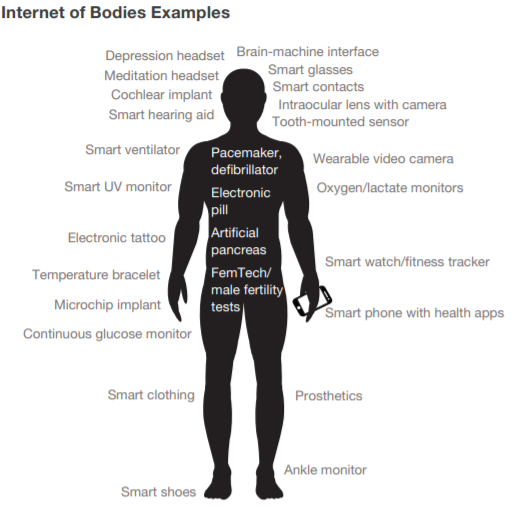 From a military and intelligence perspective, the IoB can be used for:
Remote assassination of high-ranking individuals through IoB devices (i.e. targeting someone’s pacemaker)
Making multitasking easier, enhancing cognition, or improving memory via BCI
Providing new channels of communication and the next generation of peer-to-peer networking
Human-swarm interfaces to enable users to monitor and direct potentially hundreds of unmanned platforms simultaneously in real time
According to a different RAND report from 2020, the IoB “might trigger breakthroughs in medical knowledge […] Or it might enable a surveillance state of unprecedented intrusion and consequence.”
Additionally,
“Increased IoB adoption might also increase global geopolitical risks, because surveillance states can use IoB data to enforce authoritarian regimes.”

If state-sponsored hackers or criminal organizations were to gain access to a medical device used by a high-profile target, the hackers could simply switch it off and assassinate their target.
As Richard Staynings, Chief Security Strategist at Cylera, once told The Sociable, “You no longer need to be MI6 and issued a Walther PPK in order to assassinate someone; you just need to gain access to the medical devices that are keeping that individual alive.”
What will it mean to be human in the coming decades?
Will there be pushback to the transhumanist agenda, or will the so-called fourth industrial revolution inevitably lead to the fusion of our physical, biological, and digital identities as World Economic Forum (WEF) Founder Klaus Schwab has so fervently insisted?
“Governments, corporations, and armies are likely to use technology to enhance human skills that they need like intelligence and discipline while neglecting other human skills like compassion, artistic sensitivity, and spirituality” — Yuval Harari
Speaking at several WEF meetings in Davos over the years, historian Yuval Harari has predicted that, “In the coming decades AI and biotechnology will give us godlike abilities to re-engineer life and even to create completely new life forms.”
...