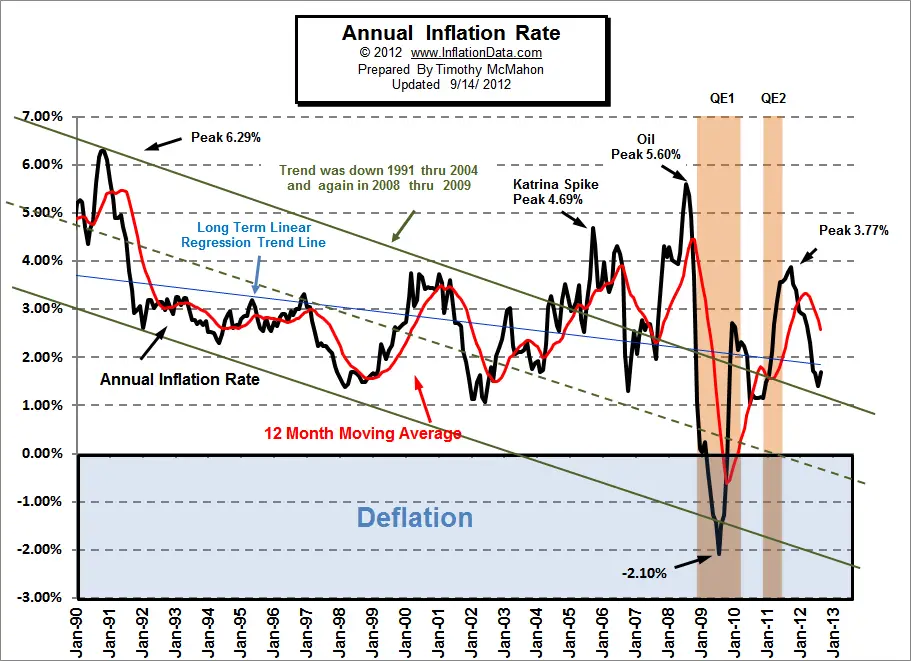
bluenoseclaret wrote:"....since quantitative easing is not something that occurs without limitation or attention to circumstance, but rather something that occurs only in a deflationary environment when it's the only option available,..."
I am sceptical of the effects of "Q.E" has on the real ecomomy .
Its microeconomic effects were negligible, apart from the people-not-finding-themselves-living-in-a-collapsed-insolvent-world thing that I mentioned.
I feel it just pours into a financial/derivative black hole.
That's an understandable feeling. What it's not is a true and accurate fact. Because it did have the measurable, quantifiable macro effect clearly displayed on the handy-dandy chart on the previous page of this thread. And it did not have any particular effect on financial or derivative markets that made some inherently bad thing about them exponentially worse.
It's a short-term anti-deflationary measure, and that's all. Even though the United States was in as good a position as it's possible to be to employ it strategically without much risk simply because treasuries are what they are -- ie, a safe-haven asset on a par with gold when times are bad -- it wasn't and isn't a happy, healthy economic thing to do, by definition. Things are really, really bad.
I don't really know what else to say. QE1 was necessary, not just here but globally. The other rounds are a little more equivocal and also more than a little inherently not-good-news-ish. They've kept the housing market from going into free-fall. And they can probably keep doing that lone single thing for a long, long time without doing much damage elsewhere. That's something. But it isn't real recovery. Or even a step towards real recovery. It's just a way of keeping the patient alive, more or less.
Why not do the following instead:
Some Possibilities That Might Be More Effective at Stimulating the Economy
"..An injection of money into the pockets of consumers would actually be good for the economy, but QE3 won’t do it. The Fed could give production and employment a bigger boost by using its lender-of-last-resort status in more direct ways than the current version of QE.
Well. For the sake of thoroughness, I feel obligated to note that, via many twists and turns, the current version of QE will probably ultimately indirectly keep people in their homes in larger numbers than they'd be without it, in conjunction with the other rounds. But that's obviously a very attenuated and not very noticeable benefit, on the ground.
Apart from that, I agree that direct assistance would be better, though not necessarily cash, exclusively. We don't do much of that here, however. Because we don't believe in helping people in need. We believe in freeloaders and low taxes. Not me, personally. I just mean it's the national ethos.
It could make the very-low-interest loans given to banks available to state and municipal governments, or to students, or to homeowners. It could rip up the $1.7 trillion in government securities that it already holds, lowering the national debt by that amount (as suggested a year ago by Ron Paul). Or it could buy up a trillion dollars’ worth of securitized student debt and rip those securities up. These moves might require some tweaking of the Federal Reserve Act, but Congress has done it before to serve the banks.
I'd rather see something a little more WPA-ish. We could use the infrastructural and cultural boost.
What on God's green earth do you think it would accomplish to rip up $1.7 trillion in government securities? It's true that it would lower the figure that appears on the balance sheet as debt. But those are not liabilities. They're assets. The taxpayer profits rather than loses by their existence.
Another possibility would be the sort of “quantitative easing” first proposed by Ben Bernanke in 2002, before he was chairman of the Fed—just drop hundred dollar bills from helicopters. (This is roughly similar to the Social Credit solution proposed by C. H. Douglas in the 1920s.) As Martin Hutchinson observed in Money Morning:
With a U.S. population of 310 million, $31 billion per month, dropped from helicopters, would have given every American man, woman and child an extra crisp new $100 bill per month.
Yes, it would produce an extra $31 billion per month on the nominal Federal budget deficit, but the Fed would have printed the new bills, so there would have been no additional strain on the nation’s finances.
Sure. But they'd be....what's the phrase I'm looking for? Oh, yes: Creating money out of thin air.
In exactly the way that can lead to hyperinflation, assuming the wage-inflation element develops. I mean, it would be politically impossible even if it were advisable, of course. So there's also that.
It would be much better than a new social program, because there would have been no bureaucracy involved, just bill printing and helicopter fuel.
And high inflation, maybe hyper.
The money would nearly all have been spent, increasing consumption by perhaps $300 billion annually, creating perhaps 3 million jobs, and reducing unemployment by almost 2%
Wait. What? Where does the job creation come in? Also how and why? What's the hedge against inflation?
None of these moves would drive the economy into hyperinflation.

I really have to stop responding line by line.
According to the Fed’s figures, as of July 2010, the money supply was actually $4 trillion LESS than it was in 2008. That means that as of that date, $4 trillion more needed to be pumped into the money supply just to get the economy back to where it was before the banking crisis hit.
Hm. I have to check something. Maybe I'm confused. As I easily am. But on an interim basis, I'm reasonably sure that the thing about that is:
No, it doesn't!
IOW: That's not really how monetary policy works, per my understanding.
As the psychological boost from QE3 wears off and the “fiscal cliff” looms, perhaps Congress and the Fed will consider some of these more direct approaches to relieving the economy’s intractable doldrums."
I don't think it really has a psychological boost, per se. That's kind of the problem with it. It's not stimulus spending.
I very much hope they do take a more direct approach, though.