Re: Republican Conspiracy Theory Biden-in-Ukraine
Posted: Fri Oct 11, 2019 10:43 am
At least four national security officials raised alarms about Ukraine policy before and after Trump call with Ukrainian president
President Trump speaks to members of the media on the White House lawn Thursday before boarding Marine One for a short trip to Andrews Air Force Base, Md., and then on to Minneapolis, for a campaign rally. (Patrick Semansky/AP)
At least four national security officials were so alarmed by the Trump administration’s attempts to pressure Ukraine for political purposes that they raised concerns with a White House lawyer both before and immediately after President Trump’s July 25 call with that country’s president, according to U.S. officials and other people familiar with the matter.
The nature and timing of the previously undisclosed discussions with National Security Council legal adviser John Eisenberg indicate that officials were delivering warnings through official White House channels earlier than previously understood — including before the call that precipitated a whistleblower complaint and the impeachment inquiry of the president.
At the time, the officials were unnerved by the removal in May of the U.S. ambassador to Ukraine; subsequent efforts by Trump’s lawyer Rudolph W. Giuliani to promote Ukraine-related conspiracies; as well as signals in meetings at the White House that Trump wanted the new government in Kiev to deliver material that might be politically damaging to Democratic presidential candidate Joe Biden.
Those concerns soared in the call’s aftermath, officials said. Within minutes, senior officials including national security adviser John Bolton were being pinged by subordinates about problems with what the president had said to his Ukrainian counterpart, Volodymyr Zelensky. Bolton and others scrambled to obtain a rough transcript that was already being “locked down” on a highly classified computer network.
“When people were listening to this in real time there were significant concerns about what was going on — alarm bells were kind of ringing,” said one person familiar with the sequence of events inside the White House, who, like others, spoke on the condition of anonymity to discuss a sensitive matter. “People were trying to figure out what to do, how to get a grasp on the situation.”
It is unclear whether some or all of the officials who complained to Eisenberg are also the ones who later spoke to the whistleblower.
Two Giuliani associates arrested at airport as they tried to leave U.S.
The accounts are sharply at odds with Trump’s depiction of the call as a “perfect” exchange in which he “did nothing wrong,” despite appearing to link U.S. support for Ukraine to that country’s willingness to investigate the family of the former vice president. On Thursday, Trump renewed his attacks on Twitter, describing the impeachment inquiry as a “Democrat Scam.”
But new details about the sequence inside the White House suggest that concerns about the call and events leading up to it were profound even among Trump’s top advisers, including Bolton and then-acting deputy national security adviser Charles Kupperman. Bolton and Kupperman did not respond to requests for comment.
Officials said that within hours of the 9 a.m. conversation, a rough transcript compiled by aides had been moved from a widely shared White House computer network to one normally reserved for highly classified intelligence operations. According to the whistleblower’s complaint, White House lawyers “directed” officials to move the transcript to the classified system. At the same time, officials were seeking ways to report what they had witnessed, an undertaking complicated by the lack of a White House equivalent to the inspector general positions found at other agencies.
As a result, one official who had listened on the call went “immediately” to Eisenberg. By the end of the next day, at least two others who had either heard the call or seen the rough transcript had also done so, said a person familiar with the matter.
It is not clear whether Eisenberg took any action either after the warnings he received earlier in July or after the Trump-Zelensky conversation. One official said Eisenberg vowed he would “follow-up,” a message interpreted to mean that he intended to investigate the matter and perhaps relay the dismay up the ranks to White House counsel Pat Cipollone.
If that occurred, it would help to explain how the White House was already aware of concerns about the July 25 call when contacted by the CIA general counsel weeks before a whistleblower complaint submitted by an agency employee had become public.
White House officials did not respond to questions about Eisenberg or a request for comment.
A former Justice Department official, Eisenberg has served as the top legal adviser to the National Security Council since the start of the administration, a tenure that encompasses numerous legal crises, including the FBI investigation of former national security adviser Michael Flynn and the special counsel probe of Russian interference in the 2016 election.
Eisenberg likely would also have played a leading role in the White House efforts to prevent the nation’s intelligence director from turning over a whistleblower complaint about Trump’s Ukraine call to lawmakers.
Officials who have worked with Eisenberg described him as conscientious and cautious, but said he has an expansive view of executive-branch authorities. One former Justice Department colleague said he is an “honest broker” but has a “disdain” for Congress.
Cipollone delivered a blistering letter to House Speaker Nancy Pelosi (D-Calif.) this week, describing the impeachment probe as “unconstitutional” and vowing that the administration would not cooperate.
The absence of any clear action by Eisenberg or others may have contributed to decisions by White House insiders to relay their concerns to a CIA employee who assembled the information they supplied into a whistleblower complaint that he submitted Aug. 12 to the U.S. intelligence community’s inspector general.
A memo turned over to congressional investigators suggests that the whistleblower, who has not been publicly identified, was contacted by a White House official on the afternoon of the July 25 Trump-Zelensky conversation. The complaint lays out many of the concerns that White House officials had shared with Eisenberg and others in the weeks leading up to that phone call.
Those involved in sounding alarms “were not a swamp, not a deep state,” said a former senior official. Rather, they were White House officials “who got concerned about this because this is not the way they want to see the government run.”
Officials traced the origins of their initial concerns about Trump and Ukraine to the abrupt and unexplained removal of the U.S. ambassador to Ukraine, Marie Yovanovitch, after she became the target of a right-wing smear campaign that accused her — with no apparent evidence — of undermining Trump and his policies.
NSC officials were alternately baffled and alarmed by the behavior of Giuliani, who had agitated for Yovanovitch’s removal and proceeded to declare on cable television interviews that he was pressing Ukraine to reopen a corruption probe of an energy company that had paid Hunter Biden, the former vice president’s son, as much as $100,000 a month to serve as a board member.
Biden has been criticized for taking that position while his father was serving as vice president and involved in Ukraine policy. But the younger Biden has never been accused of wrongdoing in his role as a board member for the company, Burisma, and there is no evidence to support the contentions by Giuliani and others that Joe Biden intervened inappropriately.
In his frequent meetings and conversations with Giuliani, Trump also became increasingly focused on Kiev-centered conspiracies, including a bizarre claim that the Democratic National Committee had not actually been hacked by Russian intelligence in 2016, and that the evidence — the infected machines — had been smuggled to Ukraine and kept there in hiding.
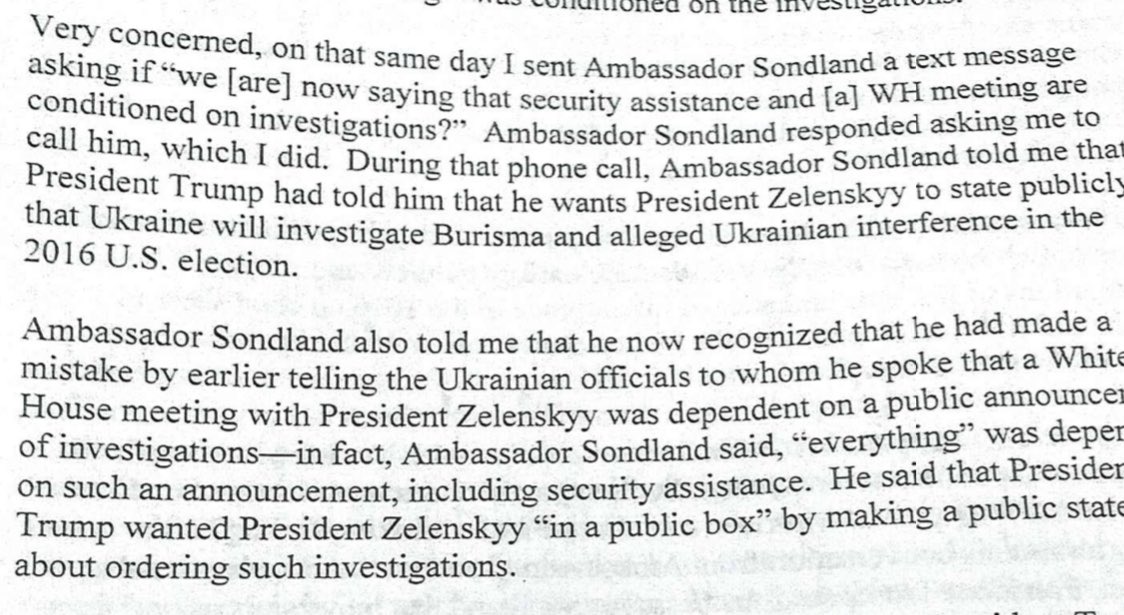
Concerns about the administration’s interactions with Ukraine ticked up further when the U.S. ambassador to the European Union, Gordon Sondland, asserted that he had been put in charge of relations with Kiev by the president. Sondland, who had operated a hotel company, got the Brussels-based ambassadorship after donating $1 million to Trump’s inauguration.
Sondland’s agenda in Ukraine began to become clear during a meeting at the White House in early July with Bolton, then-U.S. Special Representative for Ukraine Kurt Volker and a pair of advisers to Ukraine’s new president.
Amid a broader discussion in which White House officials were encouraging Ukraine to continue its work to eliminate corruption in the country’s energy sector, Sondland blurted out that there were also “investigations that were dropped that need to be started up again,” according to a U.S. official familiar with the matter.
Senior officials understood Sondland’s statement to be a reference to Burisma and Biden. “Bolton went ballistic” after the meeting, the official said. In the ensuing days, senior NSC officials including Bolton and Kupperman huddled over their concerns about Ukraine.
Those worries were also shared with Bill Taylor, who had been dispatched to Ukraine to serve as acting U.S. ambassador after Yovanovitch’s removal. Taylor pressed Sondland in a series of text messages before and after Trump’s call.
“President Zelenskyy is sensitive about Ukraine being taken seriously, not merely an instrument in Washington domestic, reelection politics,” Taylor wrote to Sondland in the days leading up to the call. Weeks later, Taylor’s tone grew more alarmed.
“As I said on the phone, I think it’s crazy to withhold security assistance for help with a political campaign,” he wrote to Sondland.
Sondland backed out of a scheduled appearance before House impeachment investigators this week after being ordered not to participate by the administration. Hearings with other officials, however, appear to remain on track. Yovanovitch is scheduled to testify Friday, and Fiona Hill, who served as the top White House aide on Russia, is due to meet with congressional investigators Monday.
Paul Sonne and Julie Tate contributed to this report.
https://www.washingtonpost.com/national ... story.html
The Mystery of Rudy Giuliani’s Vienna Trip
President Trump’s personal lawyer told me he was planning to fly to Vienna roughly 24 hours after his business associates were arrested as they prepared to do the same.
Elaina Plott5:51 PM ET
2 more free articles this month Already a subscriber? Sign in
Discover new ideas. Rethink old assumptions.
Last night, when Rudy Giuliani told me he couldn’t get together for an interview, his reason made sense: As with many nights of late, he was due to appear on Hannity. When I suggested this evening instead, his response was a bit more curious. We would have to aim for lunch, Giuliani told me, because he was planning to fly to Vienna, Austria, at night. He didn’t offer any details beyond that.
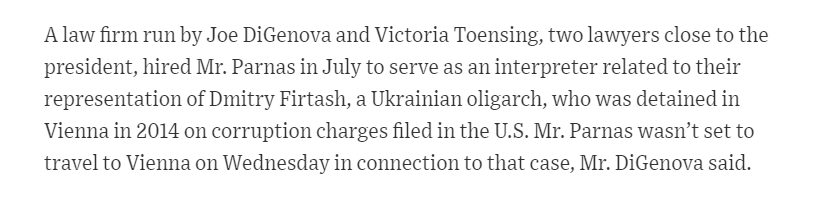
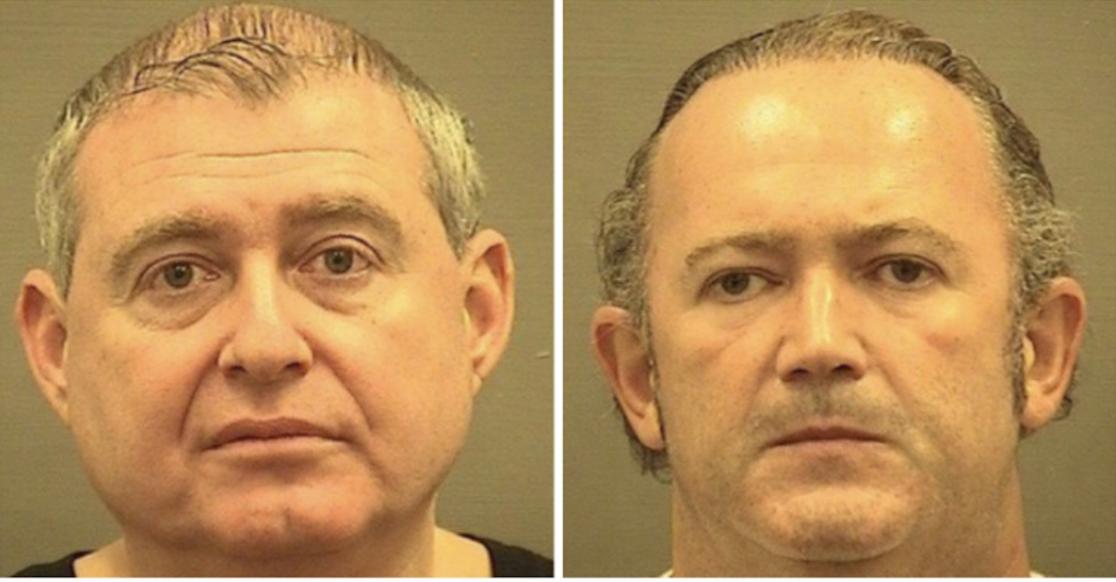
Giuliani called me at 6:22 p.m. last night—around the same time that two of his associates, Lev Parnas and Igor Fruman, were arrested at Dulles Airport while waiting to board an international flight with one-way tickets. As The Wall Street Journal reported this afternoon, the two men were bound for Vienna. The Florida businessmen, who are reported to have assisted Giuliani in his alleged efforts to investigate Joe Biden and his family ahead of the 2020 election, were charged with campaign-finance violations, with prosecutors alleging that they had conspired to funnel money from a Russian donor into Donald Trump’s presidential campaign.
But Giuliani, when confirming today that Parnas and Fruman were heading to Vienna on matters “related to their business,” told the Journal that he himself only had plans to meet with them when they returned to Washington. By this logic, Giuliani was also planning to fly to Vienna within roughly 24 hours of his business associates, but do no business with them while all three were there.
Pat Cipollone, the White House counsel, appears in a red-and-blue photo illustration with a picture of the White House behind him.
This morning, Giuliani told me he’d have to reschedule our lunch. I’ve tried to reach him since then, to discuss Parnas’s and Fruman’s arrests, among other things, to no avail. When I called at 3 p.m. ET to ask about his Vienna trip, a woman claiming to be his communications director answered the phone. I have called him more than 100 times over the past year, and this is the first time that has ever happened. She said she’d have to get back to me. As we spoke, I could hear a voice that resembled Giuliani’s shout “asshole” in the background. “Oh, sorry,” the woman told me. “He was talking to the TV.”
Why were Parnas and Fruman bound for Vienna? Why was Giuliani—if what he told me was true—planning to be in the same city a day later?
Giuliani finally sent me a text message at 4:18 p.m. ET: “I can’t comment on it at this time.”
Read: Rudy Giuliani: ‘You should be happy for your country that I uncovered this’
Parnas and Fruman, both Soviet-born, have been instrumental in helping Giuliani develop Ukrainian contacts in his quest to prove that Biden, while vice president, tried to curtail an investigation into a Ukrainian gas company for which his son Hunter Biden served on the board. Parnas told NPR, for example, that he was the one who had arranged a Skype call between Giuliani and former Ukrainian Prosecutor General Viktor Shokin to discuss their corruption theory. Parnas was also present at meetings in New York and Warsaw earlier this year with Giuliani and Yuriy Lutsenko, another former prosecutor general for Ukraine.
I met Parnas and Fruman in March, when I joined Giuliani at Shelly’s Back Room, a cigar bar in D.C., to discuss Special Counsel Robert Mueller’s soon-to-be-released report on Russian interference in the 2016 election. Sipping back-to-back glasses of Macallan—double, one large ice cube—and smoking a Nicaraguan cigar, Giuliani told me he’d known Parnas for two years. Parnas laughed and said he’d grown up “idolizing” Giuliani. They bantered about how the Mueller probe would likely amount to nothing, with Parnas adding that it was Trump’s “constitutional right” to fire former FBI Director James Comey. Save for introducing himself when I arrived, Fruman was quiet. Parnas told me they were all “great friends” and all “work together.”
Along with allegedly using a shell company to donate hundreds of thousands of dollars to Republican candidates and a pro-Trump super PAC, Parnas and Fruman were also accused by federal prosectors of meddling in American political activities on behalf of one or more Ukrainian officials. In the 21-page indictment, prosecutors allege that Parnas and Fruman lobbied for the removal of the U.S. ambassador in Kiev, Marie Yovanovitch—something Giuliani sought as well, arguing that she was biased against the president. In May, Trump ordered Yovanovitch’s removal.
The White House has kept mum about the arrests. Jay Sekulow, Trump’s personal lawyer alongside Giuliani, told reporters that neither Trump nor his campaign has “anything to do with the scheme these guys were involved in.”
It’s difficult to know, however, precisely what Trump may or may not know about Parnas and Fruman, given that Giuliani and Trump are in constant contact and that Giuliani, at least broadly, has frequently kept Trump updated on his maneuverings in Ukraine. Presumably these are the kinds of questions that House Democrats had in mind when they subpoenaed Giuliani last month, and Parnas and Fruman today. Giuliani has said he refuses to testify or provide documents to the House Intelligence Committee. Parnas and Fruman, for their part, are being held in a Virginia jail on a $1 million bond each.
Trump is already seeking to distance himself from the controversy. “I don’t know those gentlemen,” the president told reporters before departing for a rally in Minnesota. “Now, it’s possible I have a picture with them, because I have a picture with everybody.” (He does, in fact, have a picture with Parnas.)
“Maybe they were clients of Rudy,” Trump added. “You’d have to ask Rudy.”
https://www.theatlantic.com/politics/ar ... na/599833/