2 Japnse natls. arrsted w/ $134 Billion in bonds into Swtzld

Moderators: Elvis, DrVolin, Jeff

2 Japnse natls. arrsted w/ $134 Billion in bonds into Swtzld

Postby pepsified thinker » Thu Jun 11, 2009 7:15 am

not sure about this source, but seems worth looking at this a bit further--

http://www.japantoday.com/category/crime/view/2-japanese-carrying-134-bil-worth-of-us-bonds-detained-in-italy

2 Japanese carrying $134 bil worth of U.S. bonds detained in Italy
Thursday 11th June, 06:18 AM JST

ROME —Two Japanese nationals were detained by Italian financial police last week after trying to enter Switzerland with $134 billion worth of undeclared U.S. bonds, mostly Treasury bonds, an Italian daily said Wednesday. The Japanese consulate general in Milan confirmed that the detention had taken place and said it was trying to confirm with Italian authorities whether the two were indeed Japanese nationals and their identities.

According to the report in il Giornale, two unidentified Japanese in their 50s concealed the bonds, including 249 U.S. Treasury bonds each worth $500 million, in a suitcase with a false bottom that was searched by the Italian authorities June 3 when they were in Chiasso, at the border with Switzerland, about 50 kilometers north of Milan. The daily did not say on what charges they have been detained, but the two may have been detained on suspicion of attempting to take a large amount of securities out of Italy without declaring it because the paper said they had not declared the bonds.
"we must cultivate our garden"
--Voltaire
pepsified thinker
 
Posts: 1025
Joined: Thu Sep 07, 2006 11:15 pm
Blog: View Blog (0)

Postby Penguin » Thu Jun 11, 2009 12:06 pm

Theres now multiple sources and couple translations up on Cryptogon.
Ill paste the texte here with no formatting, links are in original so go there for them...

http://cryptogon.com/?p=9095

TWO JAPANESE CITIZENS CARRYING $134 BILLION WORTH OF UNDECLARED, POSSIBLY COUNTERFEIT U.S. BONDS DETAINED IN ITALY WHILE TRYING TO ENTER SWITZERLAND; ITALIAN AUTHORITIES ARE TRYING TO DETERMINE IF THE BONDS ARE AUTHENTIC

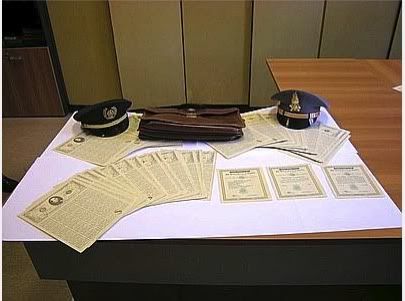
UPDATE 2: Picture of Seized Bonds

Via: adnkronos.com:

Image

U.S. Treasury documents confiscated by Italian authorities

—End Update—

UPDATE 1: English Translation of Press Release Issued by the Guardia Italiana di Finanza (Italian Financial Police) on 4 June 2009

I received two different translations and a third offer to do a translation. (Thank you, CL, A and V.) The two translations I received were similar, so I’m going to post them both here. Here is CL’s translation:

Impounded at Chiasso [place] USA securities for 96 billion euros.

249 bonds of the Federal Reserve of the United States, each with nominal value of 500 million dollars, as well as 10 Kennedy bonds each of 1 billion dollars in value, hidden in the double bootom of a suit case, for a total of a good 134 billion dollars, equal to more than 96 billion euros.

This is how much was sequestered [don't know legal implication of this term] at the internation railway station in Chiasso, at the Swiss-Italian border, functionaries of the Territorial Operational Section of Chiasso, in collaboration with soldiers/members of the Financial Police [Guardia di Finanzia] of Ponte Chiasso, during the checking of bags aimed at stopping the illegal trafficing of capital.

The amount was in the possession of to fifty year old Japanese men who had arrived at the Chiasso railway station on a train coming from Italy and who, when checked by customs, had stated that they had nothing to declare.

Instead an accurate check of the bags facilitated the discovery of the American securities, hidden in the bottom of the suitcase, in a closed section separated from the part of the bag containing personal items.

Apart from the securities the Japanese men were carrying a considerable sum of original bank documents.

Investigations are underway to establish the identity and the origin of both the bonds and the bank documents that have also been impounded. If the securities are authentic, based on regulations in place, the penalty applicable to the possessors [of the bonds] could reach 38 billion euros, equivalent to 40% of the sum in excess of the acceptable baggage allowance of 10 thousand euro.

Here’s A’s translation:

249 Federal Reserve Bonds for 500 million dollars of nominal value each, plus 10 Kennedy bonds of 1 billion dollars each was found in the hidden bottom of a suitcase for a total of 134 billion dollars, or around 96 billion euro.

That’s what has been confiscated during some checks for illicit capital traffic by operatives of Sezione Operativa Territoriale di Chiasso in the Chiasso train station, on the boundary between Italy and Switzerland, in collaboration with Guardia di Finanza del Gruppo di Ponte Chiasso.

The bonds where carried by two Japanese people in their fifties that got off in the Chiasso train station from a train coming from Italy. At customs they declared nothing of value.

An accurate search of their luggage showed up the bonds, well hidden in a special compartment of their suitcases, behind their personal effects.

In addition to the bonds the two Japanese were carrying a large amount of original banking documentation.

Investigations are underway for the bonds and the documents, which also have been confiscated, to understand their authenticity and origin. If the titles would be authentic, the administrative sanction applicable would amount 38 billion euro, equivalent to 40% of the exceeding of the maximum allowed amount of 10.000€.

—End Update—

There is a news blackout on this story. Please nail this one to the foreheads of the mainstream financial press until they cover it.

I am requesting an accurate English translation of the press release that was issued by the Guardia Italiana di Finanza (Italian Financial Police) on 4 June 2009 about this incident. If you have the ability to provide all of us with an accurate English translation of this press release, please contact me. Here is a machine translation of the press release.

Lagavulin submitted this Asia News Italy to the Cryptogon Subreddit two days ago. Here is the full text:

06/08/2009 15:18
ASIA – ITALY
US government securities seized from Japanese nationals, not clear whether real or fake Bonds worth US$ 134.5 billion are seized. This is the largest financial smuggling case in history. But are they real? Concern over ‘funny money’ or counterfeit securities is spreading in Asia. The international press is silent.

Milan (AsiaNews) – Italy’s financial police (Guardia italiana di Finanza) has seized US bonds worth US 134.5 billion from two Japanese nationals at Chiasso (40 km from Milan) on the border between Italy and Switzerland. They include 249 US Federal Reserve bonds worth US$ 500 million each, plus ten Kennedy bonds and other US government securities worth a billion dollar each.

Italian authorities have not yet determined whether they are real or fake, but if they are real the attempt to take them into Switzerland would be the largest financial smuggling operation in history; if they are fake, the matter would be even more mind-boggling because the quality of the counterfeit work is such that the fake bonds are undistinguishable from the real ones.

What caught the policemen’s attention were the billion dollar securities. Such a large denomination is not available in regular financial and banking markets. Only states handle such amounts of money.

The question now is who could or would counterfeit or smuggle these non-negotiable bonds.

In order to stop money laundering Italian law sets a ceiling of 10,000 euros per person for importing or exporting money without declaring it. The penalty for violating the law is 40 per cent of the money seized.

If the certificates were real, for Italy it would be like hitting the jackpot. The fine alone would amount to US$ 38 billion, five times the estimated cost of rebuilding quake-devastated Abruzzi region. It would help Italy’s eliminate its public deficit.

If the certificates are fakes the two Japanese nationals could get a very lengthy jail sentence for fraud.

As soon as the seizure was made the US Embassy in Rome was informed. Italian and US secret services were called in to assist the Italian financial police.

Some important international financial newspapers had already reported on the existence of ‘funny money’ circulating on parallel, i.e. unofficial, financial markets.

For AsiaNews a few points need considering:

1. When it comes to Italy the world press has tended to focus on Italian Prime Minister Berlusconi’s personal problems rather than on stories like the bonds smuggling affair which has been front page on Italian newspapers.

2. The fear of counterfeit bonds and securities has spread across Asia with the result that real securities are also considered with suspicion.

3. During the Second World War several countries at war printed and put in circulation perfectly counterfeit enemy money. It is also historically established that some central banks, like the Bank of Italy 65 years ago, issued the same securities twice (identical registered number and code). This way they could print more money with legal tender than they officially declared. The main difference though is that 65 years ago the world was involved in a bloody war, which is not the case today.

I was not able to find ANY English language translation of this story until today.

This is from Kyodo News Service, reposted on Japan Today:

2 Japanese carrying $134 bil worth of U.S. bonds detained in Italy

Thursday 11th June, 06:18 AM JST

ROME —

Two Japanese nationals were detained by Italian financial police last week after trying to enter Switzerland with $134 billion worth of undeclared U.S. bonds, mostly Treasury bonds, an Italian daily said Wednesday. The Japanese consulate general in Milan confirmed that the detention had taken place and said it was trying to confirm with Italian authorities whether the two were indeed Japanese nationals and their identities.

According to the report in il Giornale, two unidentified Japanese in their 50s concealed the bonds, including 249 U.S. Treasury bonds each worth $500 million, in a suitcase with a false bottom that was searched by the Italian authorities June 3 when they were in Chiasso, at the border with Switzerland, about 50 kilometers north of Milan. The daily did not say on what charges they have been detained, but the two may have been detained on suspicion of attempting to take a large amount of securities out of Italy without declaring it because the paper said they had not declared the bonds.

Here is the Italian language press release from Guardia Italiana di Finanza (Italian Financial Police) on 4 June 2009:

Sequestrati a Chiasso titoli USA per novantasei miliardi di euro
Milano, 4 giu. (Adnkronos)

Duecentoquarantanove bond della Federal Reserve statunitense, del valore nominale di 500 mln di dollari ciascuno, piu’ 10 bond Kennedy da 1 mld di dollari ciascuno, occultati nel doppio fondo di una valigia, per un totale di ben 134 mld di dollari, pari a oltre 96 mld di euro.

E’ quanto hanno sequestrato alla stazione ferroviaria internazionale di Chiasso, al confine tra Svizzera e Italia, funzionari della Sezione Operativa Territoriale di Chiasso, in collaborazione con i militari della Guardia di Finanza del Gruppo di Ponte Chiasso, nel corso dei controlli volti al contrasto del traffico illecito di capitali.

I valori erano posseduti da due cinquantenni giapponesi scesi alla stazione ferroviaria di Chiasso da un treno proveniente dall’Italia che, al momento del controllo doganale, hanno sostenuto di non avere nulla da dichiarare.

Un’accurata verifica dei bagagli ha consentito invece di trovare i titoli Usa, occultati sul fondo di una valigia, in uno scomparto chiuso e separato da quello contenente gli indumenti personali.

Oltre ai titoli, i due giapponesi trasportavano una cospicua documentazione bancaria in originale.

Per i bond e la documentazione che li accompagnava, anch’essa sottoposta a sequestro, sono in corso indagini volte a stabilirne autenticita’ e provenienza. Qualora i titoli risultassero autentici, in base alla vigente normativa, la sanzione amministrativa applicabile ai possessori potrebbe raggiungere i 38 miliardi di euro, pari al 40% della somma eccedente la franchigia ammessa di 10mila euro.

Research Credit: Lagavulin, LB, CL, and A
Penguin
 
Posts: 5089
Joined: Thu Aug 23, 2007 5:56 pm
Blog: View Blog (0)

Postby Nordic » Thu Jun 11, 2009 7:04 pm

I'll bump this and let the duplicate one I did die a quiet death.
Nordic
 
Posts: 14230
Joined: Fri Nov 10, 2006 3:36 am
Location: California USA
Blog: View Blog (6)

Postby wintler2 » Thu Jun 11, 2009 7:53 pm

Notice, by the way, that the US Media has totally ignored this story - even though the securities in question are allegedly US instruments. Gee, I wonder why? Might the authorities know they're real and be just a wee bit nervous that disclosure of a sovereign attempting to covertly dump nearly $140 billion in debt could cause a wee bit of panic, given that we're running nearly $200 billion a month in deficits?
http://market-ticker.org/archives/1114- ... nting.html


Further, according to the US Treasury only the nations of China, Japan, and Russia own this much in US debt instruments. Wikinews has been unable to confirm that "Kennedy Bonds" were ever issued.
http://en.wikinews.org/wiki/Italian_bor ... iss_border


Occams eraser: if the bonds are fake then US Treasury might have reason to be silent, so as to not prejudice the smugglers trial. But who would fake such denominations? Couldn't only central banks even think of 'cashing'/converting them to other forms of money? It'd be nice to know more about the two Japanese arrested.

Maybe this is preparing the media ground for crash in US dollar value - "those dirty (foriegn) crooks ruined our money".
User avatar
wintler2
 
Posts: 2884
Joined: Sun Nov 12, 2006 3:43 am
Location: Inland SE Aus.
Blog: View Blog (0)

Postby jingofever » Fri Jun 12, 2009 2:17 am

From what I understand these are supposed to be bearer bonds which the U.S. government stopped issuing in 1982, but I read on some Italian site that the bonds have Bernanke's signature which would make for a crappy counterfeit job because obviously he wasn't in office to issue these bonds and I also understand that only the Treasury issues bonds.
User avatar
jingofever
 
Posts: 2814
Joined: Sun Oct 16, 2005 6:24 pm
Blog: View Blog (0)

Postby stamp57 » Fri Jun 12, 2009 10:45 am

Something similar has happened before.....

" In November 2002,[12] German customs officers at the Swiss-German[12] border performed a routine search of Johnson's car.[12] Bank statements evidencing US$8 billion in transactions were found in the trunk of his car.[12][13][14] He was accompanied in his black Mercedes-Benz[13] by three men: an investment adviser,[13] a personal assistant,[13] and a third of unknown identity.[13] Initially it was thought Johnson was involved in money-laundering,[14] but he was cleared of wrongdoing.[15] Upon receiving word of the incident, German tabloids began exploiting and perpetuating the story, at times pointing at the irony (as perceived by them) that Don Johnson has frequently portrayed police officers in his acting works. Johnson explained the incident by saying "I was meeting with some American businessmen in Zurich for financing,[14] for a film fund that I was putting together for my company. They gave me some bank statements and some resumes and some other documents, some things to prove that they could perform as investors."[citation needed] The police found and copied these documents, and the money laundering story grew somehow out of this.[16]"

from wikipedia don johnson
stamp57
 
Posts: 17
Joined: Fri Oct 20, 2006 6:11 am
Blog: View Blog (0)

Postby barracuda » Fri Jun 12, 2009 11:10 am

wintler2 wrote:But who would fake such denominations? Couldn't only central banks even think of 'cashing'/converting them to other forms of money? It'd be nice to know more about the two Japanese arrested.


These bonds, if counterfeit, would more likely be used as collateral for loans of real capital. I seem to recall reading that much of the financial empire of Ivan Kreuger was based upon a huge stash of forged Italian bearer bonds which he kept in a bank vault and ceremoniously presented to finance officials he hoped to dupe.
The most dangerous traps are the ones you set for yourself. - Phillip Marlowe
User avatar
barracuda
 
Posts: 12890
Joined: Thu Sep 06, 2007 5:58 pm
Location: Niles, California
Blog: View Blog (0)

Postby JackRiddler » Fri Jun 12, 2009 11:41 am

.

Two guys with a false-bottom suitcase? Uh-huh.

While even more outlandish things have happened, my bet is on counterfeits.

a) Launderers of real instruments in the 134-billion-dollar league would not be smuggling paper over borders in suitcases via mules. They would be landing in private jets and meeting their personal Swiss bankers, with protection from undue searches already arranged.

b) Governments making deals on this amount in US debt would walk in the front door of whatever entity they thought was suitable and engage in direct negotiations. If they make a deal, even on bearer bonds, the transfer looks something like in a.

c) See title of this post: more outlandish things have happened, of course. Oliver North and Bud McFarlane took a cake to Iran, I hear. (Wonder what was in the cake?)

By the way, do these two have an Israeli aunt whose daughter just accidentally threw out a million dollars her mom had concealed in an old mattress?

And don't they also have cousins in the Nigerian treasury department?

.
User avatar
JackRiddler
 
Posts: 16007
Joined: Wed Jan 02, 2008 2:59 pm
Location: New York City
Blog: View Blog (0)

Postby barracuda » Sun Jun 14, 2009 1:39 pm

Denninger: The Saga Of The Bearer Bonds

    It just gets more and more odd after my original report, with the latest coming from a German newspaper (translation courtesy of Google):

    Hit for the Zöllner: The contraband securities valued at 134 billion U.S. dollars are apparently real. Die italienische Finanzpolizei hatte zwei Japaner ertappt, die im doppelten Boden eines Koffers milliardenschwere Anleihen in die Schweiz schaffen wollten. The Italian financial police had two Japanese caught in the false bottom suitcase billion-dollar bonds in Switzerland wanted to create. Von dem Fund profitiert das hochverschuldete Italien.

    Note that this has received very little coverage in the so-called "mainstream US media" - but it is everywhere in Europe and Asia.

    Japan, for its part, oddly said the following as soon as this story started to hit the press:

    “We have complete trust in the fact that the U.S. views its strong-dollar policy as fundamental,” Yosano, 70, said in an interview in Tokyo on June 10 before attending a Group of Eight meeting of finance ministers starting today in Italy. “So our trust in U.S. Treasuries is absolutely unshakable.”

    Uh huh.  And the Japanese said in December of 1941 that all was well too.  Anyone remember what happened on the morning of the 7th?

    Let's apply a little "Occam's Razor" to this entire story.

    You're not going to walk into a bank with $130 billion in bearer bonds and cash them.  Nor are you going to sell a bond with a $500 million face value to someone without them authenticating it.  They will be authenticated before you get one dime out of them - no matter who you think you're going to "give" them to. 

    So if they're fakes and you're "just screwing around", there is no reason to hide them.  Nor is there any particular reason to have authentic and recent original bank documents in your luggage with them, as has been reported.

    Next, unless someone knew you were smuggling them, why would you be subject to that sort of search?  What made the people involved "interesting" to the authorities?  This doesn't sound like a random stop to me; how many people are carrying $130 billion in bearer bonds at any given point in time?  No, someone was tipped off that this was happening.  Now why would you bother to stop them here, prior to their attempted delivery of such instruments, if they were fake? 

    Think about this: You know someone is smuggling a load of drugs.  You can either bust them immediately or you can tail them and bust them when they show up at the "meet" to exchange the dope for the money.  If you do the former the guys with the money get away, having committed no crime.  But if you do the latter, you get to bust both the courier and the purchaser - two times the effectiveness for the price of one, and double the seizure value, since you get to seize the cash too!

    So let's assume that the certificates are real, as German media seems to believe and which, by the way, makes logical sense given what they were and the sheer impossibility of cashing a fake $500 million bond.

    Ok, who has $130 billion in bearer bonds?  Remember, bearer instruments haven't been issued by the Treasury since 1982, when they became illegal to issue, at least to US institutions and residents (there was an exception carved out for Treasury instruments issued to non-US residents in 1985 - a time of high deficits)  The answer to that question: it is rather unlikely that there remains $130 billion of legitimate US Bearer issuance outstanding anywhere - to anyone.

    Mr. Holmes would be initially puzzled by such a caper.  On the one hand we have the impossibility of the bonds being real, because there simply isn't $130 billion of issues remaining outstanding.  On the other hand we have the impossibility of negotiating a fake $500 million bearer instrument, making the exercise of counterfeiting one expensive and futile.

    This leaves us with more questions than answers at this point.  

    Or does it?

    As Mr. Holmes is famously rumored to have said, "once you eliminate the impossible, whatever remains, however implausible, must be the truth."

    So what remains?  Let's run a theory here - one of the few possible remaining options, given the exclusion of what we know not to be true...

    Are we willing to assume that all the "issue" of Treasury bonds has been done "above board" as required by law.  If Treasury has been surreptitiously issuing bonds to, say, Japan, as a means of financing deficits that someone didn't want reported over the last, oh, say 10 or 20 years, then the following is about to occur:

    Image

    Who could have possibly been complicit in such a scheme?  I can come up with only two nations (and only nations could be involved due to size): The Japanese and Chinese.  Since the two individuals who were arrested were reported to be Japanese nationals......

    There are tremendous implications in an event like this, again, assuming the bonds are real.

    The owner is going to want them back, of course.  But Italy is going to keep a third as their statutory penalty for non-declaration on the border.  Oops.  That's great for Italy, but it blows bananas for the actual owner.

    Of course Italy (or the US!) could declare them "fake" and as a consequence simply burn them.  If they are in fact real, that's an even bigger problem.  See, Bearer Bonds are issued without registration - they are as anonymous as a $100 bill in terms of who owns them.  That's one of their "features", and why they were often used for various clandestine money operations.  So if they are real and are destroyed, the owner is out of luck - their money is gone just as it is if you burn a $100 bill in an ashtray.

    How much is $130 billion in this context?  About 1/5th or so of what Japan legitimately owns of US Treasury debt.  How would you like to take an instantaneous (and permanent!) 20% haircut on your securities?  That's what I thought.

    To add some balance here, there have been stories about fake bearer bonds coming out of North Korea and other places for years.  But the idiocy of attempting to pass a $500 million certificate belies this possibility - who in the name of God would take such a thing and give you anything for it without authenticating it first?  While bearer instrument are "anonymous" in terms of who owns them, their authenticity is easily verified as they ARE serialized instruments.

    I remain puzzled, and am not advancing the above theory as fact. 

    It is, however, one of the few explanations that actually fits the facts, and for that reason, I think we need some answers.  If in fact previous administrations were issuing "off-book" Treasury debt in this fashion to sovereigns then implications are truly explosive as such issues are blatant and outrageous unlawful acts and would expose everyone involved to severe criminal penalties.

    Let's hope we get those answers, and this isn't one of those "funny things" that just disappears into the night
The most dangerous traps are the ones you set for yourself. - Phillip Marlowe
User avatar
barracuda
 
Posts: 12890
Joined: Thu Sep 06, 2007 5:58 pm
Location: Niles, California
Blog: View Blog (0)

Postby StarmanSkye » Sun Jun 14, 2009 3:19 pm

Good going, Barracuda; Nice find. That sure puts this caper in perspective. It does look a lot like part of a very hush-hush, ongoing transfer of legitimate off-the-books financial instrument securities. So what's the deal? Balancing bank-loan books? Security on ? Pay-off?

A real deep-hole mystery alright. WEirder and wierder. Wasn't all that long ago, another 'counterfeit' bearer-bond smuggling incident was foiled, in the Phillipines as I recall. Seemed to disappear pretty damn quietly and thoroughly in a very short time.

VERY odd, that this latest event has met a virtual black-hole in US reporting. Nothing here, move along ... (The hand is quicker than the spycam, eh?)

-S
StarmanSkye
 
Posts: 2670
Joined: Thu Nov 03, 2005 11:32 pm
Location: State of Jefferson
Blog: View Blog (0)

Postby JackRiddler » Sun Jun 14, 2009 7:13 pm

.

My inner Holmes says Denninger's shitstorm is bovine.

Everything I see in this story points to counterfeits plus stupid, over-ambitious con artists. My guess is they shopped bogus bonds around as collateral in attempts to secure loans or get their hands on real securities, until the authorities picked them up.

OMG, how could they be so stupid? It's just unbelievable!

Well, no. If they were smarter, they'd be Denninger, right?

Just because they get caught on some embarrassing obvious detail doesn't mean the story's untrue. Of course, if any of us set out to commit this kind of fraud, we'd hope we'd be smarter; perhaps the essential point is that we wouldn't set out to do this in the first place.

OMG, but why are the authorities treating this so seriously?!

Well, why not, it's easy sport for serious-looking prosecutions. A lot easier than taking on the ongoing heist of the entire world by the financial pirates, no? They get to throw the word billions around, as though billions were actually involved. This story is tailor-made to distract and confuse around the real financial issues. And if the extensively quoted whole two sentences from the "German press" really imply real bonds (they don't), well, it sure makes for a sexier story, no? Need to sell some papers, people!

As for the idea that this is actually some kind of high-level dollar dump by a nation: COME ON. Why would central banks or governments ever do it like this, with mules wandering around with false-bottom suitcases?! See my earlier post above.

You could also ask how the Nigerian spammers think their silly account-theft attempts could ever work, and yet you'd have to admit that they work enough times out of a million to make it worth their while.

Finally, as for Denninger, his niche marketing (doom-saying and mild xenophobic exploitation) shine through.

The world is full of middling-smart idiots, whose unlikely-seeming schemes are oft-fueled by megalomania, mental illness or drugs.

Here's what Bloomberg had:

http://www.bloomberg.com/apps/news?pid= ... JXAA1ahZyo

Italian Police Ask SEC to Authenticate Seized U.S. Treasuries

By Sonia Sirletti and John Glover

June 12 (Bloomberg) -- Italy’s financial police said they asked the U.S. Securities and Exchange Commission to authenticate U.S. government bonds found in the false bottom of a suitcase carried by two Japanese travelers attempting to cross into Switzerland.

The bonds, with a face value of more than $134 billion, are probably forgeries, Colonel Rodolfo Mecarelli of the Guardia di Finanza in Como, Italy, said today. If the notes are genuine, the pair would be the U.S. government’s fourth-biggest creditor, ahead of the U.K. with $128 billion of U.S. debt and just behind Russia, which is owed $138 billion.

The seized notes include 249 securities with a face value of $500 million each and 10 additional bonds with a value of more than $1 billion, the police force said on its Web site. Such high denominations would not have existed in 1934, the purported issue date of the notes, Mecarelli said. Moreover, the “Kennedy” classification of the bonds doesn’t appear to exist, he said.

The bonds were seized in Chiasso, Italy. Mecarelli said he expects a determination from the SEC “within a few days.”

To contact the reporters on this story: Sonia Sirletti in Milan at ssirletti@bloomberg.netJohn Glover in London at johnglover@bloomberg.net
Last Updated: June 12, 2009 10:37 EDT


Kennedy and 1934, eh? Again, how could they be so stupid? Simple: if they were smarter, they would have found a legal(ized) way to rip off the mega dollars, like the entire financial sector.

By the way, here's a history of the $500 million dollar bond. Found on DU, which still has a few clever people around:

http://www.democraticunderground.com/di ... g_id=65894


The High Cost of Debt: Very-High-Denomination Treasury Notes and U.S. Treasury Debt Management, 1955-1969


A Paper for Presentation at the 2005 Annual Conference of the Economic History Society at the University of Leicester, 8-10 April 2005


By Dr. Franklin Noll


Introduction

For most of their history after World War II, Treasury notes have been issued with denominations never rising above a high of $1 million. Yet, from 1955 to 1969, the Treasury issued Treasury notes with the added denominations of $100 million and $500 million. The purpose of this study is to determine why the Treasury issued these very-high-denomination Treasury notes and why it stopped doing so.


Treasury Debt Management after World War II

The history of Treasury notes, including those offered in very-high denominations is linked to the broader story of the management of the public debt. The paramount goal of Treasury debt management has always been to borrow money at the lowest cost possible. Borrowing costs include not only the interest rate at which the money is borrowed but also the costs of holding and servicing the debt. Keeping these costs low became more difficult after World War II because of the frequent need for refunding operations.


The need to refund a sizeable amount of the debt arose from the cost of the war. By 1946, the public debt had risen from a pre-war level of $49 billion to $269 billion. Debt of this magnitude, 130% of the gross domestic product in 1946, could not be paid off quickly and would have to be refunded or rolled-over into the future. Treasury officials still thought and operated as though the public debt was still at its pre-war levels; and, as in that period, managing the debt required only occasional, almost ad-hoc, entries into the market with a focus on rolling over maturing short-term securities. As a result, “ach financing operation seemed to be an independent crisis, requiring new and largely unpredictable decisions as to terms and maturities, rather than one part of a carefully planned debt-management program.”1


This crisis atmosphere in the government securities market was compounded by the Treasury’s practice of trying to dictate interest rates on government securities. In 1942, foreseeing a massive increase in the debt because of the war effort, the Treasury, with the help of the Federal Reserve, pegged interest rates on newly issued securities at below market levels.2 After World War II, the Treasury tried to maintain the wartime pattern of interest rates even though market rates began to rise and the Federal Reserve refused to continue its support of the pegged rates. As a result, it became increasingly difficult for the Treasury to sell anything other than short-term securities to investors, shortening the average length to maturity of the public debt as a whole and the time to the next refinancing. Treasury competition for short-term debt and the disturbances caused by its frequent and irregular financing operations created inflationary pressures that further raised market interest rates and compounded the Treasury’s financing problems.


By 1953, and the appointment of George M. Humphrey as Secretary of the Treasury in the Eisenhower administration, it was evident that the Treasury could not continue business as usual. Unable to borrow money at artificially low rates, Humphrey accepted that the Treasury needed to follow the market in determining rates; and after fiscal year 1953, there was a significant rise in the Treasury’s long-term rates to market levels. To minimize market rates overall, the Treasury had to do its best to lessen its involvement in the short-term market and take the uncertainty out of its financing operations by entering the market less often.3 To do this, the Treasury needed to lengthen the average length to maturity of the public debt.


Increase in Treasury Notes

Unable to sell large quantities of long-term Treasury bonds, the Treasury, in the early 1950s, was forced to turn to short-term securities and medium-term securities to refund maturing securities. And, as short-term securities would only work to further shorten the average maturity of the public debt, Humphrey was forced to use Treasury notes as the primary vehicle to lengthen maturities. The result was a rapid expansion in the issue of notes.


There were increases in both the dollar amount sold and the number of issues of Treasury notes. By the end of fiscal year 1955, the percentage increase in dollar amounts from 1952 was 979%, while the number of issues per fiscal year rose from zero to four. These changes translated into increased administrative costs and difficulties.


Costs of Servicing Treasury Notes

The Treasury notes issued in the early 1950s were all couponed bearer securities, paying interest on a semiannual basis. To receive his interest payment, the holder of the note would detach the appropriate coupon and present it to his bank, which would then send it on to the regional Federal Reserve bank. The Federal Reserve bank would issue a payment, physically cancel the coupon, and send on the coupon to the Bureau of the Public Debt.4 The Bureau then recorded the payment and destroyed the coupon.


With the ten-fold increase in the dollar amount of Treasury notes issued between 1952 and 1955, the amount of work handled by the Federal Reserve banks and the Bureau of the Public Debt exploded. Correspondingly, the printing run of Treasury notes at the Bureau of Engraving and Printing increased from around 67,000 10-coupon notes in fiscal year 1952 to 690,000 10-coupon notes (or 6.9 million coupons in total) in fiscal year 1955.5 All these millions of notes and coupons would have to pass through the Federal Reserve system and the Bureau of the Public Debt.


An investor buying millions of dollars in notes or a custodial bank holding billions of dollars in notes for their customers also had a lot of work to do when they wanted to cash in their coupons. Every year two coupons had to be detached from every individual security and turned in for payment. If an investor had $500 million in Treasury notes, and hopefully held the sum in $1 million denomination securities, he would have to detach and turn in 1,000 coupons a year. Custodial banks handling larger sums and many smaller denominations had an even worse time.6 People had to be employed to cut, count, track, file, transport, and guard the coupons. Vault space was needed to store the Treasury notes. And, between 1952 and 1955, the number of notes and coupons involved was to expand ten fold. The resulting increase in costs was burdensome.


The Rise of Very-High-Denomination Treasury Notes

An easy way to reduce the administrative costs involved would be to add a few zeros onto the existing denominations, and this is what was done. In February 1955, the denominations of $100 million and $500 million were added to the existing ones of $1,000, $5,000, $10,000, $100,000, and $1 million. Raising the maximum denomination to $500 million cut down the amount of work involved in large issues of Treasury notes for everyone. The $500 million investor now had only two coupons to worry about, as did the Bureau of the Public Debt. And, the Bureau of Engraving and Printing only had to print one $500 million security instead of 500 $1 million securities. So, very-high-denomination Treasury notes were really money saving devices.


The issue of Treasury notes bearing very-high denominations was to continue for the next 14 years, through three administrations and five Secretaries of the Treasury. Their longevity was the result of the continuation of the trends first seen in the early 1950s: the Treasury’s inability to sell long-term bonds, market pressures toward short-term securities, and upward trends in servicing costs.

continued>>>
http://74.125.47.132/search?q=cache:dn- ... J:www.eh...


For most of their history after World War II, Treasury notes have been issued with denominations never rising above a high of $1 million. Yet, from 1955 to 1969, the Treasury issued Treasury notes with the added denominations of $100 million and $500 million. The purpose of this study is to determine why the Treasury issued these very-high-denomination Treasury notes and why it stopped doing so.

The bonds found in Italy must have been issued between 1955 and 1969.

Here's a picture of the bonds

Image

http://emsnews.wordpress.com/2009/06/12 ... /#comments
Last edited by JackRiddler on Sun Jun 14, 2009 10:11 pm, edited 1 time in total.
User avatar
JackRiddler
 
Posts: 16007
Joined: Wed Jan 02, 2008 2:59 pm
Location: New York City
Blog: View Blog (0)

Postby anothershamus » Sun Jun 14, 2009 9:45 pm

Someone's private stash? I can't find any news yet on if the Italian Gov. seized the cash or not? Keep em' coming.
)'(
User avatar
anothershamus
 
Posts: 1913
Joined: Fri Jun 23, 2006 1:58 pm
Location: bi local
Blog: View Blog (0)

Postby Alfred Joe's Boy » Sun Jun 14, 2009 10:02 pm

Joe Cannon's take:
Mystery bonds update: Now I'm frustrated! (With an added note) (Hit Joe's link for links suggested below.)
I'm a little disappointed that so many readers seem to have missed the big find in the previous story about the mystery bonds (a mystery which Drudge has now publicized, although of course he would never link to this site). Let me underline it for you: The bonds were not bearer bonds, as Karl Denninger thinks, and there were not Treasury bonds, as this guy thinks. I found a video which offers a close-up of the same instruments, clearly labeled "Federal Reserve Bonds."

Such bonds do not exist. That is, the Federal Reserve has never issued bonds, and any piece of paper labeled "Federal Reserve Bond" is bogus. The bonds in the video were part of a long-running scam originating in the Philippines. Therefore, the bonds found in Italy were part of the same scam. If the Italians say otherwise, they are lying. In my previous stories, I identified the two "Japanese nationals" as (in all likelihood) a couple of well-known grifters from the Philippines, who have been dealing in these fake instruments for years.

Throughout the blogosphere, you'll find a lot of wild-and-woolly speculation connecting this mystery to world events. All of this speculation presupposes that the bonds are real. And it is all crap. Forgive the self-puffery, but frankly, my site was the first to present the likeliest solution to this mystery. A few others have independently come to the same conclusion -- for example, see here:

"The bonds are fakes. Why there were so many found? Because it's an international scam originating in the Philippines. The fake bonds are sold to investors all over the world. It's been going on for years. The carriers were taking them to Switzerland for potential further distribution.

"A very recent incident was reported in Spain two days before the Italians announced the confiscation of the "Japanese" travelers. Everything found in Spain was determined to be fakes and originated in the Manila. Everything that has been found in the USA, in the same $500 million denominations, were determined to be fakes."


Back in 2006, someone tried to sell the same 1934 "Federal Reserve Bonds" in Los Angeles. At the time, everyone quickly understood that the bonds were fake. Oddly, the names of the crooks were kept out of the news. The printing presses in Manila have been in operation for some years now.

There is something odd going on here. Why do the grifters (almost) always go unidentified in news accounts? And why have so many relevant web articles been pulled? Who started the legend of the 1934 cache in the Philippines? Why didn't the Italians immediately understand that there are no "Federal Reserve Bonds"? How did a religious cult in the Philippines become involved with this scam (as outlined in the post below)?

Added note: While taking a shower, a thought occurred to me: What laws have our two con men broken? They aren't counterfeiters, since "Federal Reserve Bonds" never existed. It's as if you printed a whole bunch of currency from the Republic of Mazumba. Since Mazumba does not exist, what law have you broken?

So they weren't smuggling the notes into Switzerland. One smuggles goods that are illegal. Why go to that country? I think they wanted to deposit the fake bonds into a safety deposit box in a bank in Geneva. Then they would come out of the deal with a piece of paper (maybe photos) showing that they had placed bonds worth billions of dollars in a Swiss bank. Such documentation would have helped them get up to all sorts of future mischief.
Alfred Joe's Boy
 
Posts: 222
Joined: Tue Jul 15, 2008 2:29 pm
Blog: View Blog (0)

Postby barracuda » Sun Jun 14, 2009 11:56 pm

Play money. It makes the phoney world go 'round.

Image
The most dangerous traps are the ones you set for yourself. - Phillip Marlowe
User avatar
barracuda
 
Posts: 12890
Joined: Thu Sep 06, 2007 5:58 pm
Location: Niles, California
Blog: View Blog (0)

Postby Jeff » Thu Jun 18, 2009 6:36 pm

[Seems that] the two individuals were not arrested or charged. Detained briefly, but not charged, with some sources claiming that an Italian lawyer is involved and essentially sprung them (whether on their own recognizance or via bail is unreported, and if on bail, how it was posted.) Others, particularly a recent article out of the UK, simply says they were "arrested." I have seen nothing from a credible news stream stating that they are being held at the present time. And then there's this:

We can't read Japanese, and Google Translate isn't particularly helpful, but a reader informs us that the gist of this story is that a newspaper sent a reporter to Como, Italy and found that the men had been released, with their whereabouts unknown.

Uh, do you really let two counterfeiters (suspected felons under American law and I suspect Italian as well) go without having any idea where they are and, it would appear, without retaining their passports?

http://market-ticker.denninger.net/archives/P2.html
User avatar
Jeff
Site Admin
 
Posts: 11134
Joined: Fri Oct 20, 2000 8:01 pm
Blog: View Blog (0)

Next

Return to General Discussion

Who is online

Users browsing this forum: No registered users and 9 guests