In parts of West Virginia, water is only for flushing

Moderators: Elvis, DrVolin, Jeff

In parts of West Virginia, water is only for flushing

Postby seemslikeadream » Fri Jan 10, 2014 3:15 pm

In parts of West Virginia, water is only for flushing
By Tom Watkins, CNN
updated 1:48 PM EST, Fri January 10, 2014
Watch this video
Many without water after chemical spill
STORY HIGHLIGHTS
NEW: Some 300,000 West Virginians affected by chemical spill into river
NEW: "We have no timeline," says water company president
A chemical spill occurred along the Elk River, contaminating the Kanawha Valley water system

(CNN) -- The water that some 300,000 people in West Virginia usually depend on to slake their thirst, wash their bodies and brush their teeth is now good for only one thing -- flushing their toilets, authorities told them Friday.
"We don't know that the water is not safe, but I can't say it is safe," Jeff McIntyre, president of West Virginia American Water Co., told reporters about the water his company provides to customers in central and southwestern West Virginia.
That's the way things have been since Thursday night, when residents of Kanawha County reported a foul odor -- like licorice -- in the air. By Friday afternoon, it was unclear when the situation would revert to normal. "We have no timeline," McIntyre said.
Fed. emergency in West Va. chemical leak
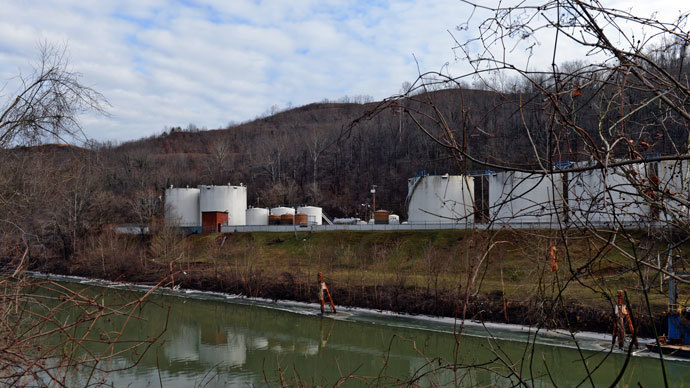
Investigators from the Kanawha County Fire Department and the state Department of Environmental Protection quickly found the source -- a leak from a 48,000-gallon storage tank along the Elk River, which serves as the source of water for the 1,500 miles of pipeline that carry water to customers in central and southwestern West Virginia.
'Can't say' water's safe in West Va.
The chemical had overflowed a containment area around the tank and then migrated over land and through the soil into the river.
"I do not believe it is continuing to flow," McIntyre said.
But finding the source didn't solve the problem. By 4 p.m. Thursday, the odor was coming from the water that had already been treated, meaning it was contaminated, McIntyre said. Within two hours, officials issued the stop-use warning, a move that McIntyre described as unprecedented.
By Thursday night, an autodialer was calling the company's 100,000 customers to alert them to the problem.
In all, more than 1,000 calls were placed in four or five hours to the 911 center, 24 of them for emergency medical services, who took some five people to hospitals, said Kent Carper, president of the Kanawha County Commission, who cited the number of people affected.
"This has been devastating to the public at large and to the people that live in our city," said Charleston Mayor Danny Jones.
The devastation has involved businesses as well. At least 15 McDonald's restaurants were shut in the area, according to their ownership group.
Patricia Peal told CNN she had to close her Charleston shop Flowers & More on Friday. "It's usually our busiest day," she said. "I just cannot operate like this.
"It's all very hectic. You don't even want to go to the grocery store. I think everyone is in a panic."
She was using water she had stored at her home and managed to pick up a couple more cases at Kroger.
West Virginia\'s governor declared a state of emergency in nine counties.
West Virginia's governor declared a state of emergency in nine counties.
Her 60-year-old husband had knee surgery this week but can't start physical therapy because it has been canceled until the water is back.
"The problem is that no one seems to know when we'll have the water restored," she said.
The tank is located on chemical storage facility belonging to Freedom Industries and is located about a mile upriver from the West Virginia American Water plant, McIntyre said.
Carper said the company's chemical tank farm was part of a former Pennzoil refinery and had been there since the 1930s or 1940s.
The leaked chemical, 4-methylcyclohexane methanol, is harmful if swallowed, said Thomas Aluise, a spokesman for the state's Department of Environmental Protection. It is used to wash coal before it goes to market.
"It is not intended to be in water," McIntyre said."Unfortunately, this is in the distribution system. Once it's in there, there's no more treatment for it."
A toxicologist with Freedom Industries told the water company there is "some health risk" associated with this chemical, said Laura Jordan, a spokeswoman for West Virginia American Water.
"The safety sheet indicated there could be some skin or eye irritation if you come in contact, or possibly harmful if swallowed, but that's at full strength of the chemical," Jordan said. "The chemical was diluted in the river."
In his first public comments on the matter, Freedom Industries President Gary Southern said Friday afternoon that residents' safety had been his company's first priority since he learned about the leak.
"We have been working with local and federal regulatory, safety and environmental entities ... and are following all necessary steps to fix the issue," he said in a prepared statement. "Our team has been working around the clock since the discovery to contain the leak to prevent further contamination."
He added that the company was working to determine how much of the chemical leaked and was setting up an incident command center.
The do-not-use notice remains in effect for the customers in nine counties served by the company, he said. Customers in Boone, Cabell, Clay, Jackson, Kanawha, Lincoln, Logan, Putnam and Roane counties are affected.
A spokeswoman for West Virginia American Water Co., Laura Jordan, said the company had received calls about illnesses, but none of them were serious.
"We just advise customers if they are feeling something that isn't right to seek medical attention."
Many -- perhaps too many -- did just that.
"Our emergency rooms have been very busy with individuals unnecessarily concerned and presenting no symptoms," Charleston Area Medical Center said.
The water restrictions affected the hospital, too. It put into place linen conservation and alternative cleaning methods and turned away all but emergency patients.
Residents moved quickly to stock up on bottled water.
"We managed to get the last five bottles of water at 7-Eleven last night," Charleston resident Beth Turley told CNN. "We are OK right now on water. We're just drinking sports drinks and teas, things like that right now."
"There was a run on water at every Walmart and convenience store in the county," said Carper.
On Thursday evening, Gov. Earl Ray Tomblin declared a state of emergency for nine counties.
"Right now, our priorities are our hospitals, nursing homes and schools," the governor said. "I've been working with our National Guard and Office of Emergency Services in an effort to provide water and supplies through the county emergency services offices as quickly as possible."
President Barack Obama signed an emergency declaration authorizing the Federal Emergency Management Agency to coordinate disaster relief efforts.
And U.S. Attorney Booth Goodwin said she and other federal authorities have opened an investigation. "We will determine what caused it and take whatever action is appropriate based on the evidence we uncover," she said.
Jordan said the company was working with DuPont and the U.S. Army Corps of Engineers to determine the level of contamination.
He said that the system would be flushed and may be returned to service in zones, but would not speculate when that might occur.
Meanwhile, the company has provided 12 tanker trucks filled with water, and bought four tractor-trailer loads of bottled water for distribution to those in need, McIntyre said.
And water stations were being set up in malls, churches, high schools, recreation centers and fire departments.
The emergency's ripple effects included the closure Friday of the state supreme court of appeals in Charleston, courts in Boone and Lincoln counties, and the cancellation of classes at West Virginia State University.
Mazars and Deutsche Bank could have ended this nightmare before it started.
They could still get him out of office.
But instead, they want mass death.
Don’t forget that.
User avatar
seemslikeadream
 
Posts: 32090
Joined: Wed Apr 27, 2005 11:28 pm
Location: into the black
Blog: View Blog (83)

Re: In parts of West Virginia, water is only for flushing

Postby seemslikeadream » Sat Jan 11, 2014 5:38 pm

The 6 Most Terrifying Facts About the Chemical Spill Contaminating West Virginia’s Drinking Water
No one knows when water will be safe to drink again.

January 10, 2014 |

On Thursday, an estimated 300,000 residents of nine counties in West Virginia were told they could not use or drink their tap water after a chemical used to wash coal of impurities spilled from a holding tank into the Elk River. The spill prompted Gov. Earl Ray Tomblin to declare a state of emergency, and 9-1-1 received more than 1,000 calls in the hours after a spill, with four or five people transported to the hospital by ambulance. According to the National Library of Medicine, repeated or prolonged exposure to the chemical, 4-Methylcyclohexane Methanol, can “cause headaches, irritation of the eyes, nose, and throat, and can also cause a skin rash.”

On Friday, West Virginia American Water Co. held a press conference to share what they knew so far about the spill. Unfortunately, they still don’t know much about the spill or the chemical involved.

1. No one knows when water will be safe to drink again. “I can’t ballpark it because I don’t know,” Jeff McIntyre, president of West Virginia American Water Co. said at the conference. The entire water system will have to be flushed and tested, and though the Elk River was the water source immediately impacted by the spill, McIntyre said that the spill impacts the entire distribution of the water system — sending water to a total of 1,500 miles in the area.

Charleston Mayor Danny Jones said that he had hoped to find out a timeline for when residents could use their tap water again at the press conference.

“This has been devastating to the public at large and the people that live in our city,” he said. “The folks out there that just work every day and go to work and who are just regular citizens, they would like an end to this.”

2. No one knows when the leak started or how much has leaked into the Elk River. It was complaints of an odor coming from communities near the river that triggered city and county officials to investigate. They found the source of the spill at 4 p.m. Thursday, but had no way of knowing how long the chemical had been leaking. McIntyre also said he didn’t think the chemical was still leaking, but didn’t know the current status of the spill for sure. According to a Department of Environmental Protection spokesman, the state is “confident that no more than 5,000 gallons escaped,” but only knows that “a certain amount of that got into the river. Some of that was contained.”

3. The water company has had no contact with Freedom Industries, the company that manufactures the spilled chemical. According to McIntyre, the company provided no notice of the spill and hasn’t been in communication with the water company since.

4. There is no standard process for testing the toxicity of the spilled chemical in water. When the water company found out about the spill, it was originally told it was a different chemical than the 4-Methylcyclohexane Methanol that had spilled into the water. But even when the company found out what the chemical was, it couldn’t answer many questions about it. “This not a chemical that’s typical to be in water treatment process,” McIntyre said during the press conference.

5. It’s unclear just how dangerous the diluted chemical is to drink or breathe.According to McIntyre, toxicologists have said that people would have to eat a large amount of the chemical to cause harm, but still, McIntyre said he didn’t know how the chemical had affected the safety of the water. “We don’t know that the water’s not safe, but I can’t say it is safe.” However, Kanawha County Deputy Emergency Services Director C.W. Sigman said during the press conference that the chemical is hazardous, which lines up with the National Library of Medicine information on the chemical.

6. The chemical may have leached into the soil. McIntyre said that when the containment in the chemical holding tank failed, the chemical traveled over land and into the Elk River. That could have caused some leaching, he said.
Mazars and Deutsche Bank could have ended this nightmare before it started.
They could still get him out of office.
But instead, they want mass death.
Don’t forget that.
User avatar
seemslikeadream
 
Posts: 32090
Joined: Wed Apr 27, 2005 11:28 pm
Location: into the black
Blog: View Blog (83)

Re: In parts of West Virginia, water is only for flushing

Postby Searcher08 » Sun Jan 12, 2014 8:31 am

The lack of capability of organisations to coordinate for their stakeholders benefit , during a time of crisis is enormous - a lot of this is down to the fact that there is no 'owner' of the problem who can set up a timelined project to make it work. NIMR (Not In My Remit) thinking abounds.

In the example above, the water company and chemical company ARE NOT IN COMMUNICATION!!!

In a crisis, organisations still respond with non-crisis cycle times. These might be monthly... the concept of keeping stakeholders up to date with eg a website updated hourly just isn't on the radar and 'incident centres' tend to be for managing PR and media, not people affected by it.
User avatar
Searcher08
 
Posts: 5887
Joined: Thu Dec 20, 2007 10:21 am
Blog: View Blog (0)

Re: In parts of West Virginia, water is only for flushing

Postby seemslikeadream » Sun Jan 12, 2014 10:36 am

US House passed bill ravaging toxic-waste law - on same day as W. Virginia chemical spill
Published time: January 11, 2014 02:50 Get short URL
Freedom Industries on Barlow St on the banks of the Elk River is seen on January 10, 2014 in Charleston, West Virginia. (AFP Photo / Getty Images / Tom Hindman)Freedom Industries on Barlow St on the banks of the Elk River is seen on January 10, 2014 in Charleston, West Virginia. (AFP Photo / Getty Images / Tom Hindman)

As West Virginians were learning Thursday of a devastating chemical spill in the Elk River that has rendered water undrinkable for 300,000 people, the US House of Representatives was busy gutting federal hazardous-waste cleanup law.

The House passed the Reducing Excessive Deadline Obligations Act that would ultimately eliminate requirements for the Environmental Protection Agency to review and update hazardous-waste disposal regulations in a timely manner, and make it more difficult for the government to compel companies that deal with toxic substances to carry proper insurance for cleanups, pushing the cost on to taxpayers.

In addition, the bill would result in slower response time in the case of a disaster, requiring increased consultation with states before the federal government calls for cleanup of Superfund sites - where hazardous waste could affect people and the environment.

The bill amends both the Solid Waste Disposal Act and the Comprehensive Environmental Response, Compensation and Liability Act - often referred to as Superfund, which was created in 1980 to hold polluter industries accountable for funding the cleanup of hazardous-waste sites.

There are over 1,300 priority Superfund sites in the US.

The legislation was passed by a vote of 225 to 188, mostly along party lines, with all but four Republicans supporting the bill and all but five Democrats opposing it. One of those Democrats crossing party lines to support the changes to environmental law was Rep. Nick Rahall of West Virginia.

The sponsor of the bill, Rep. Cory Gardner (R-CO), touted the “common-sense” changes as needed economic relief.

"We are five years into this failed experiment of increased government spending, taxation, and regulation," Gardner said in a statement. "The results are clear: The power to grow our economy and put Americans back to work lies in the private sector. With more than 80,000 pages of new federal regulations published in 2013 alone, common-sense revisions of existing rules and regulations are a vital part of ensuring businesses that power our state and local economies are given the capability to grow."

Critics point out that the bill severely weakens environmental protections. Earthjustice and 128 public interest groups said the legislation would “threaten human health and the environment while protecting polluters from liability for the costs of toxic cleanups.”

The legislation also "substantially increases the potential for harm in communities across the United States. As one in four Americans live within three miles of a hazardous-waste site, safe management and prompt cleanup of toxic waste sites are essential to our nation's health and economy,” the group added.

The bill is a "New Year’s gift to corporate interests,” said Scott Slesinger, legislative director at the Natural Resources Defense Council, in a statement, adding that taxpayers will be the one to assume cleanup costs.

Opponents will probably find salvation in the US Senate, which is unlikely to pass the bill. In addition, the White House has promised to veto the legislation.

"The bill's requirements could result in significant site cleanup delays, endangering public health and the environment," White House policy advisers wrote in a statement.

In West Virginia, federal authorities opened an investigation into what caused the leak that poisoned the river and shut down much of the state’s capital, Charleston and surrounding counties. US Attorney Booth Goodwin said authorities will take whatever action is appropriate based on the evidence found, reports the Associated Press.

In response to the crisis, the West Virginia Department of Environmental Protection’s Division of Water and Waste Management ordered Freedom Industries to cease operations Friday afternoon. The state also ordered the company to remove chemicals from the facility where the leak contaminated the area's water supply, the AP reported.
Mazars and Deutsche Bank could have ended this nightmare before it started.
They could still get him out of office.
But instead, they want mass death.
Don’t forget that.
User avatar
seemslikeadream
 
Posts: 32090
Joined: Wed Apr 27, 2005 11:28 pm
Location: into the black
Blog: View Blog (83)

Re: In parts of West Virginia, water is only for flushing

Postby mulebone » Mon Jan 13, 2014 1:11 pm

This reminds me of a story a co-worker told me over this past summer. I should state at the beginning that he's a very conservative older man who is also an evangelical preacher. I should also state that, unlike most conservatives, he doesn't rigidly ignore the evidence of his own eyes. Working with him was uncomfortable at first since I have no religious or spiritual beliefs whatsoever, but we had some decent discussions & I think we achieved a mutual respect.

One night, in the wee hours of the morning, he & his wife were driving home to Steubenville. As they crossed the Veteran's Memorial Bridge into Steubenville from West Virginia their eyes became severely irritated & there was a horrendous smell in the air. When they got to the other side the symptoms subsided so he pulled over & looked down by the water's edge. He told me he saw a fairly large number of trucks parked at the water's edge with their lights on but he was unable to see what they were doing. While he suspected they were dumping something, he had no idea who to call & he did not have a camera with him so photos were out of the question.

From what I know of that area job's are pretty scarce. The care facility I work for is primarily stocked with employees from that area, many of them drive 1 hour each way for a job that only pays $11.50 an hour. They do this because there isn't anything comparable near home. So, it probably isn't exceedingly difficult to find employees who would be willing to dump a company's poisonous crap into local waterways if the price was right.
Well Robert Moore went down heavy
With a crash upon the floor
And over to his thrashin' body
Betty Coltrane she did crawl.
She put the gun to the back of his head
And pulled the trigger once more
And blew his brains out
All over the table.
mulebone
 
Posts: 279
Joined: Thu Dec 07, 2006 12:31 am
Blog: View Blog (0)

Re: In parts of West Virginia, water is only for flushing

Postby seemslikeadream » Mon Jan 13, 2014 6:18 pm

Monday, 13 January 2014 11:38
Founder of WV Chemical Spill Company Is a Twice-Convicted Felon

MARK KARLIN, EDITOR OF BUZZFLASH AT TRUTHOUT

According to the Charleston Gazette (West Virginia), "Freedom Industries, the company responsible for contaminating the water of 300,000 Kanawha Valley residents, was founded by a two-time convicted felon [and] benefited from the 2009 federal stimulus."

The Gazette identifies the co-founder as Carl Lemley Kennedy II. The Gazette also states that Kennedy, "In 1987 ... pleaded guilty to selling between 10 and 12 ounces of cocaine in connection with a scandal that toppled then-Charleston Mayor Mike Roark." He eventually got his sentence reduced for his company related felonies by becoming a government informant to entrap cocaine dealers.

Although there are some signs that the water turned toxic by the massive chemical spill in the southern part of the state is becoming less polluted, nearly a third of a million West Virginia residents are still warned not to drink tap water for several days.

The spill occurred when a Freedom Industries storage tank containing a noxius chemical used to clean coal spilled into the Elk River, according to Think Progress:

The chemical, 4-Methylcyclohexane Methanol (MCHM), is used to wash coal of impurities and spilled from a tank at Freedom Industries into the river. While the amount of MCHM that spilled wasn’t immediately known, West Virginia American Water has been conducting water quality testing every hour. According to Laura Jordan, a spokesperson with the water company, they believe the chemical is leaking at ground level and “there is a possibility this leak has been going on for sometime before it was discovered Thursday,” WSAZ reported.

Local officials described MCHM as smelling like licorice and looking like “cooking oil floating on top of the water.” The West Virginia Department of Health and Human Resources said symptoms of MCHM exposure include “severe burning in throat, severe eye irritation, non-stop vomiting, trouble breathing or severe skin irritation such as skin blistering....” The New York Times reported Saturday that at least 122 people have gone to local hospitals complaining of nausea, vomiting, and skin and eye irritation.

Serving as a symbolic poster child for corporations that both pollute and exploit employees, it is noteworthy to document what exactly Carl Lemley Kennedy II was found guilty of, according to the Gazette:

Kennedy filed for bankruptcy in 2005 after he was charged with tax evasion and willful failure to pay employees' withholdings to the government. He pleaded guilty to both charges in U.S. District Court in the Southern District of West Virginia.

He admitted that between 2000 and 2003, while he was the accountant for Freedom Industries, Poca Blending and New River Chemical Co., he withheld more than $1 million from employee paychecks that he never passed on to the federal government, according to court filings. He also owed more than $200,000 in state taxes.

"Carl L. Kennedy II took steps to conceal a large portion of his income from the Internal Revenue Service by, among other things, using his position as an accountant to ensure a W2 form was not filed in his name," the court document reads, "using corporate funds for his personal benefit and writing corporate checks to cash for his personal enrichment."

No, not all corporation execs are as a corrupt as Kennedy, but the chemical industry appears to have many companies within it who act recklessly in regards to preventing hazards that might endanger local populations. This is particularly true in poorer areas, where constituents have little political impact over zoning and the regulation of pollutants.

Indeed, West Virginia state officials,

are now estimating that as much as 7,500 gallons of a chemical used to process coal — Crude MCHM — may have spilled into the Elk River. That number is a substantial increase from early estimates of 2,000 to 5,000 gallons.

The chemical leak, first reported Thursday, was at a facility owned by Freedom Industries along the Elk River, just 1.5 miles upstream from a major intake used by the largest water utility in the state, West Virginia American Water. (Italics inserted by BuzzFlash.)

Although, again, it would be wrong to paint every chemical company executive with the broad brush of Kennedy's criminal convictions, it does sometimes appear that the United States has been developing into a perverse corporate culture akin to the incestuous corruption of the movie "Chinatown" from many years back.

Kennedy, after all, is the ultimate literal "taker": taking from his employees, taking from the government, and founding a company that just caused a colossal toxic spill.

It may be excessive to generalize, but there does appear a seedy, profligate symmetry at work here that surely extends to many other corporate "takers" in the environmental and toxic pollutant industries.

Further Note: The Koch Brothers Connection

According to the Gazette:

In 2008, Freedom Industries secured a contract to distribute a line of products called Talon that are used as a binder in coal processing, according to a news release issued at the time. Freedom distributed Talon to eight states, including West Virginia.

"We are excited to offer our customers inventive products like Talon that push past the status quo in coal recovery to bring profit and productivity benefits to mining preparation plants," Joshua Herzing, a Freedom executive, said in the press release.

Talon is made by Georgia-Pacific Chemicals LLC. Georgia-Pacific is owned by the billionaire industrialists Charles and David Koch.

That information just adds to the whole toxic tale revealing the dark side of US corporate "takers."
Mazars and Deutsche Bank could have ended this nightmare before it started.
They could still get him out of office.
But instead, they want mass death.
Don’t forget that.
User avatar
seemslikeadream
 
Posts: 32090
Joined: Wed Apr 27, 2005 11:28 pm
Location: into the black
Blog: View Blog (83)

Re: In parts of West Virginia, water is only for flushing

Postby seemslikeadream » Fri Jan 17, 2014 1:09 pm

January 16, 2014
Water-relief tankers filled from Charleston water system
By Greg Moore


CHARLESTON, W.Va. -- West Virginia American Water pulled its bulk water tankers out of service in Kanawha County Thursday evening, after complaints that the water being distributed to residents had the same odor as the chemical-tainted water from last week's Freedom Industries spill into the Elk River.

Kanawha County Manager Jennifer Sayre said complaints began coming in late Thursday afternoon about the now-familiar licorice odor in water given out at the Crossings Mall in Elkview and at Riverside High School.

"We were getting conflicting information as to where [those tankers] were filled," Sayre said Thursday evening. "We wanted to clear that up."

According to Sayre, county officials originally were told the tankers were being filled "off site, out of Charleston." After hearing complaints, though, they checked again with West Virginia American Water officials, who told them to take the tankers out of circulation, Sayre said.

Water company spokeswoman Laura Jordan said the tankers had been filled near the plant after zero levels of the chemical "Crude MCHM" were recorded. "But to avoid any concerns," she said, "just to reassure our customers, we're filling up the tankers from another system."

Jordan referred to the Wednesday night recommendation from the federal Centers for Disease Control and Prevention that pregnant women not drink the water, and said that had made people more nervous.

"We understand that people are a little sensitive, especially with that," she said. "We don't want to add to it."

Jordan said the bulk water distribution, with water from outside the tainted Charleston system, should be ready by Friday morning to resume at Crossings Mall and Riverside High.

Bottled-water distribution will continue at the Crossings Mall, according to Sayre, as well as at the Nitro Police Department, the Marmet Recreation Center and volunteer fire departments in Belle, Clendenin, Glasgow, Malden and Sissonville.

Earlier Thursday, Sayre said that -- despite the CDC's warning about pregnant women not drinking the water -- distribution points in Kanawha County weren't busier than they had been before.

"Really, all of the water distribution points have been busy all of the time," Sayre said. "No one really said when they stopped by they were there for that reason."

State government and water company officials, saying they were relying on CDC guidance, have declared a level of 1 part per million as the "safe" level for the coal-processing chemical. About 71,000 customers -- nearly three-quarters of the people affected by WVAW's "do-not-use" water advisory -- had been removed from the advisory area as of Thursday evening.

Those included about 12,200 customers in the Cross Lanes, Culloden, Hamlin, Poca and Nitro areas, as well as all affected parts of Boone County, which had the order lifted before 7 a.m. Another 1,800 customers in the Big Bottom, Bona Vista, Cemetery, Clover Hollow, Elk Two Mile and Valley Grove areas had the order lifted around 1:40 p.m.

Mazars and Deutsche Bank could have ended this nightmare before it started.
They could still get him out of office.
But instead, they want mass death.
Don’t forget that.
User avatar
seemslikeadream
 
Posts: 32090
Joined: Wed Apr 27, 2005 11:28 pm
Location: into the black
Blog: View Blog (83)

Re: In parts of West Virginia, water is only for flushing

Postby conniption » Fri Jan 17, 2014 6:05 pm

RT

Company responsible for W. Virginia chemical spill files for bankruptcy

Published time: January 17, 2014 20:53

Image
Freedom Industries on Barlow St on the banks of the Elk River is seen on January 10, 2014 in Charleston, West Virginia.(AFP Photo / Tom Hindman)

Freedom Industries, the company responsible for the methanol leak that contaminated the water supply in a West Virginia town, has filed for Chapter 11 bankruptcy, according to a new report.

The company’s Board of Directors convened at a special meeting on Friday to file a voluntary petition for bankruptcy protection, according to WVNS-TV in West Virginia. Notes taken at the meeting obtained by the Wall Street Journal indicate that Freedom Industries estimates the company debt is currently at approximately $10 million, although the inevitable clean-up costs, lawsuits, and other fees incurred because of the spill will add to that burden.

Approximately 300,000 people throughout nine counties near Charleston, West Virginia have been under a “do not use” tap water order since January 9. The mandate was put in place because a coal-cleaning chemical, known as 4-methlycyclohexane methanol, seeped into the Elk River.

Image
Known as 'buffalos', water tanks from Northern PA were arrive at a steady pace at West Virginia American Water on January 10, 2014 in Charleston, West Virginia.(AFP Photo / Tom Hindman)

The bankruptcy document claimed that some sort of object appeared to have pierced an already-leaking storage tank, releasing so much of the chemical into the river that some witnesses said they saw it pooling in ditches along roadsides.

“It is presently hypothesized that a local water line break adjacent to the Charleston Facility may have, or contributed to, the ground beneath a storage tank at the Charleston Facility freezing in the extraordinary frigid temperatures in the days immediately preceding the incident,” the filing speculated. “The debtor and investigative authorities have taken note of the hole in the affected storage tank that appears to have come from an object piercing upwards through the base of the affected storage tank.”

The “do not use” order stipulated that residents should not drink, cook, bathe in, or wash with the water – even if they tried to rid it of contaminants by boiling. In some instances the water that was coming out of the tap was flammable, as evidenced by a number of people who posted images and video of their experiences online. The prohibition has been lifted for most of the 300,000 people, even though the water coming out of the tap was a startling shade of yellow.

Federal authorities have said that they plan to investigate the company, which has not been the subject of a safety inspection since 1991. US Attorney Booth Goodwin told WVNS-TV that the bankruptcy filing does not change anything from their standpoint, although the average West Virginian seeking restitution by way of a lawsuit may not be so fortunate.

At least 20 lawsuits have already been filed against Freedom Industries since the spill began, and filing for Chapter 11 does help the company avoid paying punitive damages in many of them. The filing itself admits that vendors have demanded Freedom Industries compensate them in cash, quickly putting a major strain on the company’s financial resources.

“Likewise, the defense of the numerous suits filed against the debtor will exhaust the debtor’s liquidity,” the documents note, as quoted by Reuters. This legal condition puts an indefinite stay on the pending suits.
conniption
 
Posts: 2480
Joined: Sun Nov 11, 2012 10:01 pm
Blog: View Blog (0)

Re: In parts of West Virginia, water is only for flushing

Postby slimmouse » Sun Jan 19, 2014 5:34 am

Image

Ahh. the sweet taste of Freedom
slimmouse
 
Posts: 6129
Joined: Fri May 20, 2005 7:41 am
Location: Just outside of you.
Blog: View Blog (3)

Re: In parts of West Virginia, water is only for flushing

Postby seemslikeadream » Wed Jan 22, 2014 11:24 am

Published on Wednesday, January 22, 2014 by Common Dreams
Officials Reveal Second Chemical Spilled in W. Virginia Waters
Media groups slam 'lack of openness,' say official response 'aggravated an alarming situation'

- Lauren McCauley, staff writer

Containment tanks labeled with chemical markers at Freedom Industries. (Photo: Robert Johnson/ Business Insider)
West Virginia officials revealed Tuesday that a second potentially harmful chemical had also spilled into the Elk River contaminating the water supply of over 300,000 area residents.

According to the Charleston Gazette, it wasn't until 12 days after the Jan. 9 spill that Gary Southern, the President of Freedom Industries—the source of the leak—told the state Department of Environmental Protection emergency response director Mike Dorsey that the 7,500 gallons of Crude MCHM also contained a chemical known as "PPH," which contains potentially toxic glycol ethers.

The Gazette reports:

A Freedom Industries data sheet on the chemical says it can irritate the eyes and skin and is harmful if swallowed. The sheet lists the material as less lethal than Crude MCHM but also says no data are available on its long-term health effects.
State officials said late Tuesday that they believe the West Virginia American Water utility company would "likely have removed the chemical from drinking water during its normal treatment process," and are performing additional testing of water samples from the first days after the incident to confirm that.

"We have to go back and confirm things and make sure we're doing our due diligence for public health," said Gen. James Hoyer of the West Virginia National Guard.

The news comes less than a week after WVAW announced the water was safe to drink.

Ahead of the revelation, the Society of Environmental Journalists (SEJ) and the Society of Professional Journalists (SPJ) sent an open letter to the heads of the Environmental Protection Agency and the Centers for Disease Control and Prevention denouncing the "lack of openness" on the part of government officials regarding the spill and ongoing clean up effort.

The groups write:

The recent drinking-water contamination incident represents a major crisis for 300,000 people living in the Charleston, W.Va. area, but it’s also a wake-up call to people across the United States who rely on their public servants to ensure their health and safety. The lack of openness during this crisis by government officials and agencies has aggravated an alarming situation and left many people doubting the competence and credibility of the people in whom their welfare is entrusted.[...]

From the beginning of the West Virginia emergency, government agencies seemed to be evading the news media, and by extension the public.[...]

In crises like these, it’s imperative for government and those entrusted with the public’s welfare to inform people promptly and continually about what they know — and what they don’t.
The lack of transparency regarding the spill coupled with the unregulated containment of toxic chemicals along the region's water supply have raised many questions regarding the state's notoriously lax regulation regime.

On Monday, West Virginia Governor Earl Ray Tomblin announced new proposed legislation that would regulate above-ground chemical storage tanks— in response to which Huffington Post reporter Jason Linkins quipped: "Wait, you mean that West Virginia regulators weren't doing this stuff already?"

Reuters reports:
Tomblin said the legislation would allow the state Department of Environmental Protection to implement an above-ground tank regulation program that would require operators to report tanks' location, construction and maintenance.

It also requires annual inspections and certifications and allows the head of the environmental agency to order a plant to take corrective action when storing potentially harmful material. Plants also would have to submit spill prevention plans for each tank.
___
Mazars and Deutsche Bank could have ended this nightmare before it started.
They could still get him out of office.
But instead, they want mass death.
Don’t forget that.
User avatar
seemslikeadream
 
Posts: 32090
Joined: Wed Apr 27, 2005 11:28 pm
Location: into the black
Blog: View Blog (83)

Re: In parts of West Virginia, water is only for flushing

Postby BrandonD » Wed Jan 22, 2014 12:01 pm

seemslikeadream » Fri Jan 10, 2014 2:15 pm wrote:
In parts of West Virginia, water is only for flushing
By Tom Watkins, CNN
updated 1:48 PM EST, Fri January 10, 2014
Watch this video
Many without water after chemical spill
STORY HIGHLIGHTS
NEW: Some 300,000 West Virginians affected by chemical spill into river
NEW: "We have no timeline," says water company president
A chemical spill occurred along the Elk River, contaminating the Kanawha Valley water system

(CNN) -- The water that some 300,000 people in West Virginia usually depend on to slake their thirst, wash their bodies and brush their teeth is now good for only one thing -- flushing their toilets, authorities told them Friday.
"We don't know that the water is not safe, but I can't say it is safe," Jeff McIntyre, president of West Virginia American Water Co., told reporters about the water his company provides to customers in central and southwestern West Virginia.
That's the way things have been since Thursday night, when residents of Kanawha County reported a foul odor -- like licorice -- in the air. By Friday afternoon, it was unclear when the situation would revert to normal. "We have no timeline," McIntyre said.
Fed. emergency in West Va. chemical leak
Investigators from the Kanawha County Fire Department and the state Department of Environmental Protection quickly found the source -- a leak from a 48,000-gallon storage tank along the Elk River, which serves as the source of water for the 1,500 miles of pipeline that carry water to customers in central and southwestern West Virginia.
'Can't say' water's safe in West Va.
The chemical had overflowed a containment area around the tank and then migrated over land and through the soil into the river.
"I do not believe it is continuing to flow," McIntyre said.
But finding the source didn't solve the problem. By 4 p.m. Thursday, the odor was coming from the water that had already been treated, meaning it was contaminated, McIntyre said. Within two hours, officials issued the stop-use warning, a move that McIntyre described as unprecedented.
By Thursday night, an autodialer was calling the company's 100,000 customers to alert them to the problem.
In all, more than 1,000 calls were placed in four or five hours to the 911 center, 24 of them for emergency medical services, who took some five people to hospitals, said Kent Carper, president of the Kanawha County Commission, who cited the number of people affected.
"This has been devastating to the public at large and to the people that live in our city," said Charleston Mayor Danny Jones.
The devastation has involved businesses as well. At least 15 McDonald's restaurants were shut in the area, according to their ownership group.
Patricia Peal told CNN she had to close her Charleston shop Flowers & More on Friday. "It's usually our busiest day," she said. "I just cannot operate like this.
"It's all very hectic. You don't even want to go to the grocery store. I think everyone is in a panic."
She was using water she had stored at her home and managed to pick up a couple more cases at Kroger.
West Virginia\'s governor declared a state of emergency in nine counties.
West Virginia's governor declared a state of emergency in nine counties.
Her 60-year-old husband had knee surgery this week but can't start physical therapy because it has been canceled until the water is back.
"The problem is that no one seems to know when we'll have the water restored," she said.
The tank is located on chemical storage facility belonging to Freedom Industries and is located about a mile upriver from the West Virginia American Water plant, McIntyre said.
Carper said the company's chemical tank farm was part of a former Pennzoil refinery and had been there since the 1930s or 1940s.
The leaked chemical, 4-methylcyclohexane methanol, is harmful if swallowed, said Thomas Aluise, a spokesman for the state's Department of Environmental Protection. It is used to wash coal before it goes to market.
"It is not intended to be in water," McIntyre said."Unfortunately, this is in the distribution system. Once it's in there, there's no more treatment for it."
A toxicologist with Freedom Industries told the water company there is "some health risk" associated with this chemical, said Laura Jordan, a spokeswoman for West Virginia American Water.
"The safety sheet indicated there could be some skin or eye irritation if you come in contact, or possibly harmful if swallowed, but that's at full strength of the chemical," Jordan said. "The chemical was diluted in the river."
In his first public comments on the matter, Freedom Industries President Gary Southern said Friday afternoon that residents' safety had been his company's first priority since he learned about the leak.
"We have been working with local and federal regulatory, safety and environmental entities ... and are following all necessary steps to fix the issue," he said in a prepared statement. "Our team has been working around the clock since the discovery to contain the leak to prevent further contamination."
He added that the company was working to determine how much of the chemical leaked and was setting up an incident command center.
The do-not-use notice remains in effect for the customers in nine counties served by the company, he said. Customers in Boone, Cabell, Clay, Jackson, Kanawha, Lincoln, Logan, Putnam and Roane counties are affected.
A spokeswoman for West Virginia American Water Co., Laura Jordan, said the company had received calls about illnesses, but none of them were serious.
"We just advise customers if they are feeling something that isn't right to seek medical attention."
Many -- perhaps too many -- did just that.
"Our emergency rooms have been very busy with individuals unnecessarily concerned and presenting no symptoms," Charleston Area Medical Center said.
The water restrictions affected the hospital, too. It put into place linen conservation and alternative cleaning methods and turned away all but emergency patients.
Residents moved quickly to stock up on bottled water.
"We managed to get the last five bottles of water at 7-Eleven last night," Charleston resident Beth Turley told CNN. "We are OK right now on water. We're just drinking sports drinks and teas, things like that right now."
"There was a run on water at every Walmart and convenience store in the county," said Carper.
On Thursday evening, Gov. Earl Ray Tomblin declared a state of emergency for nine counties.
"Right now, our priorities are our hospitals, nursing homes and schools," the governor said. "I've been working with our National Guard and Office of Emergency Services in an effort to provide water and supplies through the county emergency services offices as quickly as possible."
President Barack Obama signed an emergency declaration authorizing the Federal Emergency Management Agency to coordinate disaster relief efforts.
And U.S. Attorney Booth Goodwin said she and other federal authorities have opened an investigation. "We will determine what caused it and take whatever action is appropriate based on the evidence we uncover," she said.
Jordan said the company was working with DuPont and the U.S. Army Corps of Engineers to determine the level of contamination.
He said that the system would be flushed and may be returned to service in zones, but would not speculate when that might occur.
Meanwhile, the company has provided 12 tanker trucks filled with water, and bought four tractor-trailer loads of bottled water for distribution to those in need, McIntyre said.
And water stations were being set up in malls, churches, high schools, recreation centers and fire departments.
The emergency's ripple effects included the closure Friday of the state supreme court of appeals in Charleston, courts in Boone and Lincoln counties, and the cancellation of classes at West Virginia State University.


I've often wondered whether the poisoning of the groundwater in industrialized nations like the US is in some way an intentional action.

It seems quite clear at this point that major corporations intend to charge money, like a troll at the bridge, for every necessity that human life requires. This includes drinking water, of course, and I believe this has already been implemented in some underdeveloped countries.

However, Americans and citizens of industrialized nations would never tolerate being charged for tap water, and so plan B is to simply poison all the freely-available drinking water so that there is no other option but to purchase Ozarka and Dasani and Deja Blue, etc.

It's a little bit of a wild and wacky theory, but those are the kinds that occur to me.
"One measures a circle, beginning anywhere." -Charles Fort
User avatar
BrandonD
 
Posts: 768
Joined: Tue Oct 25, 2011 2:05 am
Blog: View Blog (0)

Re: In parts of West Virginia, water is only for flushing

Postby Sounder » Wed Jan 22, 2014 1:03 pm

I've often wondered whether the poisoning of the groundwater in industrialized nations like the US is in some way an intentional action.

It seems quite clear at this point that major corporations intend to charge money, like a troll at the bridge, for every necessity that human life requires. This includes drinking water, of course, and I believe this has already been implemented in some underdeveloped countries.

However, Americans and citizens of industrialized nations would never tolerate being charged for tap water, and so plan B is to simply poison all the freely-available drinking water so that there is no other option but to purchase Ozarka and Dasani and Deja Blue, etc.

It's a little bit of a wild and wacky theory, but those are the kinds that occur to me.


Huum, so maybe yet another variation on the Roman tactic of ‘salting the earth’.

Well, if it was good enough for the Romans, it’s good enough for US.
All these things will continue as long as coercion remains a central element of our mentality.
Sounder
 
Posts: 4054
Joined: Thu Nov 09, 2006 8:49 am
Blog: View Blog (0)

Re: In parts of West Virginia, water is only for flushing

Postby Asta » Wed Jan 22, 2014 2:40 pm

BrandonD, I don't know where you live that you don't pay for drinking water, but I've had to pay a water bill every month since I got a job and left home. And if I turn the water off at the meter, I will still have to pay a minimum fee.
Asta
 
Posts: 429
Joined: Mon May 16, 2005 2:48 pm
Blog: View Blog (0)

Re: In parts of West Virginia, water is only for flushing

Postby seemslikeadream » Wed Jan 22, 2014 2:49 pm

Asta » Wed Jan 22, 2014 1:40 pm wrote:BrandonD, I don't know where you live that you don't pay for drinking water, but I've had to pay a water bill every month since I got a job and left home. And if I turn the water off at the meter, I will still have to pay a minimum fee.


where I live many people have their own wells...still have to pay for the electricity to use the pump and the initial cost of the well/upkeep but the water's free after you pay for all of that :)


I pay for water but I also have 6 huge rain barrels
Mazars and Deutsche Bank could have ended this nightmare before it started.
They could still get him out of office.
But instead, they want mass death.
Don’t forget that.
User avatar
seemslikeadream
 
Posts: 32090
Joined: Wed Apr 27, 2005 11:28 pm
Location: into the black
Blog: View Blog (83)

Re: In parts of West Virginia, water is only for flushing

Postby Iamwhomiam » Wed Jan 22, 2014 3:29 pm

Brando wrote,
I've often wondered whether the poisoning of the groundwater in industrialized nations like the US is in some way an intentional action.

It seems quite clear at this point that major corporations intend to charge money, like a troll at the bridge, for every necessity that human life requires. This includes drinking water, of course, and I believe this has already been implemented in some underdeveloped countries.

However, Americans and citizens of industrialized nations would never tolerate being charged for tap water, and so plan B is to simply poison all the freely-available drinking water so that there is no other option but to purchase Ozarka and Dasani and Deja Blue, etc.

It's a little bit of a wild and wacky theory, but those are the kinds that occur to me.


Yes it is wacky and wild to believe this, at least right now. But you left out he best bottled water of all -- Evian. Of course, if you believe it's the best, you're naive.

I've often wondered whether the poisoning of the groundwater in industrialized nations like the US is in some way an intentional action.


It is and as mentioned in the anecdote mulebone related, corporations hire unscrupulous private contractors who by law must be licensed to haul such chemicals to places registered and licensed to dispose or recycle regulated chemicals. But that's costly and we all know capitalism will find any avenue to higher profits, legal or not.

In this case the spill might have been accidental and unexpected and I'm sure that will be their tact. They've already declared bankruptcy to protect their assets. But it is more likely that once more is learned, we will find the state responsible because of weak regulatory site inspections.

Toxic chemicals industry deems too costly or problematic to recycle or dispose of oftentimes are injected deep underground into previously drilled and exhausted wells.

So, yes they do this purposely, but not for the nefarious reasons mulebone stated, but to drive-up their profit margin. What mulebone poses may occur far in the future, but as the Romans learned, they cannot utilize resources once poisoned.

Everyone of us has been poisoned by chemicals. The longer we live, the more they accumulate in our bodies. And the longer we live, the greater the probability we will experience the harm any are know to cause.

While we do discuss many vitally important issue here at RI, one we have not touched upon is the unintentional genetic engineering taking place silently with every pregnancy. Our 'gift' to our children. Courtesy of the Chemical industry.

Their spawn, the Plastics industry's most visible gift can be found blowing in the wind and choking our ocean life. Their other gifts, no longer visible, are buried six feet down.

We have industry complaining they cannot fairly compete, that our regulatory process is complicated and too expensive, but the truth is we have few regulations and fewer people working to see they are enforced.

On the rare occasion a polluter is caught, the fines imposed are laughable and fail to incentive the violator not to repeat the offense.

And this is the practice, cheat and lie for the benefit of your stockholders and in the process, of course yourself.

In court, we just kicked the cement industry's and the EPA's conjoined ass. The announcement will come soon.

I'd be more concerned about our aged nuclear power plants, were I a worrier.

(I see some have posted while I was writing... Unless one has a gravity-fed water source from an uphill spring, we pay for our water. In many parts of India many pay Bechtel for their water sourced from what was once public wells.)
User avatar
Iamwhomiam
 
Posts: 6572
Joined: Thu Sep 27, 2007 2:47 am
Blog: View Blog (0)

Next

Return to General Discussion

Who is online

Users browsing this forum: No registered users and 12 guests