
Trump Russia Dossier Decoded: Yes, There Really Was A Massive Oil Deal (UPDATED)
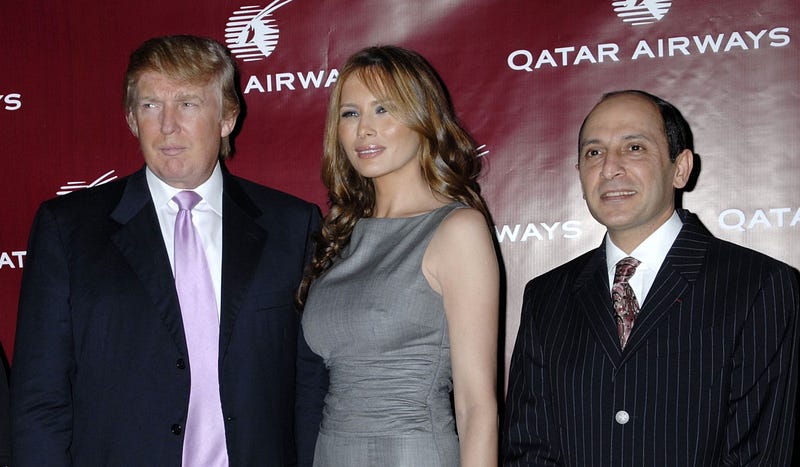
Donald and Melania Trump with Qatari Airlines CEO Akbar Al Baker at the Trump Tower
Circumstantial evidence strongly indicates that President Donald J. Trump and his campaign associates brokered a massive oil privatization deal, where his Organization facilitated a global financial transaction to sell Russian Oil stock to its Syrian War adversary, the Emirate of Qatar.
The Trump Russia Dossier describes a massive privatization deal to deliver a chunk of the state-owned Rosneft Oil company to Qatar and also a secret buyer in the Cayman Islands.
Qatar has been a tenant at Trump Tower since 2008, though recent reports indicate they may have recently vacated their state-run airlines’ corporate campus.
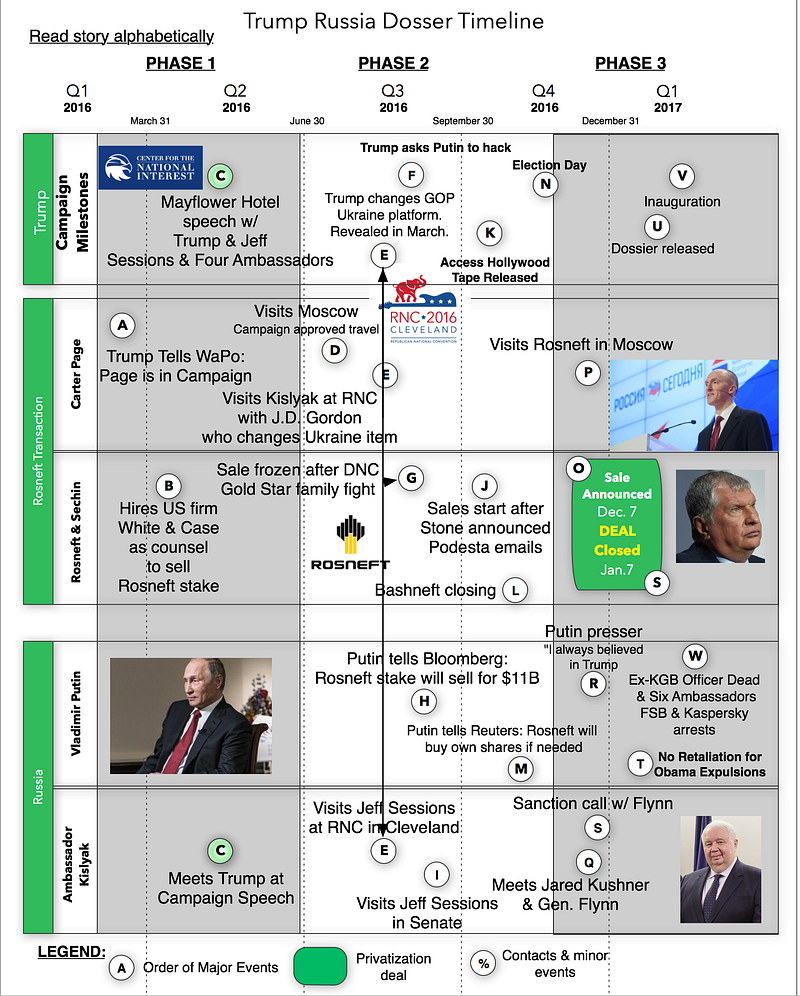
Donald Trump and Russia conducted the transaction in three phases; Phase 1 began in early 2016 with a meeting of the minds at The Mayflower Hotel to start the deal and a due diligence period, Phase 2 began just before the Republican National Convention and continued through Election Day, and Phase 3 happened after Trump’s shocking win and concluding just days before Buzzfeed published the bombshell dossier describing the deal.
The end result allowed Russia to trade stolen emails to help to Donald Trump’s election campaign (as well as that of many Republican Congressmen), in exchange for help circumventing American sanctions to transact the sale of Rosneft, which Putin desperately needed to finance his budget deficit.
The Rosneft transaction also purportedly sent a $500 million dollar brokerage fee to Carter Page, or perhaps the Trump Organization.
The Trump Campaign would’ve been extremely familiar with Rosneft, since top surrogate Rudy Giuliani listed the Russian oil giant as one of his law clients at Bracewell & Giuliani, LLP in 2014 according to Bloomberg.
For the first time here, we’ve broken down the entire Rosneft privatization transaction and US election, by using open source media stories to create a comprehensive timeline of events over three phases in a single graphic.
This is the transaction Ranking House Intel Committee Member Adam Schiff (D-CA) described when kicked off Congress’ Russia hearings discussing Rosneft’s privatization deal, and the many contacts between the Trump campaign and Putin’s allies.
The most deal significant milestone was the “meeting of the minds” which occurred last April 27th at the Center for National Interest gathering in Washington, D.C.
Four Ambassadors convened at The Mayflower Hotel, who represent the three countries definitely involved in the Rosneft privatization deal: Italy, Russia, Singapore, and also the Philippines.
They all attended Donald Trump’s foreign policy campaign speech.
Key players from every country involved were in that one room, for one night, one time only, and even now-Attorney General Jeff Sessions was there.
The former Alabama Senator only admitted that he had two meetings with the Russian Ambassador, publicly excusing his own lies maintaining that contacts both weren’t campaigning discussions, even though one meeting was at the RNC in Cleveland. The April contact makes a third undisclosed meeting by Sessions with Ambassador Kislyak. Former US Ambassador Richard Burt is now a Russian lobbyist, and is thought to have written the speech that night, and serves on the Center’s Board of Directors.
After the-Republican candidate Donald Trump locked down the GOP nomination in early May against Ted Cruz, the plan described in Steele’s dossier leapt into action.
From the look of events, starting in July, a massive international oil privatization transaction began, and it was concluded in early January, right around the time the Electoral College certified Donald Trump as America’s 45th President.
The April 27th campaign speech at CNFI effectively concluded the due diligence or first phase of the Dossier’s privatization transaction and began a ‘quiet period’ before the pace of events quickened.
The second phase of the transaction began just before the Republican Convention and ran through election day.
The third phase happened after election day, and before the January 10th disclosure of the Steele Dossier, itself just a few short days after the Rosneft privatization sale finished.
Here’s our comprehensive infographic, the story continues below:
This week, the Democratic Coalition just released a 40-page report which factually confirms more than a dozen major allegations of the Trump Russia Dossier published by Buzzfeed on January 10th.
Our exhaustive research breaks down the findings of the Dossier chronologically and highlights the ties between Trump and the buyer of Russia’s oil company shares.
Oil-rich Gulf Arab nation of Qatar was the end buyer of a massive stake in the Russian, state-run oil company Rosneft’s privatization deal.
The new Democratic Coalition report (below) reveals that Trump has hosted a Qatari state-run business owned by the QIA — the buyer of Rosneft shares in this transaction — located in the Manhattan Trump Tower for many years, as well as numerous factual confirmations of the dossier’s findings.
Democratic Coalition Senior Advisor Scott Dworkin is set to advise a bipartisan group of Congresspeople this week on his factual findings, which back up the information contained in the Dossier that implicates President Trump in a foreign affair with Vladimir Putin.
He tells us this is his main advice:
“The Dossier and its contents are mostly real.”
The President’s son-in-law and White House advisor Jared Kushner met with the Russian Ambassador during the Transition period, with disgraced General Michael Flynn.
“Carter Page met with Rosneft in December to assist with the deal, and he’s on the record admitting it but claims he didn’t meet Igor Sechin,” said Dworkin incredulously. “Really? It must have been a webcast with an intermediary. Everything in the Dossier adds up, and it still leaves more questions than answers.”
A mighty brokerage fee to one of the Trump campaign advisors, Moscow-based investment banker Carter Page, is highlighted in the former MI-6 operative’s report.
Theoretically, the former Merrill Lynch investment banker, Page, may have only been the “bag man” or go-between and someone else is the recipient of the cash premium in the dossier. Five hundred million dollars is a lot of money, and conceivably, many members of the Trump Organization, or family, could be involved in a deal of that scope.
What is most unusual about the sale is that Qatar is on the opposite sides of the Syrian war from Russia.
Not only that but in 2004 Russian agents openly assassinated a top Chechen rebel in Doha, the capital of Qatar, by bombing his SUV.
However, friendship between Donald Trump and the Qatari state-run airline who paid him anywhere from $19,000–100,000 a month in rent since 2008, must run deep.
Rosneft began taking steps towards a sale in early 2016, which accelerated right around the time of the Republican National Convention.
Russia’s state oil companies both declared that they would not privatize in 2016, right after Trump’s feud with a gold star family whose patriarch Khizr Khan spoke at the Democratic National Convention.
Putin announced the sale after new management changed the Trump campaign’s momentum in an exclusive Bloomberg interview in early September, which set the price at $11 billion dollars.
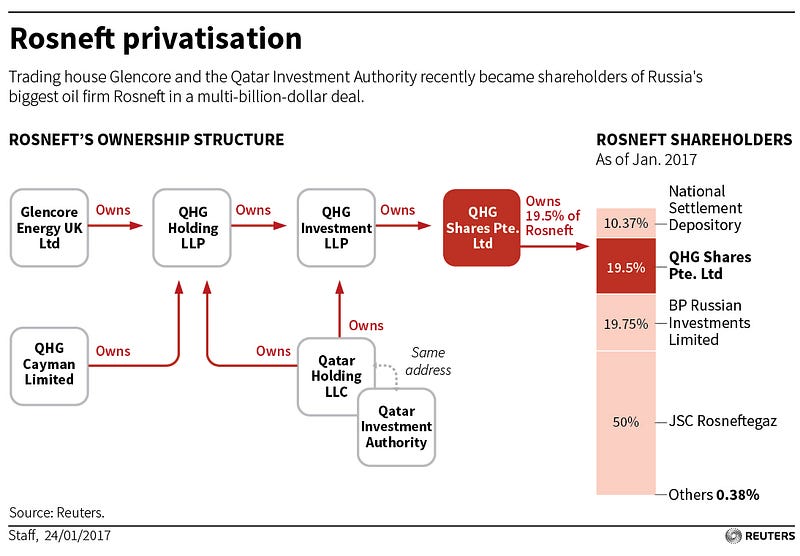
Reuters: Rosneft stake Ownership Chart
Six countries are known to have participated in the massive privatization deal of Russia’s jewel, its state-run oil company, which left the end ownership of the stake impenetrable, and a purchase price of roughly $10.7 billion dollars, which Reuters reported about in January as:
“How Russia sold its oil jewel: without saying who bought it.”
In early October, once Russia knew about their damaging cache of Clinton Campaign Chair John Podesta’s emails, they re-ignited the privatization sales.
Rosneft CEO Igor Sechin had already spent $5 billion dollars to buy out a foreign stake in Bashneft, another massive Russian oil partnership, whose oligarch was compromised, and charged (as Putin often does) with criminal offenses.
The Bashneft deal closed right before the damaging Access Hollywood political scandal, which would’ve swamped a presidential campaign without Trump’s collusive assistance from Putin’s massive propaganda machine.
After the Access Hollywood tape releases had seemed to doom Trump’s campaign, Putin even announced that the companies would buy their own shares if they had to — there was a serious budget hole to fill.
Nineteen and a half percent of Rosneft’s stock was agreed to be transferred on December 7th, before the board was informed of the transaction’s terms only after it took place.
The “matryoshka” (named after the famous nesting dolls) or complex deal structure is most likely designed to avoid American sanctions imposed over the Ukraine invasion against Rosneft, its CEO Igor Sechin, and its parent company Gazprom.
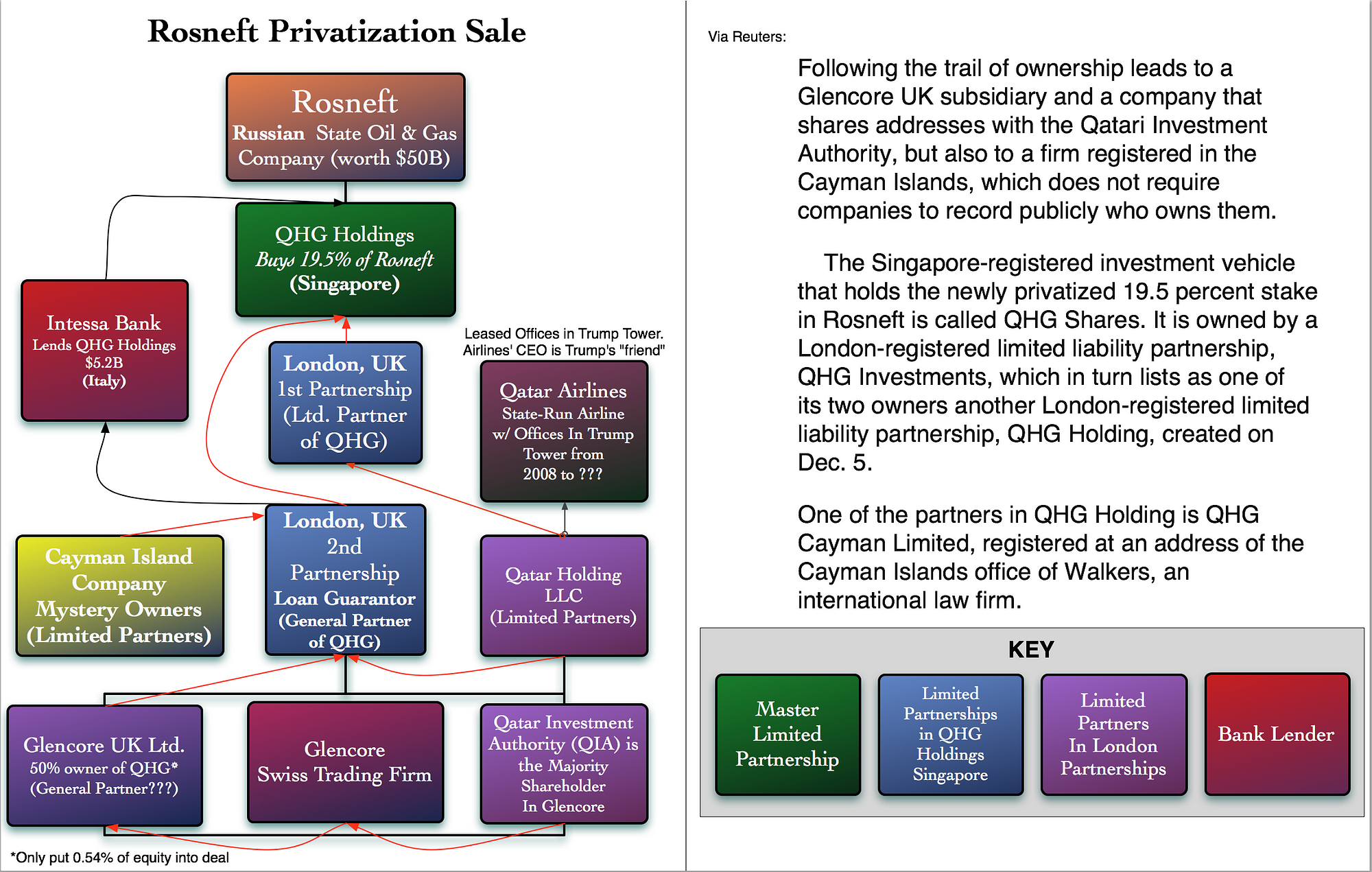
The highlighted yellow company in the below organization chart is a total mystery and based in the Cayman Islands law firm Walkers.
This is the kind of financial engineering it took for the Italian bank Intesa, to lend money to the buyers of the Rosneft stake.
The story continues below:
Anonymous blogger The Trump Watchdog indicates that the Walkers law firm is linked to Trump economic advisor Steven Schwartzman, a co-founder of the Wall Street giant Blackstone, because they own the Intertrust Group, who provided the Singapore holding company (item 17.)
The shelf company owned by Intertrust Group was renamed QHG Holdings — which was discovered after internet sleuths tracked down a scrivener’s error — and which probably links US interests to the international transaction.
Coincidentally, the other co-founder of Blackstone Pete Peterson also happens to be on the Board of Directors for the Center for National Interest who booked The Mayflower Hotel at the last moment for the April 27th meeting with the four ambassadors, Trump, and Sessions.
Left: Convicted felon, former Reagan NSA Robert “Bud” McFarland
Disgraced former Reagan National Security Advisor “Bud” McFarlane also attended The Mayflower Hotel speech on April 27th — in an especially ironic twist, where he attended another speech nearly 30 years earlier by Ronald Reagan, which he attended six short months before another international scandal erupted named Iran-Contra. Reagan’s speech that night demanded House Democrats to fund the Contra’s guerrilla war in Nicaragua, and like Trump’s speech proposing an unusual Russian “peace” deal, 30-years ago that Republican President described a foreign policy wish list, which eventually was revealed to have illegally transpired.
In November, despite Bud McFarlane’s public criticism in April, the Trump Transition team included the ex-felon’s compliments of Fox TV personality KT McFarland’s appointment as a Deputy NSA in their official press release.
Anyone who knows the Trump Administration, knows that they’re hypersensitive to criticism, yet oddly, this Trump critic was allowed to make a national security appointment so signficant that qualified applicants refused the job after Flynn’s dismissal, just to avoid KT McFarland being on their staff.
Then, Bud McFarlane mysteriously re-appeared at Trump Tower on December 5th, just two days before the Rosneft deal was announced, which didn’t make news when Henry Kissinger’s visit — he’s the Chairman Emeritus of the Center for National Interest — drew major headlines that day in Manhattan.
The end game for Russia was to funnel at least $5 billion dollars of new capital into state coffers to staunch some of the red ink expected to plague Putin’s budgets going into his 2018 elections, and through at least 2020 according to economists; and to do the deal while tiptoeing past American financial sanctions.
That’s where the cash-rich Gulf Arab nation stepped in to make a deal. The Qatari sovereign wealth fund (QIA) is the known buyer of 50% of these shares of Rosneft.
Yet still, nobody knows where well over $2 billion dollars of equity for the purchase came from, as Reuters reports:
Although Qatar has never publicly confirmed how much it has contributed to the deal or the size of the stake that it bought, Glencore and Rosneft say it contributed 2.5 billion euros. Along with the 300 million from Glencore and the 5.2 billion loaned by Intesa [an Italian bank], that still leaves a shortfall of 2.2 billion euros.
The QIA is coincidentally also the largest shareholder in the Swiss oil trading firm Glencore, who executed the purchase with a minimal direct investment, and used the “Singapore vehicle” or holding company to hold their Rosneft share.
Glencore guaranteed the Italian bank Intesa’s loan for only 1/3rd of its value.
Donald Trump has had business ties to Qatar’s government for years, according to a Jan. 10th report in Time:
Trump has stakes in four companies that appear to be tied in business in the desert nation. The country’s state-owned carrier, Qatar Airways, has leased an office in Manhattan’s Trump Tower since 2008. Ivanka Trump told Hotelier Middle East in 2015 that the Trump Hotel Collection was eyeing opportunities in Qatar.
It’s unclear when or if Qatari Airlines left Trump Tower, or when their lease actually expires, but a Jan. 28th story in Vox says that their operations have departed the President’s home building in New York.
What is clear is that Qatari Airlines’ CEO has publicly called Donald Trump a “good friend” and it is one of the countries excluded from the Muslim Ban, which coincidentally, does business with the President.
Recently, CEOs of American airliners met with Trump recently to decry government subsidized competition from Qatar and other foreign state-run carriers, which is an obvious conflict for President Trump.
If that wasn’t enough conflicted interest, Trump Organization announced a plan to build or license their brand in Qatar in 2015, but there are no further reports to substantiate the move.
The CEO of Qatari Airlines says that he was one of the first people to give congratulations after election day:
Qatar Airways’ Group Chief Executive Akbar al-Baker, who voiced support for Trump even after his comments about Muslims, welcomed his victory. “Our relationship goes way back, and I was one of the first to commend Donald on his well-deserved new leadership position,” he said in a statement to Reuters.
Qatari Airlines rented pricey office space at President Trump’s tower for many years. If their lease continues today, it would be a violation of the Constitution’s Emoluments Clause, which prevents federal employees and the executive from accepting any foreign payments whatsoever.
Qatar’s complete and total involvement in the Rosneft deal is undeniable.
The small Emirate that just publicly participated in the purchase of Russia’s state-run oil and gas giant — happens to be extremely close to Donald Trump.
It’s unknown if the Philippines had any direct or indirect involvement in the Rosneft transaction, but their President Duarte is a staunch Trump supporter, who assigned one of the President’s business partners as a trade envoy.
The island nation took the unusual step of hosting Russian naval ships in early January, which is extremely out of the ordinary for the longtime US ally and former colony.
What we do know is that the Cayman Islands company investors were conspicuously missing whe Rosneft’s CEO Igor Sechin and Vladimir Putin met with their new partners at Intesa Bank, the Qatar Investment Authority and Glencore in January.
Why Russia Needed The Money
At the heart of the Dossier’s disclosures is the Russian goal of ending economic sanctions, some of which specifically target Rosneft CEO Igor Sechin, who was Putin’s top deputy in government service just a few short years ago, in a country where the lines between business and government can be blurry.
President Obama’s 2014 sanctions have crippled the Russian economy when compounded with low global oil prices.
That caused a massive budget gap last year, which led Putin to privatize assets to pay current costs for the Russian government.
After President Obama leveled retaliatory sanctions in December 2016 and expelled diplomats in late December for meddling in our election, Vladimir Putin announced and then stunningly reserved retaliation.
Last month, disgraced Gen. Michael Flynn was fired as NSA, apparently just for discussing Russian sanctions with the Russian Ambassador in late December.
At the time, Obama’s expulsion of Russian diplomats and spies sparked a highly unusual public “bromance” between the President-elect and the dictator, which sparked speculation about a quid pro quo when Trump tweeted a love letter to the Russian dictator.
Strategically, Russia is desperate to shake the larger economic sanctions, but America’s Congress is seeking more, not less economic retaliation against Putin’s regime.
Shortly after taking office, President Trump did indeed relax sanctions against Russia’s lead spy agency, the FSB, but most observers said was a minor concession.
Into that void, Trump’s lawyer and a group of his Ukrainian family connections and lawmakers, and the notorious Felix Sater appeared with a “peace plan” that would’ve accomplished the end of sanctions.
One of the ‘peacemakers,’ a Ukrainian relative of Trump’s trusted lawyer Michael Cohen, has already perished under mysterious circumstances since then.
If America lifts sanctions against the Putin regime, then the value of Russia’s public oil companies stands to skyrocket.
Already, Donald Trump’s presence has sparked a market rally on Moscow’s MICEX stock exchange.
US Media Is Connecting The Dots On Steele’s Dossier
Open source journalism confirms some of the more important political elements of the Trump Russia Dossier.
My original report two weeks ago revealed a major point of affirmation in CNN’s interview with former Trump campaign associate, J.D. Gordon, whose remarks confirmed a serious political allegation in the Trump Russia Dossier.
Then, Rachel Maddow echoed the essence of our report on MSNBC a few days later and added that Politico linked a participant in the RNC Ukraine policy changes to one of then-Trump Campaign Manager Paul Manafort’s associates, who is himself a foreign national being investigated by the FBI.
Wikileaks involvement to assist Russia in Trump’s campaign is a cornerstone of the dossier’s claims; it was seen as essential for Putin and Russia to maintain plausible deniability for political interference.
Sure enough, new factual data shows that the anti-secrecy organization switched to their web hosting to use a Russian DNS server right before releasing the most damaging email material during last year’s elections.
That means Vladimir Putin certainly has knowledge of the physical location of Wikileaks’ servers and allows their messages to be broadcast using Russian soil.
Trump’s former top advisor Roger Stone admitted to communicating with Russian hackers in August 2016, during the election about releases of information through Wikileaks.
This month, Gen. Flynn revealed that he was secretly an unregistered Turkish foreign agent ‘volunteering’ his time during the Trump campaign, and Congress revealed proof this week, which he was simultaneously on the payroll of Russian state-sponsored RT “News” and the Kaspersky security firm, who is thought to have been involved in the election hacks.
One must imagine that Flynn’s role as a secret, unregistered foreign agent of two nations (in other words, he’s a SPY) is one of the main targets of the FBI’s counterintelligence investigation.
“When the dossier became public it generated more questions than answers,” says Scott Dworkin late at night via chat. “Over the last several months we’ve corroborated the dossier with the facts. The deeper we dig, the more truth we find in it. Just look at the author — Christopher Steele — who is a former MI-6 agent who’s saved more lives than Trump ever has.”
“He’s the real person people imagine James Bond to be.”
The Trump Russia Dossier describes the Rosneft privatization deal almost exactly, and Putin’s resulting purge of Russian allies and ex-officials looks like the kind of deadly cover up a dictator would apply, to erase his friends who knew about the deal.
Scott Dworkin says to expect full confirmation of the report within a week from official sources, or when Steele testifies in front of Congress in person or via remote link.
“A majority of the dossier and its contents are factual,” says the intrepid investigator Dworkin, who began making #TrumpLeaks posts in October. Now, when he tweets @funder 3 million people per day see and share his research. “The dossier is more real than anything Trump’s ever said.”
“A majority of it is factual and news reports over time have proven some of those facts.”
This weekend, the Republican Chair of the House Intel Committee said that only one person is being investigated for treason in the White House by the FBI’s Counter-Intelligence division.
There’s no way a deal of this magnitude would completely envelop the Trump Campaign, its manager, its outside affiliates and inside agents so thoroughly, without the principal or head of a group knowing that something was happening.
Any reasonable person would have to conclude that Donald Trump is the FBI’s target, based upon the bevy of circumstantial evidence tying RNC campaign events to Russian oil, economic sanctions, and the simmering conflict in Ukraine.
Nearly three decades ago, Trump admitted on national television to participating in a straw-man transaction with the Sultan of Brunei and infamous Iran-Contra middleman Adnan Khashoggi, through which he acquired a large yacht, so we’ve got proof that the Trump Organization has engaged these kinds of multi-national transactions in the Middle East.
The most important commodity traded in the oil business or politics is money.
The privatization deal described in Christopher Steele’s dossier has played out on the pages of Bloomberg and Reuters for a year — shows that there was a whole lot of money in brokering oil deals for Donald Trump’s associates, and a rapid profit by Qatar if sanctions are released this year.
The only question that’s not even pondered in these many public reports, and which must be a central focus of the American intelligence community’s investigations:
Where is the $500 million dollar brokerage fee today?
Where did the other $2 billion dollars come from?
What is Donald Trump’s true role in the deal?
Here’s the complete Democratic Coalition report:
Democratic Coalition Report On Trump Russia Dossier by Grant Stern on Scribd
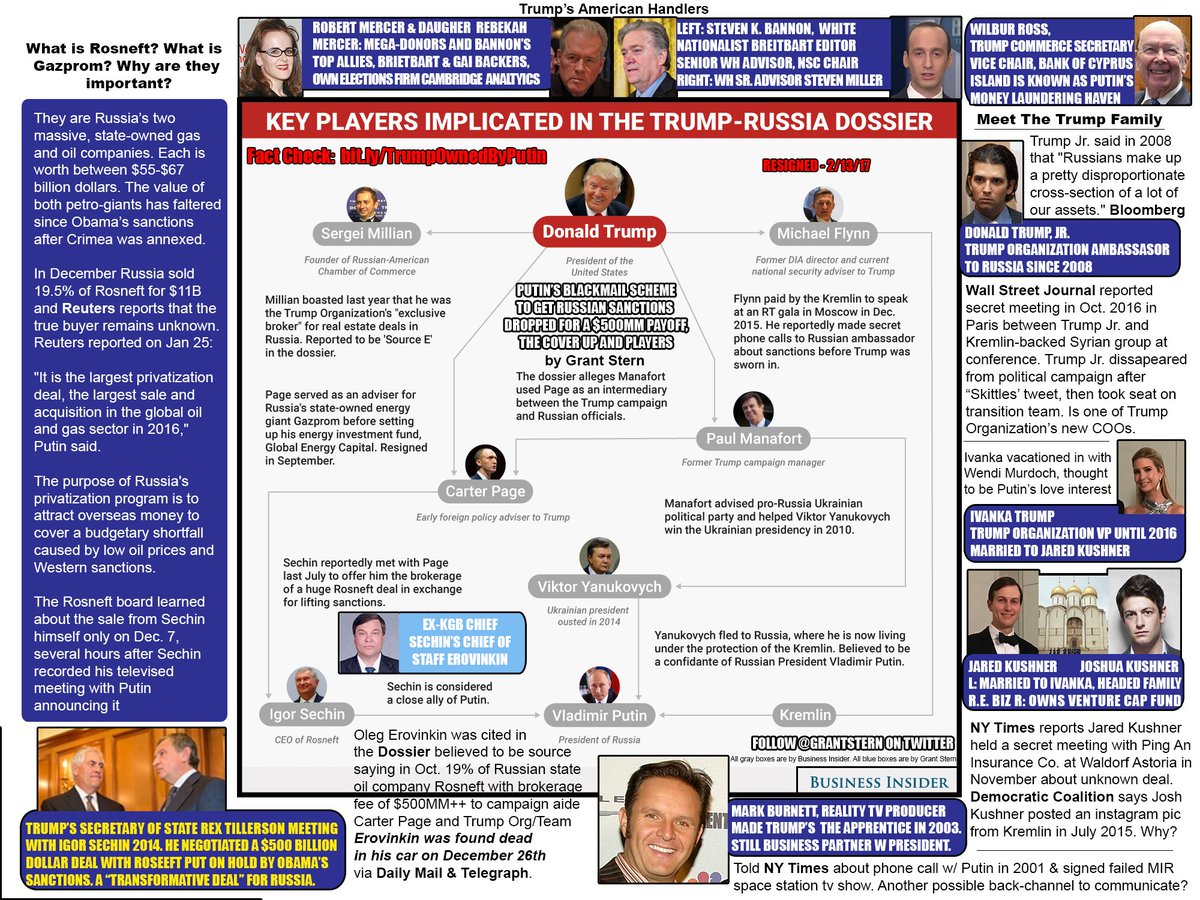
Here’s an infographic which describes many of the key players in the Trump Russian Dossier:
https://thesternfacts.com/trump-russia- ... 3370349b67

seemslikeadream » Wed Aug 23, 2017 9:51 pm wrote:1
2
3
4
5
6
7
8
9
11
12
13
14
15
16
17
18
19
20
21
22
23
24
25
26
27
28
29
30
31
32
33
34
35
https://www.documentcloud.org/documents ... tions.html"Fusion GPS is proud of the work it has conducted and stands by it," Levy, Simpson's lawyer, said in a statement.
He said the "investigation into Mr. Simpson began as a desperate attempt by the Trump campaign and its allies to smear Fusion GPS because of its reported connection to the Trump dossier."
Committee Hears From Founder of Firm Tied to Trump Dossier
The co-founder of a Washington opposition research firm that produced a dossier of salacious allegations involving President Donald Trump met for hours with congressional investigators Tuesday in a closed-door appearance that spanned into the evening.
Aug. 22, 2017, at 8:47 p.m.
Committee Hears From Founder of Firm Tied to Trump Dossier
By ERIC TUCKER, Associated Press
WASHINGTON (AP) — The co-founder of a Washington opposition research firm that produced a dossier of salacious allegations involving President Donald Trump met for hours with congressional investigators Tuesday in a closed-door appearance that spanned into the evening.
Glenn Simpson's lawyer emerged from the daylong private appearance and said his client had "told Congress the truth and cleared the record on many matters of interest."
The lawyer, Josh Levy, noted that Simpson appeared voluntarily and has so far been the only witness to be interviewed by the Senate Judiciary Committee as it looks into Russian interference in the 2016 presidential election.
The sheer length of Simpson's appearance — far longer, for instance, than Trump's son-in-law spent earlier this summer with Senate and House intelligence committees — reflected the intrigue on Capitol Hill surrounding the dossier and the origins of the document.
Simpson's firm, Fusion GPS, hired a British intelligence officer who produced a dossier containing allegations of ties between Trump and his associates and Russia. Simpson kept the identities of the firm's clients confidential during his appearance before Congress, his lawyer said.
The document attracted public attention in January when it was revealed that FBI Director James Comey had briefed Trump about its existence soon before he was inaugurated as president. It's unclear to what extent the allegations in the dossier have been corroborated or verified by the FBI since the bureau has not publicly discussed it.
"Fusion GPS is proud of the work it has conducted and stands by it," Levy, Simpson's lawyer, said in a statement.
He said the "investigation into Mr. Simpson began as a desperate attempt by the Trump campaign and its allies to smear Fusion GPS because of its reported connection to the Trump dossier."
Leaders of the Judiciary Committee said last month that they were negotiating private appearances for Donald Trump Jr., who has attracted scrutiny for accepting a June 2016 meeting with Russians at which he expected to receive damaging information about Hillary Clinton, and for Paul Manafort, the former Trump campaign chairman. Yet no dates have been announced for their appearances.
"Following up on comments from certain Senate Judiciary Committee members who have noted Mr. Simpson's cooperation with this investigation," Levy said, I would like to add that he is the first and only witness to participate in an interview with the Committee as it probes Russian interference in the 2016 election."
___
https://www.usnews.com/news/politics/ar ... mp-dossier






seemslikeadream » Wed Sep 06, 2017 1:57 pm wrote:
A Second Look at the Steele Dossier—Knowing What We Know Now
By John Sipher
Wednesday, September 6, 2017 at 8:01 AM
[Editor’s Note: In this special Just Security article, highly respected former member of the CIA’s Senior Intelligence Service, John Sipher examines the Steele dossier using methods that an intelligence officer would to try to validate such information. Sipher concludes that the dossier’s information on campaign collusion is generally credible when measured against standard Russian intelligence practices, events subsequent to Steele’s reporting, and information that has become available in the nine months since Steele’s final report. The dossier, in Sipher’s view, is not without fault, including factual inaccuracies. Those errors, however, do not detract from an overarching framework that has proven to be ever more reliable as new revelations about potential Trump campaign collusion with the Kremlin and its affiliates has come to light in the nine months since Steele submitted his final report.]
Recent revelations of Trump campaign connections to Russia have revived interest in the so-called Steele Dossier. The dossier is composed of a batch of short reports produced between June and December 2016 by Orbis Business Intelligence, a London-based firm specializing in commercial intelligence for government and private-sector clients. The collection of Orbis reports caused an uproar when it was published online by the US website BuzzFeed, just ten days before Donald Trump’s inauguration. Taken together, the series of reports painted a picture of active collusion between the Kremlin and key Trump campaign officials based on years of Russian intelligence work against Trump and some of his associates. This seemed to complement general statements from US intelligence officials about Russia’s active efforts to undermine the US election. The greatest attention was paid to the first report, which conveyed salacious claims about Trump consorting with prostitutes in Moscow in 2013. Trump himself publicly refuted the story, while Trump associates denied reported details about their engagement with Russian officials. A lot of ink and pixels were also spent on the question whether it was appropriate for the media to publish the dossier. The furor quickly passed, the next news cycle came, and the American media has been largely reluctant to revisit the report over the months since.
Almost immediately after the dossier was leaked, media outlets and commentators pointed out that the material was unproven. News editors affixed the terms “unverified” and “unsubstantiated” to all discussion of the issue in the responsible media. Political supporters of President Trump simply tagged it as “fake news.” Riding that wave, even legendary Washington Post reported Bob Woodward characterized the report as “garbage.”
For professional investigators, however, the dossier is by no means a useless document. Although the reports were produced episodically, almost erratically, over a five-month period, they present a coherent narrative of collusion between the Kremlin and the Trump campaign. As a result, they offer an overarching framework for what might have happened based on individuals on the Russian side who claimed to have insight into Moscow’s goals and operational tactics. Until we have another more credible narrative, we should do all we can to examine closely and confirm or dispute the reports.
Many of my former CIA colleagues have taken the Orbis reports seriously since they were first published. This is not because they are not fond of Trump (and many admittedly are not), but because they understand the potential plausibility of the reports’ overall narrative based on their experienced understanding of both Russian methods, and the nature of raw intelligence reporting. Immediately following the BuzzFeed leak, one of my closest former CIA colleagues told me that he recognized the reports as the obvious product of a former Secret Intelligence Service (SIS) officer, since the format, structure, and language mirrored what he had seen over a career of reading SIS reports provided to CIA in liaison channels. He and others withheld judgment about the veracity of the reports, but for the reasons I outline further below they did not reject them out of hand. In fact, they were more inclined for professional reasons to put them in the “trust but verify” category.
So how should we unpack the so-called Steele dossier from an intelligence perspective?
I spent almost thirty years producing what CIA calls “raw reporting” from human agents. At heart, this is what Orbis did. They were not producing finished analysis, but were passing on to a client distilled reporting that they had obtained in response to specific questions. The difference is crucial, for it is the one that American journalists routinely fail to understand. When disseminating a raw intelligence report, an intelligence agency is not vouching for the accuracy of the information provided by the report’s sources and/or subsources. Rather it is claiming that it has made strenuous efforts to validate that it is reporting accurately what the sources/subsources claim has happened. The onus for sorting out the veracity and for putting the reporting in context against other reporting – which may confirm or deny the new report – rests with the intelligence community’s professional analytic cadre. In the case of the dossier, Orbis was not saying that everything that it reported was accurate, but that it had made a good-faith effort to pass along faithfully what its identified insiders said was accurate. This is routine in the intelligence business. And this form of reporting is often a critical product in putting together more final intelligence assessments.
In this sense, the so-called Steele dossier is not a dossier at all. A dossier suggests a summary or case history. Mr. Steele’s product is not a report delivered with a bow at the end of an investigation. Instead, it is a series of contemporaneous raw reports that do not have the benefit of hindsight. Among the unnamed sources are “a senior Russian foreign ministry official,” “a former top-level intelligence officer still active inside the Kremlin,” and “a close associate of Republican U.S. presidential candidate Donald Trump.” Thus, the reports are not an attempt to connect the dots, but instead an effort to uncover new and potentially relevant dots in the first place.
What’s most relevant in the Orbis reports?
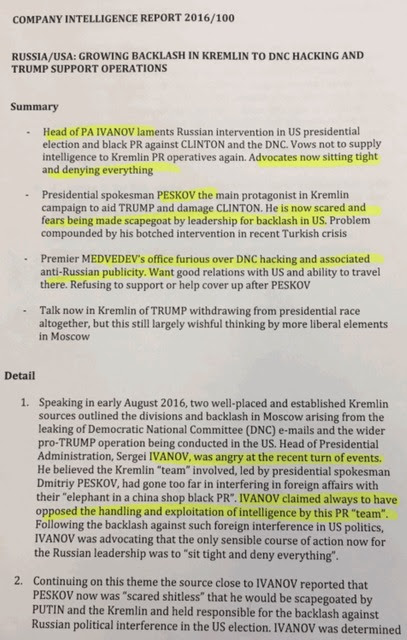
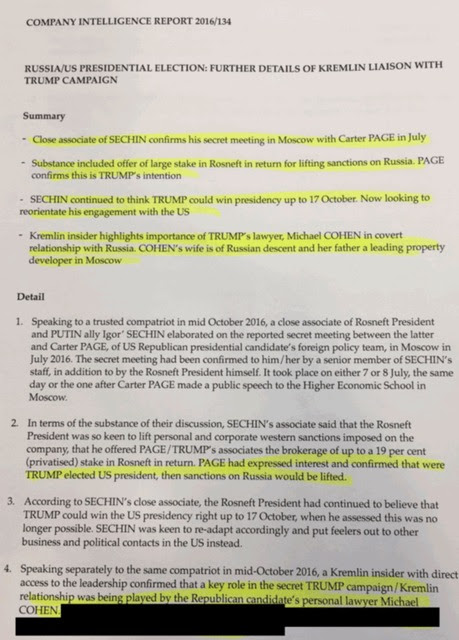
Let me illustrate what the reports contain by unpacking the first and most notorious of the seventeen Orbis reports, and then move to some of the other ones. The first 2 ½ page report was dated June 20, 206 and entitled “Company Intelligence Report 2016/080.” It starts with several summary bullets, and continues with additional detail attributed to sources A-E and G (there may be a source F but part of the report is blacked out). The report makes a number of explosive claims, all of which at the time of the report were unknown to the public.
Among other assertions, three sources in the Orbis report describe a multi-year effort by Russian authorities to cultivate, support and assist Donald Trump. According to the account, the Kremlin provided Trump with intelligence on his political primary opponents and access to potential business deals in Russia. Perhaps more importantly, Russia had offered to provide potentially compromising material on Hillary Clinton, consisting of bugged conversations during her travels to Russia, and evidence of her viewpoints that contradicted her public positions on various issues.
The report also alleged that the internal Russian intelligence service (FSB) had developed potentially compromising material on Trump, to include details of “perverted sexual acts” which were arranged and monitored by the FSB. Specifically, the compromising material, according to this entry in the report, included an occasion when Trump hired the presidential suite at a top Moscow hotel which had hosted President and Mrs. Obama, and employed prostitutes to defile the bed where the President had slept. Four separate sources also described “unorthodox” and embarrassing behavior by Trump over the years that the FSB believed could be used to blackmail the then presidential candidate.
The report stated that Russian President Putin was supportive of the effort to cultivate Trump, and the primary aim was to sow discord and disunity within the U.S. and the West. The dossier of FSB-collected information on Hillary Clinton was managed by Kremlin chief spokesman Dimitry Peskov.
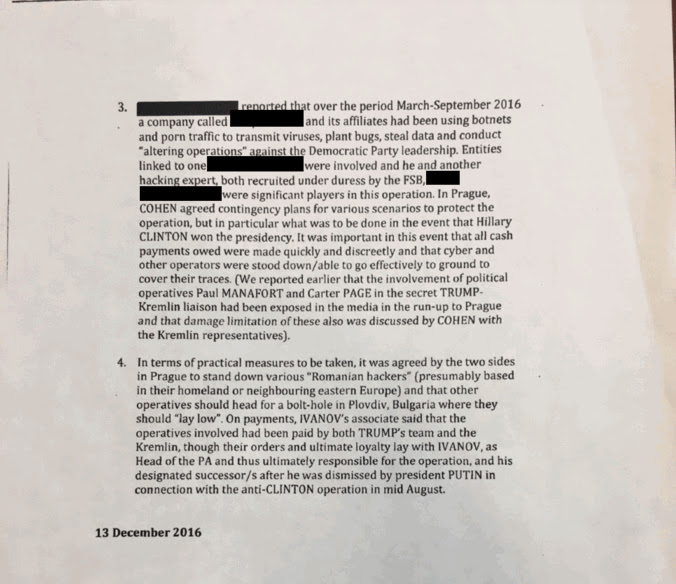
Subsequent reports provide additional detail about the conspiracy, which includes information about cyber-attacks against the U.S. They allege that Paul Manafort managed the conspiracy to exploit political information on Hillary Clinton in return for information on Russian oligarchs outside Russia, and an agreement to “sideline” Ukraine as a campaign issue. Trump campaign operative Carter Page is also said to have played a role in shuttling information to Moscow, while Trump’s personal lawyer, Michael Cohen, reportedly took over efforts after Manafort left the campaign, personally providing cash payments for Russian hackers. In one account, Putin and his aides expressed concern over kick-backs of cash to Manafort from former Ukrainian President Viktor Yanukovych, which they feared might be discoverable by U.S. authorities. The Kremlin also feared that the U.S. might stumble onto the conspiracy through the actions of a Russian diplomat in Washington, Mikhail Kalugin, and therefore had him withdrawn, according to the reports.
By late fall 2016, the Orbis team reported that a Russian-supported company had been “using botnets and porn traffic to transmit viruses, plant bugs, steal data and conduct ‘altering operations’ against the Democratic Party leadership.” Hackers recruited by the FSB under duress were involved in the operations. According to the report, Carter Page insisted that payments be made quickly and discreetly, and that cyber operators should go to ground and cover their tracks.
Assessing the Orbis reports
What should be made of these leaked reports with unnamed sources on issues that were deliberately concealed by the participants? Honest media outlets have reported on subsequent events that appear to be connected to the reports, but do not go too far with their analysis, concluding still that the dossier is unverified. Almost no outlets have reported on the salacious sexual allegations, leaving the public with very little sense as to whether the dossier is true, false, important or unimportant in that respect.
While the reluctance of the media to speculate as to the value of the report is understandable, professional intelligence analysts and investigators do not have the luxury of simply dismissing the information. They instead need to do all they can to put it into context, determine what appears credible, and openly acknowledge the gaps in understanding so that collectors can seek additional information that might help make sense of the charges.
Step One: Source Validation
In the intelligence world, we always begin with source validation, focusing on what intelligence professionals call “the chain of acquisition.” In this case we would look for detailed information on (in this order) Orbis, Steele, his means of collection (e.g., who was working for him in collecting information), his sources, their sub-sources (witting or unwitting), and the actual people, organizations and issues being reported on.
Intelligence methodology presumes that perfect information is never available, and that the vetting process involves cross-checking both the source of the information as well as the information itself. There is a saying among spy handlers, “vet the source first before attempting to vet the source’s information.” Information from human sources (the spies themselves) is dependent on their distinct access to information, and every source has a particular lens. Professional collectors and debriefing experts do not elicit information from a source outside of the source’s area of specific access. They also understand that inaccuracies are inevitable, even if the source is not trying to mislead. The intelligence process is built upon a feedback cycle that corroborates what it can, and then goes back to gather additional information to help build confidence in the assessment. The process is dispassionate, unemotional, professional and never ending.
Faced with the raw reports in the Orbis document, how might an intelligence professional approach the jumble of information?
The first thing to examine is Christopher Steele, the author of the reports, and his organization Orbis International. Are they credible?
Steele was the President of the Cambridge Union at university, and was a career British intelligence officer with service in Moscow, Paris and Afghanistan prior to work as the head of the Russia desk at British intelligence HQS. While in London he worked as the personal handler of Russian defector Alexander Litvinenko. He was a respected professional who had success in some of the most difficult intelligence environments. He retired from SIS in 2009 and started Orbis Business Intelligence along with a former colleague. Prior to his work on the Russian dossier for Orbis, he was best known for his investigation of the world soccer association (FIFA), which provided direct support to the FBI’s successful corruption case. Steele and Orbis were also known for assisting various European countries in understanding Russian efforts to meddle in their affairs.
Like any private firm, Orbis’ ability to remain in business relies on its track record of credibility. Success for Steele and his colleagues depends on his integrity, reliability, and the firm’s reputation for serious work. In this regard, Steele is putting his reputation and his company’s continued existence on the line with each report. Yes, as with anyone operating in the murky world of intelligence, he could be duped. Nonetheless, his reputation for handling sensitive Russian espionage operations over the years suggests that he is security conscious and aware of Russian counterintelligence and disinformation efforts. His willingness to share his work with professional investigative agencies such as the FBI and the British Security Service also suggest that he is comfortable opening his work to scrutiny, and is seen as a serious partner by the best in the business.
The biggest problem with confirming the details of the Steele “dossier” is obvious: we do not know his sources, other than via the short descriptions in the reports. In CIA’s clandestine service, we spent by far the bulk of our work finding, recruiting and validating sources. Before we would ever consider disseminating an intelligence report, we would move heaven and earth to understand the access, reliability, trustworthiness, motivation and dependability of our source. We believe it is critical to validate the source before we can validate the reliability of the source’s information. How does the source know about what he/she is reporting? How did the source get the information? Who are his/her sub-sources? What do we know about the sub-sources? Why is the source sharing the information? Is the source a serious person who has taken appropriate measures to protect their efforts?
One clue as to the credibility of the sources in these reports is that Steele shared them with the FBI. The fact that the FBI reportedly sought to work with him and to pay him to develop additional information on the sources suggest that at least some of them were worth taking seriously. At the very least, the FBI will be able to validate the credibility of the sources, and therefore better judge the information. As one recently retired senior intelligence officer with deep experience in espionage investigations quipped, “I assign more credence to the Steele report knowing that the FBI paid him for his research. From my experience, there is nobody more miserly than the FBI. If they were willing to pay Mr. Steele, they must have seen something of real value.”
Step Two: Assessing the Substantive Content
As outsiders without the investigative tools available to the FBI, we can only look at the information and determine if it makes sense given subsequent events and the revelation of additional information. Mr. Steele did not have the benefit of knowing Mr. Trump would win the election or how events might play out. In this regard, does any of the information we have learned since June 2016 assign greater or less credibility to the information? Were the people mentioned in the report real? Were their affiliations correct? Did any of the activities reported happen as predicted?
To a large extent, yes.
The most obvious occurrence that could not have been known to Orbis in June 2016, but shines bright in retrospect is the fact that Russia undertook a coordinated and massive effort to disrupt the 2016 U.S. election to help Donald Trump, as the U.S. intelligence community itself later concluded. Well before any public knowledge of these events, the Orbis report identified multiple elements of the Russian operation including a cyber campaign, leaked documents related to Hillary Clinton, and meetings with Paul Manafort and other Trump affiliates to discuss the receipt of stolen documents. Mr. Steele could not have known that the Russians stole information on Hillary Clinton, or that they were considering means to weaponize them in the U.S. election, all of which turned out to be stunningly accurate. The U.S. government only published its conclusions in January 2017, with an assessment of some elements in October 2016. It was also apparently news to investigators when the New York Times in July 2017 published Don Jr’s emails arranging for the receipt of information held by the Russians about Hillary Clinton. How could Steele and Orbis know in June 2016 that the Russians were working actively to elect Donald Trump and damage Hillary Clinton? How could Steele and Orbis have known about the Russian overtures to the Trump Team involving derogatory information on Clinton?
We have also subsequently learned of Trump’s long-standing interest in, and experience with Russia and Russians. A February 2017 New York Times article reported that phone records and intercepted calls show that members of Trump’s campaign and other Trump associates had repeated contacts with senior Russian officials in the year before the election. The New York Times article was also corroborated by CNN and Reuters independent reports. And even Russian officials have acknowledged some of these and other repeated contacts. Although Trump has denied the connections, numerous credible reports suggest that both he and Manafort have long-standing relationships with Russians, and pro-Putin groups. In August 2017, CNN reported on “intercepted communications that US intelligence agencies collected among suspected Russian operatives discussing their efforts to work with Manafort…to coordinate information that could damage Hillary Clinton’s election prospects” including “conversations with Manafort, encouraging help from the Russians.”
We learned that when Carter Page traveled to Moscow in July 2016, he met with close Putin ally and Chairman of the Russian state oil company, Igor Sechin. A later Steele report also claimed that he met with Parliamentary Secretary Igor Divyekin while in Moscow. Renowned investigative journalist Michael Isikoff reported in September 2016 that U.S. intelligence sources confirmed that Page met with both Sechin and Divyekin during his July trip to Russia. What’s more, the Justice Department obtained a wiretap in summer 2016 on Page after satisfying a court that there was sufficient evidence to show Page was operating as a Russian agent.
While the Orbis team had no way to know it, subsequent reports from U.S. officials confirmed that Washington-based diplomat Mikhail Kalugin was an undercover intelligence officer and was pulled out of the Embassy and sent home in summer 2016.
The Orbis documents refer repeatedly to Paul Manafort’s “off-the-books” payments from ousted Ukrainian President Viktor Yanukovych’s pro-Russian party, and Russian concerns that it may be a vulnerability that could jeopardize the effort. According to the Orbis report, the Russians were concerned about “further scandals involving Manafort’s commercial and political role in Russia/Ukraine.” And, indeed, there have been further scandals since the Orbis reports were written. Those include Manafort being compelled in June 2017 to register retroactively as a foreign agent of a pro-Russian political parties in Ukraine, and Mueller and New York Attorney Generals’ reported investigation of Manafort for possible money laundering and tax evasion linked to Ukrainian ventures.
We do not have any reporting that implicates Michael Cohen in meetings with Russians as outlined in the dossier. However, recent revelations indicate his long-standing relationships with key Russian and Ukrainian interlocutors, and highlight his role in a previously hidden effort to build a Trump tower in Moscow. During the campaign, those efforts included email exchanges with Trump associate Felix Sater explicitly referring to getting Putin’s circle involved and helping Trump get elected.
Further, the Trump Administration’s effort lift sanctions on Russia immediately following the inauguration seems to mirror Orbis reporting related to Mr. Cohen’s promises to Russia, as reported in the Orbis documents. A June 2017 Yahoo News article by Michael Isikoff described the Administration’s efforts to engage the State Department about lifting sanctions “almost as soon as they took office.” Their efforts were halted by State Department officials and members of Congress. Following the inauguration, Cohen was involved, again with Felix Sater, to engage in back-channel negotiations seeking a means to lift sanctions via a semi-developed Russian-Ukrainian plan (which also included the hand delivery of derogatory information on Ukrainian leaders) also fits with Orbis reporting related to Cohen.
The quid pro quo as alleged in the dossier was for the Trump team to “sideline” the Ukrainian issue in the campaign. We learned subsequently the Trump platform committee changed only a single plank in the 60-page Republican platform prior to the Republican convention. Of the hundreds of Republican positions and proposals, they altered only the single sentence that called for maintaining or increasing sanctions against Russia, increasing aid for Ukraine and “providing lethal defensive weapons” to the Ukrainian military. The Trump team changed the wording to the more benign, “appropriate assistance.”
Consider, in addition, the Orbis report saying that Russia was utilizing hackers to influence voters and referring to payments to “hackers who had worked in Europe under Kremlin direction against the Clinton campaign.” A January 2017 Stanford study found that “fabricated stories favoring Donald Trump were shared a total of 30 million times, nearly quadruple the number of pro-Hillary Clinton shares leading up to the election.” Also, in November, researchers at Oxford University published a report based on analysis of 19.4 million Twitter posts from early November prior to the election. The report found that an “automated army of pro-Trump chatbots overwhelmed Clinton bots five to one in the days leading up to the presidential election.” In March 2017, former FBI agent Clint Watts told Congress about websites involved in the Russian disinformation campaign “some of which mysteriously operate from Eastern Europe and are curiously led by pro-Russian editors of unknown financing.”
The Orbis report also refers specifically to the aim of the Russian influence campaign “to swing supporters of Bernie Sanders away from Hillary Clinton and across to Trump,” based on information given to Steele in early August 2016. It was not until March 2017, however, that former director of the National Security Agency, retired Gen. Keith Alexander in Senate testimony said of the Russian influence campaign, “what they were trying to do is to drive a wedge within the Democratic Party between the Clinton group and the Sanders group.” A March 2017 news report also detailed that Sanders supporter’s social media sites were infiltrated by fake news, originating from “dubious websites and posters linked back to Eastern Europe,” that tried to shift them against Clinton during the general election. John Mattes, a former Senate investigator who helped run the online campaign for Sanders, said he was struck by Steele’s report. Mattes said, Steele “was writing in real time about things I was seeing happening in August, but I couldn’t articulate until September.” It is important to emphasize here that Steele’s source for the change in plan was “an ethnic Russian associate of Republican US presidential candidate Donald Trump [who] discussed the reaction inside his camp.”
A slew of other revelations has directly tied many of the key players in the Trump campaign – most notably Paul Manafort, Carter Page, Michael Cohen, and Michael Flynn – who are specifically mentioned in the Orbis reports to Russian officials also mentioned in the reports. To take one example, the first report says that Kremlin spokesman Dmitry Peskov was responsible for Russia’s compromising materials on Hillary Clinton, and now we have reports that Michael Cohen had contacted Peskov directly in January 2016 seeking help with a Trump business deal in Moscow (after Cohen received the email from Trump business associate Felix Sater saying “Our boy can become president of the USA and we can engineer it. I will get all of Putins team to buy in on this.”). To take another example, the third Orbis report says that Trump campaign manager Paul Manafort was managing the connection with the Kremlin, and we now know that he was present at the June 9 2016 meeting with Donald Trump, Jr., Russian lawyer Natalia Veselnitskaya and Rinat Akhmetshin, who has reportedly boasted of his ties to ties and experience in Soviet intelligence and counterintelligence. According to a recent New York Times story, “Akhmetshin told journalists that he was a longtime acquaintance of Paul J. Manafort.”
The Orbis reports chronicle, and subsequent events demonstrate, that the Russian effort evolved over time, adapting to changing circumstances. When their attack seemed to be having an effect, they doubled down, and when it looked like negative media attention was benefiting Ms. Clinton, they changed tactics. The Orbis reports detail internal Kremlin frictions between the participants as the summer wore on. If the dossier is to be believed, the Russian effort may well have started as an anti-Clinton operation, and only became combined with the separate effort to cultivate the Trump team when it appeared Trump might win the nomination. The Russian effort was aggressive over the summer months, but seemed to back off and go into cover-up mode following the Access Hollywood revelations and the Obama Administration’s acknowledgement of Russian interference in the fall, realizing they might have gone too far and possibly benefitted Ms. Clinton. However, when Trump won, they changed again and engaged with Ambassador Kislyak in Washington to get in touch with others in the Trump transition team. As this process unfolded, control of operation on the Russian side passed from the Ministry of Foreign Affairs, to the FSB, and later to the Presidential Administration. It should be noted in this context, that the much-reported meetings with Ambassador Kislyak do not seem to be tied to the conspiracy. He is not an intelligence officer, and would be in the position to offer advice on politics, personalities and political culture in the United States, but would not be asked to engage in espionage activity. It is likewise notable that Ambassador Kislyak receives only a passing reference in the Steele dossier and only having to do with his internal advice on the political fallout in the U.S. in reaction to the Russian campaign.
Of course, to determine if collusion occurred as alleged in the dossier, we would have to know if the Trump campaign continued to meet with Russian representatives subsequent to the June meeting. As mentioned, in February, the New York Times, CNN, and Reuters, reported that members of Trump’s campaign and other Trump associates had repeated contacts with senior Russian officials in the year before the election, according to current and former American officials. Subsequent reports cite receipt of intelligence from European security agencies reporting on odd meetings between Trump associates and Russian officials in Europe. And, perhaps the best clue that there might be something to the narrative of meetings in summer 2016 was former CIA Director John Brennan’s carefully chosen phrase in front of the Senate intelligence committee about the contacts – “frequently, people who go along a treasonous path do not know they are on a treasonous path until it is too late.” This period will likely be the one most closely scrutinized by FBI investigators.
In retrospect, there is even some indication that the salacious sexual allegations should not be dismissed out of hand. Efforts to monitor foreigners and develop compromising material is completely consistent with Russian M.O. I am certain that they have terabytes of film and audio from inside my apartment in Moscow. Putin himself is known to have been implicated in several sex stings to embarrass his rivals, to include the famous broadcast of a clandestinely-acquired sex video to shame then Prosecutor General Yuriy Skuratov.
Perhaps more intriguing, the most explosive charge in the Steele document was the claim that Trump hired prostitutes to defile a bed slept in by former President Obama. The important factor to consider is that Trump did not engage with the prostitutes himself, but instead allegedly sought to denigrate Obama. If there is anything consistent in what we have learned about President Trump, it seems that his policies are almost exclusively about overturning and eradicating anything related to President Obama’s tenure. In this sense, he is akin to the ancient Pharaohs, Byzantine and Roman Emperors like Caligula, who sought to obliterate the existence of their predecessors, even destroying and defacing their images. Is it inconceivable that he would get some satisfaction from a private shaming of the former President?
Separate Orbis reports also asserted that Trump himself engaged in unorthodox, perverted sexual behavior over the years that “has provided authorities with enough embarrassing and compromising material on the Republican presidential candidate to be able to blackmail him if they so wished.” While it is not worth serious exploration, the notion that Trump might be involved with beautiful young women as alleged in the reports doesn’t seem to be much of a stretch. His private life is well documented and litigated, such that it doesn’t seem wholly out-of-bounds to tie the reports about his activity in Russia with his history of undue interest in young women. Again, there is no means to independently confirm the information and the media shouldn’t try. An intelligence professional or investigator cannot shy away, however, and should try to ascribe some level of confidence in the information as part of the process of validating the various sources and the overall credibility of the reporting. If the specific reports prove untrue, it would cast doubt on other reporting from that source.
In these cases, blackmail does not need to be overt to be useful. Simple knowledge that a potential adversary might have compromising information can influence behavior. Whether or not his subsequent behavior as a candidate and President is consistent with possible overt or subtle blackmail is beyond my ability to assess or the FBI’s ability to prove, and is instead for each citizen to ponder. Suffice it to say that Trumps obsequiousness toward Putin, his continued cover-ups, and his irrational acquiescence to Russian interests, often in direct opposition to his own Administration and Party, keep the issue on the table.
On the other hand, there is also information in the Steele reports that appears wrong or questionable. For example, the notion that Steele and his team could develop so many quality sources with direct access to discussions inside the Kremlin is worth serious skepticism. The CIA and other professional intelligence services rarely developed this kind of access despite expending significant resources over decades, according to published accounts. It is also hard to believe that Orbis could have four separate sources reporting on the incident at the Moscow hotel. The reputation of the elite hotel in the center of Moscow depends on the discretion of its staff, and crossing the FSB is not something taken lightly in Russian society. A source that could be so easily identified would be putting themselves at significant risk. Further, additional information in the reports cannot be checked without the tools of a professional investigative service. Of course, since the dossier was leaked, and we do not have additional follow-up reports, we don’t know if Orbis would have developed other sources or revised their reporting accordingly as they were able to develop feedback. We also don’t know if the 35 pages leaked by BuzzFeed is the entirety of the dossier. I suspect not.
* * *
So, more than a year after the production of the original raw reports, where do we stand?
I think it is fair to say that the report is not “garbage” as several commentators claimed. The Orbis sources certainly got some things right – details that they could not have known prior. Steele and his company appear serious and credible. Of course, the failure of the Trump team to report details that later leaked out and fit the narrative may make the Steele allegations appear more prescient than they otherwise might. At the same time, the hesitancy to be honest about contacts with Russia is consistent with allegations of a conspiracy.
All that said, one large portion of the dossier is crystal clear, certain, consistent and corroborated. Russia’s goal all along has been to do damage to America and our leadership role in the world. Also, the methods described in the report fit the Russians to a tee. If the remainder of the report is largely true, Russia has a powerful weapon to help achieve its goal. Even if it is largely false, the Kremlin still benefits from the confusion, uncertainty and political churn created by the resulting fallout. In any regard, the Administration could help cauterize the damage by being honest, transparent and assisting those looking into the matter. Sadly, the President has done the opposite, ensuring a Russian win no matter what. In any event, I would suspect the Russians will look to muddy the waters and spread false and misleading information to confuse investigators and public officials.
As things stand, both investigators and voters will have to examine the information in their possession and make sense of it as best they can. Professional investigators can marry the report with human and signals intelligence, they can look at call records, travel records, interview people mentioned in the report, solicit assistance from friendly foreign police and intelligence services, subpoena records and tie it to subsequent events that can shed light on the various details. We, on the other hand, will have to do our best to validate the information at hand. Looking at new information through the framework outlined in the Steele document is not a bad place to start.
https://www.justsecurity.org/44697/stee ... r-knowing/