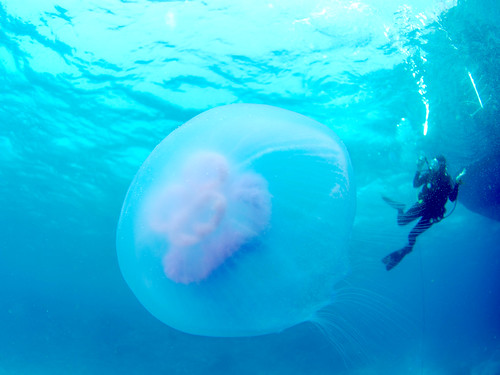
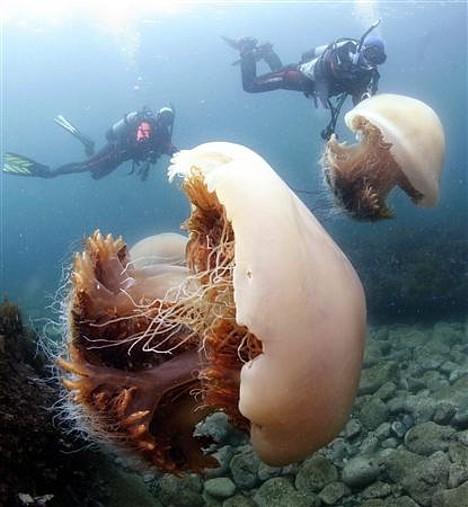
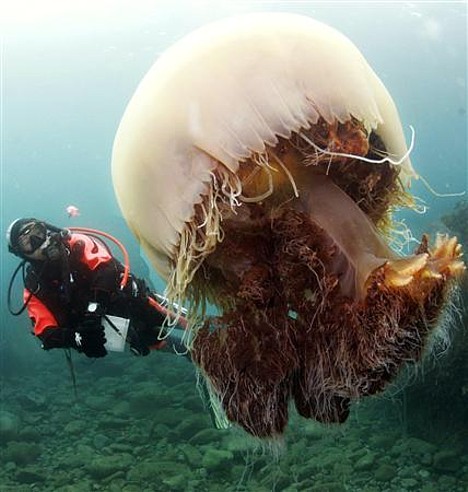
Giant jellyfish are taking over the seas

Moderators: Elvis, DrVolin, Jeff

Nordic
Posts: 14230
Joined: Fri Nov 10, 2006 3:36 am
Location: California USA

Giant jellyfish are taking over the seas

Post by Nordic »

http://www.enn.com/wildlife/article/40035

Overfishing, Other Factors Leading to Proliferation of Giant Jellyfish

Britain Readies Itself for Future Jellyfish Attacks

Jellyfish swarm hits Scotland prompting warnings

Jellyfish attack wipes out N.Ireland salmon farm

It's 'attack of the slime' as jellyfish jeopardize the Earth's oceans

Giant jellyfish are taking over parts of the world's oceans as overfishing and other human activities open windows of opportunity for them to prosper, say researchers.

Jellyfish are normally kept in check by fish, which eat small jellyfish and compete for jellyfish food such as zooplankton, researchers said. But, with overfishing, jellyfish numbers are increasing.
Yet another unintended consequence of stupid human activity.

They say climate change could also cause jellyfish populations to grow. The team believes that for the first time, water conditions could lead to what they call a "jellyfish stable state," in which jellyfish rule the oceans.

The combination of overfishing and high levels of nutrients in the water has been linked to jellyfish blooms. Nitrogen and phosphorous in run-off cause red phytoplankton blooms, which create low-oxygen dead zones where jellyfish survive, but fish can't, researchers said.
Jellyfish, soon to be coming to a dinner plate near you.
User avatar
elfismiles
Posts: 8512
Joined: Fri Aug 11, 2006 6:46 pm

Post by elfismiles »

Image

Image

Image

Image

Image

Image

Image

Image

Image

Image

Image
Nordic
Posts: 14230
Joined: Fri Nov 10, 2006 3:36 am
Location: California USA

Post by Nordic »

Yuck. Those things give me the willies.
User avatar
AhabsOtherLeg
Posts: 3285
Joined: Sun Dec 30, 2007 8:43 pm

Post by AhabsOtherLeg »

elfismiles wrote: ...
Jesus.
User avatar
wintler2
Posts: 2884
Joined: Sun Nov 12, 2006 3:43 am
Location: Inland SE Aus.

Post by wintler2 »

You can't stop progress (personal epithet for decline of capitalism).

The very unattractiveness of jellyfish might save them.. Jared Diamonds Collapse book relates the story of the early Greenlanders who starved because they didn't eat fish. But jellyfish will be probably rendered pallatable even to white folks, fished out, and then what'll we be down to - bluegreen algae? Thanks for the photos.
American Dream
Posts: 19946
Joined: Sat Sep 15, 2007 4:56 pm
Location: Planet Earth

Post by American Dream »

1/2 lb prepared shredded jellyfish
2 tsp light soy sauce
3 tbsp sesame oil
2 tsp white rice vinegar
2 tsp sugar
3 tbsp white sesame seeds, toasted


Rinse jellyfish well in cold running water and drain. Put it in a stainless steel bowl and cover with boiling water. Let the jellyfish sit in the hot water for about 15 minutes or until it is tender. Drain and continue to soak at least 6 times in several changes of cold water. Drain thoroughly and blot dry with paper towels and set aside. Mix soy sauce, sesame oil, vinegar and sugar in a small bowl. Toss the jellyfish well in this sauce and let it sit for at least 30 minutes. Just before serving, garnish with the sesame seeds. (Serves 4 as part of a Chinese meal or 2 as a single dish.)

Image


http://www.deependdining.com/2007/03/al ... me-pb.html
User avatar
brainpanhandler
Posts: 5127
Joined: Fri Dec 29, 2006 9:38 pm

Post by brainpanhandler »

wintler2 wrote:and then what'll we be down to - bluegreen algae?
Soylent Green
"Nothing in all the world is more dangerous than sincere ignorance and conscientious stupidity." - Martin Luther King Jr.
Alfred Joe's Boy
Posts: 222
Joined: Tue Jul 15, 2008 2:29 pm

Post by Alfred Joe's Boy »

"Giant jellyfish are taking over the seas"
And the land as well?
BBC:
A 250m-long crop circle of a jellyfish has appeared on farmland.

The owners of the land in Oxfordshire have urged visitors to stay away from the circle, which is also 60m (197ft) wide, to avoid further crop damage.

Sally Ann Spence and husband Bill, who own Berry Croft Farm near Ashbury, said hundreds of visitors have been trampling over their field.

They said it was "beautiful" but the flattened crops were now "useless" and the damage would cost about £600.

"We have not given permission for people to walk on our land," Mrs Spence said.

"The pattern has already cost a great deal of damage - possibly about £600.

"People can get a better view from the air."

She said she was not concerned about tracking down the culprits and the incident has not been reported to the police.

It is not the first time crop circles have appeared on their land, they said, but the jellyfish is one of the most spectacular.
Crop circles season 2009 starts early in the British Isles
User avatar
smiths
Posts: 2205
Joined: Wed May 18, 2005 4:18 am
Location: perth, western australia

Post by smiths »

The End of the Line: Ep.1 - The Biggest Problem You've Never Heard Of

http://www.babelgum.com/browser.php#pla ... |0,3020264
the question is why, who, why, what, why, when, why and why again?
JoseFreitas
Posts: 93
Joined: Thu Nov 09, 2006 6:24 am
Location: Lisbon, Portugal

Post by JoseFreitas »

I've had jellyfish a few times, and they're actually good. Although, in all honesty, they probably fall into the "acquired taste" category.
yathrib
Posts: 1880
Joined: Tue May 16, 2006 11:44 pm

Post by yathrib »

I ate jellyfish once at a Chinese restaurant to impress my boyfriend at that time with my multicultural awareness, or something... It wasn't as awful as it sounds. Better than Soylent Green, probably.
JoseFreitas
Posts: 93
Joined: Thu Nov 09, 2006 6:24 am
Location: Lisbon, Portugal

Post by JoseFreitas »

But.... but... Soylent Green comes in SO many flavors!

:-)
cptmarginal
Posts: 2741
Joined: Tue Apr 10, 2007 8:32 pm
Location: Gordita Beach
Contact:

Post by cptmarginal »

Japan fears massive jellyfish invasion this year
Japanese researchers monitoring the activity of giant jellyfish in Chinese waters are warning of a potentially historic and catastrophic invasion this year.

Marine surveys conducted in late June have revealed alarming numbers of Nomura’s jellyfish — massive creatures that grow up to 2 meters (6 ft 7 in) in diameter and weigh as much as to 220 kilograms (about 450 lbs) — lurking in the Yellow Sea and East China Sea. The researchers warn that ocean currents may bring swarms of the monster jellies to Japan, which has been plagued by similar invasions in recent years.

Based on what they have seen so far, the researchers warn this year’s onslaught of Nomura’s jellyfish (Nemopilema nomurai, or Echizen kurage in Japanese) could deliver a massive blow to Japan’s fishing industry, rivaling even the devastating 2005 deluge that caused tens of billions of yen (hundreds of millions of dollars) in damage nationwide.

The surveys are being conducted by a team led by Shinichi Ue, a professor of biological oceanography at Hiroshima University who also chairs a government research committee tasked with developing technology to predict and control jellyfish explosions. Ue has been monitoring the population density of Nomura’s jellyfish in the southern Yellow Sea and northern East China Sea since 2006.

Between June 20 and 24, 2009, Ue’s team observed numerous specimens with umbrellas measuring 10 to 50 centimeters across, and they calculated an average distribution of 2.14 jellyfish per 100 square meters. This figure is more than 200 times higher than the 0.01 jellyfish per 100 square meters observed in the same region in 2008. It is also nearly triple the 0.77 jellyfish per 100 square meters observed in 2007, when the fishing industry in the Sea of Japan suffered widespread damage.

To make matters worse, this year’s swarms appear to be taking a more direct and southerly route to Japan, unlike in 2007 when the jellyfish appeared to take a more northerly route, approaching the Sea of Japan coast from the direction of Korea. According to the researchers, the ocean currents could bring unprecedented numbers of Nomura’s jellyfish to Japan’s Pacific coast, which typically sees far fewer of the monster blobs than the Sea of Japan coast.

Nomura’s jellyfish typically bloom in Chinese waters in spring, and they mature into adults as ocean currents slowly carry them north. By July, when the first swarms reach Tsushima (just north of the southern island of Kyushu), many jellyfish are as large as sumo wrestlers. At this size, it only takes about 5 or 10 of them to destroy a commercial fishing net.

In addition to damaging nets, the giant jellyfish are blamed for killing other fish with their venom, lowering the quality and quantity of catches, increasing the risk of capsizing trawlers, and stinging fishermen.

In 2005, the fishing industry reported over 100,000 cases of jellyfish-related damage nationwide. At the peak of the invasion that year, an estimated 300 to 500 million monster jellyfish passed through the Tsushima Strait into the Sea of Japan each day.
Penguin
Posts: 5089
Joined: Thu Aug 23, 2007 5:56 pm

Post by Penguin »

Ha, serves them japanese fishermen just about right -
"We is just fishing these whales for...erm scientific taste research!"
User avatar
Ben D
Posts: 2005
Joined: Sun Aug 12, 2007 8:10 pm
Location: Australia
Contact:

Re: Giant jellyfish are taking over the seas

Post by Ben D »

Recurrent jellyfish blooms are a consequence of global oscillations

PNAS

Abstract

A perceived recent increase in global jellyfish abundance has been portrayed as a symptom of degraded oceans. This perception is based primarily on a few case studies and anecdotal evidence, but a formal analysis of global temporal trends in jellyfish populations has been missing.

Here, we analyze all available long-term datasets on changes in jellyfish abundance across multiple coastal stations, using linear and logistic mixed models and effect-size analysis to show that there is no robust evidence for a global increase in jellyfish. Although there has been a small linear increase in jellyfish since the 1970s, this trend was unsubstantiated by effect-size analysis that showed no difference in the proportion of increasing vs. decreasing jellyfish populations over all time periods examined. Rather, the strongest nonrandom trend indicated jellyfish populations undergo larger, worldwide oscillations with an approximate 20-y periodicity, including a rising phase during the 1990s that contributed to the perception of a global increase in jellyfish abundance.

Sustained monitoring is required over the next decade to elucidate with statistical confidence whether the weak increasing linear trend in jellyfish after 1970 is an actual shift in the baseline or part of an oscillation. Irrespective of the nature of increase, given the potential damage posed by jellyfish blooms to fisheries, tourism, and other human industries, our findings foretell recurrent phases of rise and fall in jellyfish populations that society should be prepared to face.

Robert H. Condona,1, Carlos M. Duarteb,c, Kylie A. Pittd, Kelly L. Robinsona,e, Cathy H. Lucasf, Kelly R. Sutherlandg, Hermes W. Mianzanh, Molly Bogeberga, Jennifer E. Purcelli, Mary Beth Deckerj, Shin-ichi Uyek, Laurence P. Madinl, Richard D. Brodeurm, Steven H. D. Haddockn, Alenka Malejo, Gregory D. Parryp,2, Elena Eriksenq, Javier Quiñonesr, Marcelo Achah, Michel Harveys, James M. Arthurd, and William M. Grahamt

There is That which was not born, nor created, nor evolved. If it were not so, there would never be any refuge from being born, or created, or evolving. That is the end of suffering. That is God**.

** or Nirvana, Allah, Brahman, Tao, etc...
Post Reply