THE MUELLER REPORT
This Is What Obstruction Looks Like
by CHARLES SYKES APRIL 18, 2019 4:45 PM
Featured Image
(Illustration by Hannah Yoest / photos: GettyImages / Shutterstock)
Now we know why the pre-spin was so important for Trump World.
While the Mueller report does not find evidence of a criminal conspiracy between the Russians and the Trump campaign, the picture it paints is, frankly, devastating: its narrative exposes a cascade of lies, coverups, and corruption, while providing a clear road map to the president’s attempts to obstruct the investigation. At times it reads like an open invitation to Congress to launch impeachment proceedings.
It’s that bad.
Many of us had come to doubt whether Attorney General William Barr was a reliable narrator here, but his attempts to pre-empt the report turn out to be both bizarre and inept. His press conference this morning undoubtedly won him plaudits from his audience of one in the White House, but effectively destroyed his reputation as an honest broker.
An hour and half before the release of the report, Barr tried to rationalize Trump’s behavior by saying that his efforts—which included bullying witnesses, attempting to fire the special counsel, and repeatedly lying to the American people—were all the result of his sincerity. Trump, he argued, was sincerely angry when he sought to limit, control, and shut down the criminal probe.
Sounding for all the world like Trump’s personal lawyer, Barr argued that it was “important to bear in mind the context. President Trump faced an unprecedented situation.”
Barr insisted that there was “substantial evidence to show that the President was frustrated and angered by a sincere belief that the investigation was undermining his presidency, propelled by his political opponents, and fueled by illegal leaks.”As he entered into office, and sought to perform his responsibilities as President, federal agents and prosecutors were scrutinizing his conduct before and after taking office, and the conduct of some of his associates. At the same time, there was relentless speculation in the news media about the President’s personal culpability.
This is an odd argument on several levels: undoubtedly many people who commit crimes are sincere in their belief that they are justified, just as many authoritarian rulers or mob bosses can be quite sincere in their belief that they are justified in lying or obstructing justice. At the same time, Barr also seems to be suggesting that the president of the United States was too emotional to control his behavior. He couldn’t help himself.
Nonetheless, the attorney general argued Thursday morning that the “White House fully cooperated with the Special Counsel’s investigation.” Moreover, he said, Trump had taken no action that had
This is, frankly, amazing.in fact deprived the Special Counsel of the documents and witnesses necessary to complete his investigation. Apart from whether the acts were obstructive, this evidence of non-corrupt motives weighs heavily against any allegation that the President had a corrupt intent to obstruct the investigation.
Barr’s spin doesn’t survive even the most cursory reading of the actual report, which declared that Trump “engaged in efforts to curtail the Special Counsel’s investigation and prevent the disclosure of evidence to it, including through public and private contacts with potential witnesses.” (page
There’s so much more:
And Mueller explicitly does not rule out the possibility that some of those efforts succeeded. The report says “the investigation established that several individuals affiliated with the Trump Campaign lied to the Office, and to Congress, about their interactions with Russian-affiliated individuals and related matters. Those lies materially impaired the investigation.” (page 17)Many of the president’s acts directed at witnesses, including discouragement of cooperation with the government and suggestions of possible future pardons, occurred in public view. . . .And no principle of law excludes public acts from the scope of obstruction statutes. If the likely effect of the acts is to intimidate witnesses or alter their testimony, the justice system’s integrity is equally threatened . . .
Our investigation found multiple acts by the President that were capable of exerting undue influence over . . . investigations . . . the incidents were often carried out through one-on-one meetings in which the President sought to use his official power outside of usual channels. (page 157)
The damage might have been worse had Trump’s attempts not been thwarted by some of his own staff:
The President’s efforts to influence the investigation were mostly unsuccessful, but that is largely because the persons who surrounded the President declined to carry out orders or accede to his requests. (Page 370)
And Mueller actively does not exonerate Trump: “f we had confidence after a thorough investigation of the facts that the President did not obstruct justice, we would so state. Based on the facts and the applicable legal standards, we are unable to reach that judgement.” (page 182.)
Podcast episode cover image
PODCAST · APRIL 18 2019
The Mueller Report First Read
Kim Wehle and host Charlie Sykes give their first read of the Mueller Report.
Mueller’s report suggests that any judgment about Trump’s motives should be “informed by the totality of the evidence.” The totality of evidence is damning.
The report’s narrative on Trump’s efforts to obstruct the investigation is broken down into several sections:
The Trump campaign’s response to reports of Russian support (which largely consisted in denying and lying about them).
Trump’s conduct involving former FBI director James Comey and Michael Flynn.
Trump’s reaction to the continuing Russia investigation.
Trump’s termination of Comey over the Russia probe.
The appointment of Special Counsel and Trump’s repeated efforts to fire him.
Efforts to curtail the Special Counsel’s investigation.
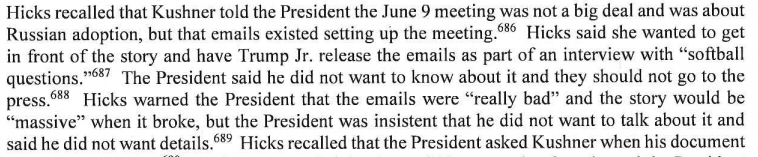
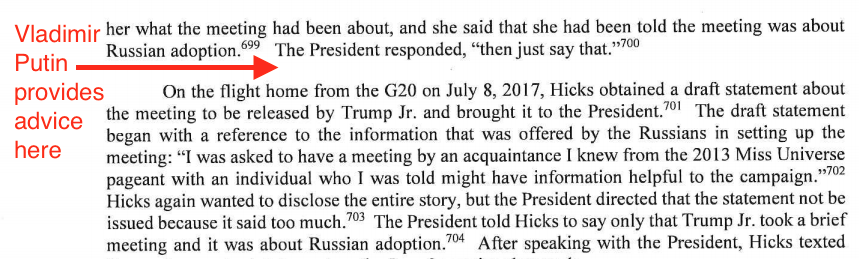
Efforts to prevent public disclosure of evidence (including his attempts to cover up the June 2016 Trump tower meeting and to lie about to the public).
Trump’s further efforts to have Attorney general Jeff Sessions take control of the investigation and limit it.
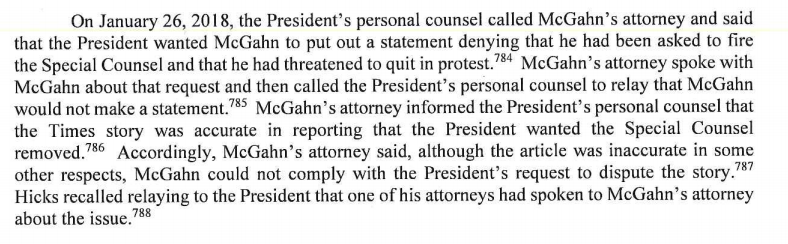
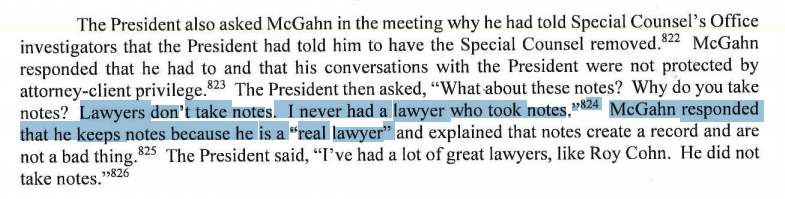
Trump’s efforts to have White House counsel Don McGahn lie by denying that Trump had ordered him to have Mueller fired.
Trump’s conduct toward Michael Flynn, Paul Manafort and another person whose name is redacted (including dangling pardons).
Trump’s conduct toward Michael Cohen.
Mueller’s report argues that Trump’s efforts to impede the investigation can be divided into two broad time periods: basically before and after his firing of the FBI director.
Early in the report on obstruction, Mueller says that the evidence “indicates that the President wanted to protect himself from an investigation into his campaign. In addition the president had a motive to put the FBI’s investigation behind him.” Nevertheless, it concludes, the “evidence does not establish that the termination of Comey was designed to cover up a conspiracy between the Trump campaign and Russia.” (page 76)
But, the report says, things changed shortly after the president fired the FBI director, when Trump became aware that investigators were conducting an obstruction-of-justice inquiry into his own conduct. This awareness marked a significant shift as “the President engaged in a second phase of conduct, involving public attacks on the investigation, non-public efforts to control it, and efforts in both public and private to encourage witnesses not to cooperate with the investigation.” (page 219)
This included his attempts to fire the special counsel and have Attorney General Sessions un-recuse himself and limit the probe. Trump also “sought to prevent public disclosure of information about the June 9, 2016 meeting between Russians and campaign officials; and he used public forums to attack potential witnesses who might offer adverse information and to praise witnesses who declined to cooperate with the government.” (page 158)
In his four-page letter and press conference, Barr had insisted that Trump did not obstruct justice because he was not guilty of any underlying crime. Mueller explicitly rejects this argument. Trump, Mueller writes, had more than enough motive to try to impede the investigation:
As described in Volume I, the evidence uncovered in the investigation did not establish that the President or those close to him were involved in the charged Russian computer-hacking or active-measure conspiracies, or that the President otherwise had an unlawful relationship with any Russian official. But the evidence does indicate that a thorough FBI investigation would uncover facts about the campaign and the President personally that the President could have understood to be crimes or that would give rise to personal and political concerns. [Emphasis added.] (page 76)
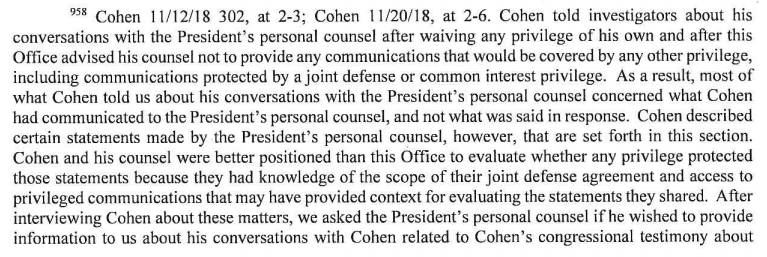
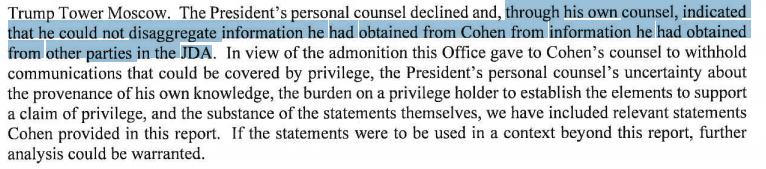
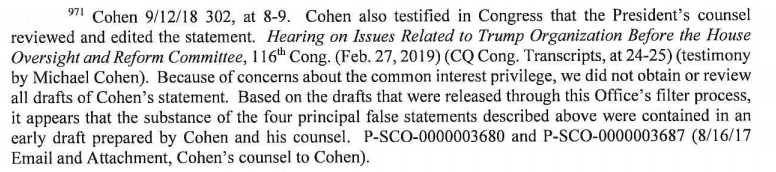
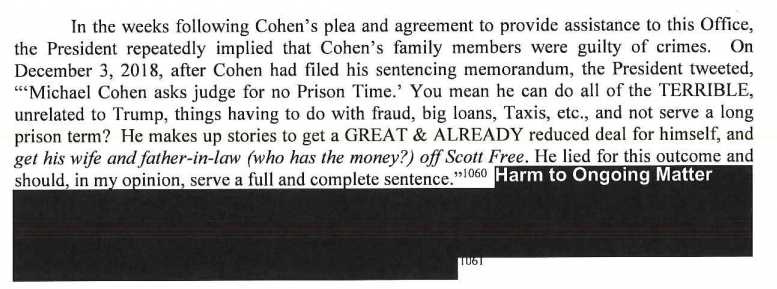
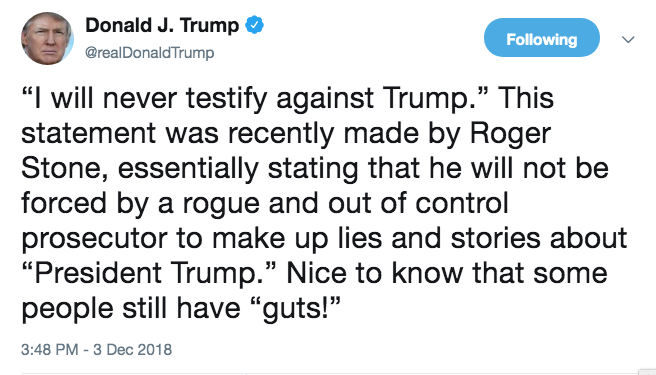
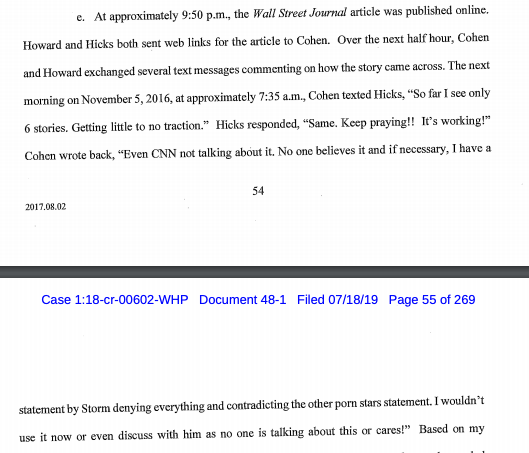
According to Mueller, Trump’s efforts included public attempts to intimidate witnesses. For example, Trump’s repeated suggestion that members of his former attorney Michael Cohen’s family committed crimes, “could be viewed as an effort to retaliate against Cohen and chill further testimony adverse to the President by Cohen or others,” Mueller’s team writes. “The timing of the statements supports an inference that they were intended at least in part to discourage Cohen from further cooperation.” (page 156)
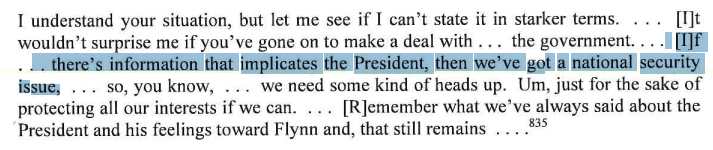
The report also suggests that Trump had dangled pardons to potential witnesses. The report says that “Cohen also discussed pardons with the President’s personal counsel and believed that if he stayed on message he would be taken care of. But after Cohen began cooperating with the government in the summer of 2018, the President publicly criticized him, called him a “rat.” (page 6)
Likewise in January, 2018, Paul Manafort told a colleague that he had “talked to the President’s personal counsel & they were ‘going to take care of us.’”
Mueller’s report also documents Trump’s efforts to fire Mueller:
“Substantial evidence . . . supports the conclusion that the President . . . directed McGahn to call Rosenstein to have the Special Counsel removed. First, McGahn’s clear recollection was that the President directed him to tell Rosenstein . . . ‘Mueller has to go.'”
According to the report, after Trump ordered McGahn to call Rod Rosenstein and have Mueller fired, McGahn “called his lawyer, drove to the White House, packed up his office, prepared to submit a resignation letter . . . told Priebus that the President had asked him to ‘do crazy shit.'” (Page 300)
Does all of this constitute obstruction? The implications seem clear; if Donald Trump was not the sitting president, the case against him would be overwhelming. Indeed, Mueller goes out of his way to note that Trump could face criminal charges after he leaves office. Even though the Office of Legal Counsel has decided that a sitting president cannot be prosecuted, Mueller says pointedly, “it recognizes that a criminal investigation during the President’s term is permissible. The OLC opinion also recognizes that a President does not have immunity after he leaves office.” (Page 335)
And in a passage that seemed directly addressed to Congress, Mueller writes:
[W]e concluded that Congress has the authority to prohibit a president’s corrupt use of his authority in order to protect the integrity of the administration of justice . . . The conclusion that Congress may apply the obstruction laws to the president’s corrupt exercise of the powers of office accords with our constitutional system of checks and balances and the principle that no person is above the law.” (Page
None of this good news for Trump.
https://thebulwark.com/this-is-what-obs ... ooks-like/

What Mueller Found on Russia and on Obstruction: A First Analysis
“Really the best day since he got elected,” said Kellyanne Conway, the president’s counselor, about a day on which 400 pages dropped into the public’s lap describing relentless presidential misconduct and serial engagements between his campaign and a foreign actor. The weeks-long lag between Attorney General William Barr’s announcement of Robert Mueller’s top-line findings and the release of the Mueller report itself created space for an alternate reality in which the document released today might give rise to such a statement. But the cries of vindication do not survive even the most cursory examination of the document itself.
No, Mueller did not find a criminal conspiracy between the Trump campaign and Russia, and no, he did not conclude that President Trump had obstructed justice. But Mueller emphatically did not find that there had been “no collusion” either. Indeed, he described in page after damning page a dramatic pattern of Russian outreach to figures close to the president, including to Trump’s campaign and his business; Mueller described receptivity to this outreach on the part of those figures; he described a positive eagerness on the part of the Trump campaign to benefit from illegal Russian activity and that of its cutouts; he described serial lies about it all. And he describes as well a pattern of behavior on the part of the president in his interactions with law enforcement that is simply incompatible with the president’s duty to “take care” that the laws are “faithfully executed”—a pattern Mueller explicitly declined to conclude did not obstruct justice.
The Mueller report is a document this country will be absorbing for months to come. Below is a first crack at analyzing the features that are most salient to us.
The report answers a great many questions, resolving a raft of concerning issues that had cried out for public resolution. Some of these questions it resolves in Trump’s favor, thereby reducing the long list of concerns that reasonable people will harbor about the president. But by creating a rigorous factual record concerning both Russian intervention in 2016 and presidential obstruction of the effort to investigate that intervention, the report poses other questions acutely. Most importantly, it poses the question of whether this conduct is acceptable—not whether it’s lawful or prosecutable or whether the evidence is admissible, but whether as a nation we choose to accept it, and if not, what means we exercise to reject it. Mueller is not a political figure, but the record he has created puts these fundamentally political questions squarely before us.
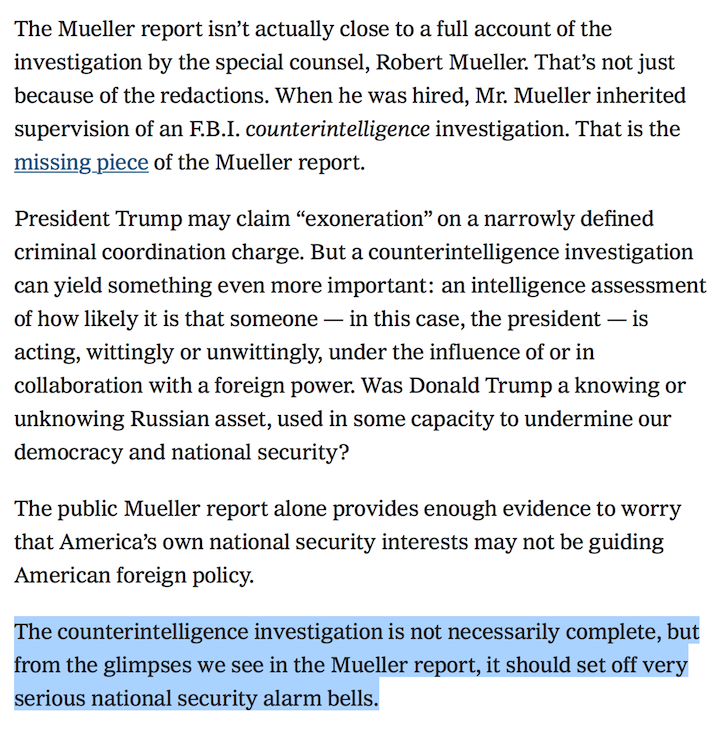
Before turning to what’s in the Mueller report, let’s pause a moment to note something that’s not in it: classified information. The document contains no so-called “portion marking,” which denotes classified material. While it describes sensitive intelligence matters, it does so in an unclassified manner. What’s more, it is almost entirely devoid of discussion of the counterintelligence equities at issue in the Russia matter. This is a prosecutor’s report, focused entirely on application of fact to criminal laws and to assessment of whether legal standards were met. Whether this absence is because the counterintelligence elements of the investigation were handled in some other format or because they were entirely sublimated to the criminal investigation is unclear. But this is a document summarizing a criminal probe and the thinking of the prosecutors who ran it—not a document describing the management of threats to the country.
Like the report itself, we begin with Mueller’s resolution of matters related to Russia.
Results of the Russia Investigation
Consistent with the special counsel’s mandate, the first volume of the Mueller report focuses on “the Russian government’s efforts to interfere in the 2016 presidential election.” Toward this end, its first two substantive sections go into depth on Russia’s “active measures” social media campaign, as well as the “hacking and dumping” operations through which it accessed and disseminated private e-mails from the Democratic National Committee and others. Both provide a fascinating account of Russian influence operations, but neither adds much to the indictments that the Mueller team has previously filed against involved persons. Instead, the important element of Volume 1 is the discussion of “Russian government links to and contacts with the Trump campaign”—or the possibility of what some might describe as “collusion”.
As the report is careful to explain, “collusion” is neither a criminal offense nor a legal term of art with a clear definition, despite its frequent use in discussions of the special counsel’s mandate. Mueller and his team instead examined the relationships between members of the Trump campaign and the Russian government through the far narrower lens of criminal conspiracy. To establish a criminal conspiracy, a prosecutor must show, among other elements, that two or more persons agreed to either violate a federal criminal law or defraud the United States. This “meeting of the minds” is ultimately the piece the Mueller team felt it could not prove, leading it not to pursue any conspiracy charges against members of the Trump campaign, even as it pursued them against Russian agents.
This conclusion is far from the full vindication that chants of “no collusion” imply, a fact driven home by the detailed factual record the Mueller report puts forward. In some cases, there was indeed a meeting of the minds between Trump campaign officials and Russia, just not in pursuit of a criminal objective. In others, members of the Trump campaign acted criminally—as evidenced by the guilty pleas and indictments that the Mueller team secured—but did so on their own. At times, these efforts even worked toward the same objective as the Russian government, but on seemingly parallel tracks as opposed to in coordination. None of this amounted to a criminal conspiracy that the Mueller team believed it could prove beyond a reasonable doubt. But the dense network of interactions, missed opportunities, and shared objectives between the Trump campaign and the Russian government remains profoundly disturbing.
This report shows that the Trump campaign was reasonably aware of the Russian efforts, at least on the hacking side. They were aware the Russians sought to help them win. They welcomed that assistance. Instead of warning the American public, they instead devised a public relations and campaign strategy that sought to capitalize on Russia’s illicit assistance. In other words, the Russians and the Trump campaign shared a common goal, and each side worked to achieve that goal with basic knowledge of the other side’s intention. They just didn’t agree to work together toward that goal together.
Importantly, the report includes several areas in which the Mueller report really does meaningfully exonerate the Trump campaign.
First, while the report notes that some Trump campaign members shared tweets from Internet Research Agency (IRA)-controlled accounts and even agreed to assist in promoting IRA-devised rallies, the special counsel investigation did not conclude that any official of the Trump campaign was aware the solicitations were coming from foreign persons. Being duped is not the same as committing a crime, and Mueller conclusively puts to rest the question of whether the Trump campaign was somehow aiding the Russian social media operation.
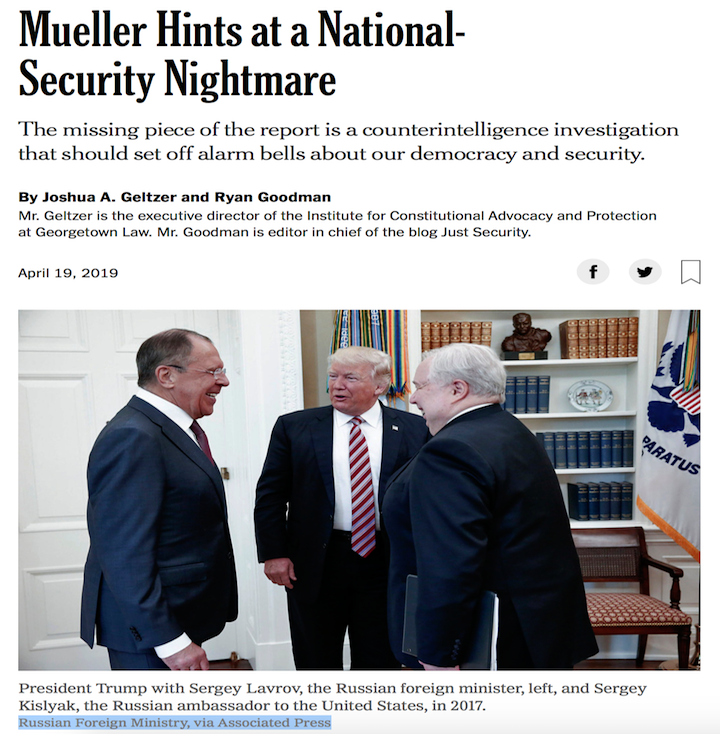
Second, the Mueller report answers lingering questions about a number of previously reported events about which people harbored reasonable suspicions. The Mueller team examined the reported contacts between campaign members, including Jared Kushner and Jeff Sessions, with Sergey Kislyak at the Mayflower Hotel in April 2016 and found that the conversations were brief and nonsubstantive, and took place in public. Similarly, Mueller examined contacts between then-Senator Sessions and Kislyak at Sessions’s Senate office in September 2016 and determined that the two did not discuss anything related to the election. That is consistent with Sessions’s account of the matter and effectively clears him on the question; nothing untoward seems to have occured.
Additionally, the special counsel’s office describes a set of interactions between campaign members—in particular, Kushner—and the head of a D.C.-based think tank, the Center for the National Interest (CNI). The investigation found no evidence that CNI facilitated back channels between the campaign and the Russian government.
Finally, the special counsel’s report puts to rest suggestions that the Republican National Convention platform on Ukraine was altered at the direction of Trump or Russia. While Trump advisor J.D. Gordon did champion an effort on behalf of the campaign to soften a proposed amendment to the Republican Party platform on supporting Ukraine against Russian aggression, the report makes clear that Gordon was not directed to seek the change by Trump. He did so after deciding that the change would better align the platform with Trump’s stated policy.
So that’s all good news for Trump. Reporting on these matters had accurately described these events as having occurred, but the Mueller report should end speculation that they were evidence of collusion or anything untoward.
The rest of the report is far less rosey for Trump World.
While the report does not find criminal conspiracy between Trump associates and Russia, it describes a set of contacts that may not involve chargeable criminality but might reasonably be described as “collusion.” In some of these cases, there was a clear “meeting of the minds”—or an effort to establish one—between members of the Trump campaign and agents of the Russian government, but the object of that agreement was not a federal crime. If these episodes fall short of a criminal conspiracy, they nonetheless reveal an alarming reality.
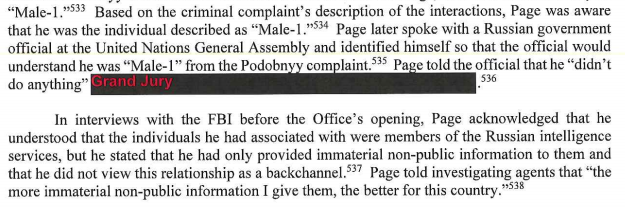
The report details numerous contacts during the presidential campaign, some of which are well known—for example, the cases of George Papadopoulos and Carter Page, two low-level recruits to the Trump campaign’s foreign policy team who became the focus of efforts by Russian agents to cultivate a relationship. A higher profile case is that of Trump’s former campaign manager, Paul Manafort. The report describes Manafort’s extensive ties to Russia in detail, ties he cultivated through his prior work for Russian oligarch Oleg Deripaska and the former Russian-backed government in Ukraine. Throughout his time with the Trump campaign—Manafort resigned in August 2016 but continued to advise the Trump campaign through at least November—Manafort maintained consistent contact with his “longtime” associate Konstantin Kilimnik, a Ukrainian who, according to the report, “the FBI assesses to have ties to Russian intelligence.” Kilimnik attempted to have Manafort pass along a peace plan for Ukraine that Manafort acknowledged to be friendly to Russian interests, though the Mueller team was unable to identify evidence that Manafort did so. Manafort in turn instructed his deputy Rick Gates to provide Kilimnik with polling data and other information regarding the Trump campaign’s electoral strategy, which he understood would be passed on to Deripaska and others.
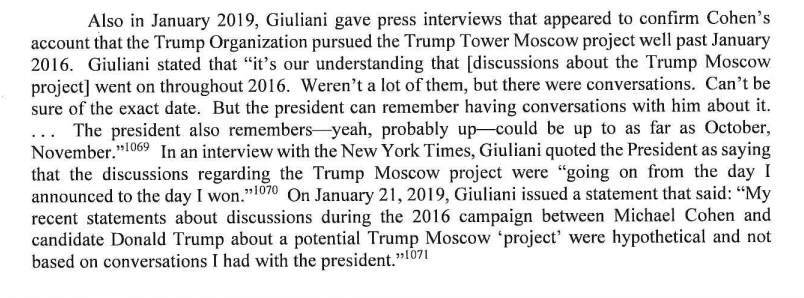
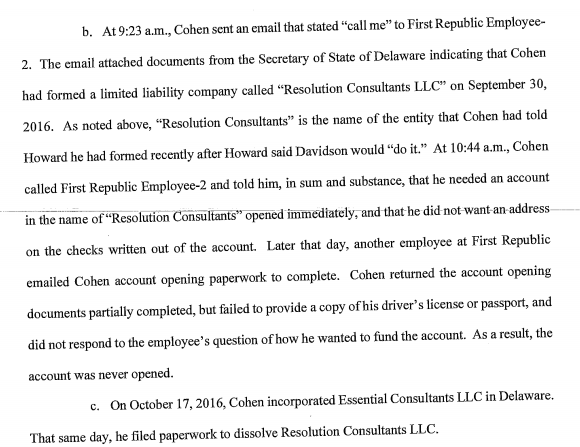
A particularly troubling example is the protracted negotiation over the Trump Tower Moscow project, in which President Trump was personally involved. In September 2015, the Trump Organization, acting through attorney Michael Cohen, restarted negotiations over a possible Trump Tower project in Moscow that had fallen through several years prior. Trump himself signed a letter of intent for the project in October 2015, on the same day as the third Republican primary debate. One of Cohen’s interlocutors on the deal, businessman Felix Sater, repeatedly raised the prospect of using the deal to enhance Trump’s electoral prospects. In January 2016, Cohen reached out to Russian officials in an attempt to contact Putin and secure support for the project, which ultimately resulted in an invitation for Cohen to visit Moscow to discuss. Cohen also raised the prospect of Trump himself visiting Russia to discuss the deal, once in late 2015 and again in spring 2016—a possibility that Cohen indicated Trump was open to if it would facilitate the deal. Neither trip ultimately came together. Cohen ultimately pleaded guilty to lying to Congress about how long into 2016 the Trump Tower Moscow project was negotiated and Trump’s personal knowledge of it.
There are other examples too. The Mueller report lays out in detail a sustained effort to obtain a set of emails which figures associated with the campaign believed hackers might have obtained from Hillary Clinton’s private server before she deleted them. The trouble is that it appears the emails didn’t exist. It has previously been reported that now-deceased Trump supporter Peter Smith went to extreme lengths to try and track down Clinton’s 30,000 deleted emails. According to today’s report, after candidate Trump stated in July 2016 that he hoped Russia would “find the 30,000 emails,” future National Security Advisor Michael Flynn reached out to multiple people to try and obtain those emails. One of the individuals he reached out to was Peter Smith. Smith later circulated a document that claimed his “Clinton Email Reconnaissance Initiative” was “‘in coordination’ with the Trump Campaign” specifically naming Flynn, Sam Clovis, Steve Bannon and Kellyanne Conway. While the investigation found that Smith communicated with both Flynn and Clovis, it found no evidence that any of the four individuals listed “initiated or directed Smith’s efforts.” So essentially, a bunch of people in Trump’s orbit tried very hard to obtain stolen emails but came up empty. Mueller decided that chasing this particular ghost did not constitute criminal conduct.
There are also a series of events for which the special counsel’s office appeared to have seriously considered the possibility of bringing charges but ultimately determined that not all of the elements were met or that the evidence was otherwise insufficient.
Most seriously, the special counsel’s office examined possible criminal charges related to the June 9, 2016, Trump Tower meeting in significant depth. The report’s account of the meeting between senior representatives of the Trump campaign and Russian attorney Natalya Veselnitskaya and other Russian government-linked individuals largely tracks with widely reported accounts. The meeting was proposed to Donald Trump Jr. in an email from Robert Goldstone, who said that the “Crown prosecutor of Russia ... offered to provide the Trump Campaign with some official documents and information that would incriminate Hillary and her dealings with Russia” as “part of Russia and its government's support for Mr. Trump.” Trump Jr. responded that “if it’s what you say I love it” and arranged the meeting through a series of emails and telephone calls. Trump Jr., Paul Manafort, and Jared Kushner attended. The meeting lasted approximately 20 minutes and left the campaign officials frustrated because the Russians were not able to offer any concrete information and instead talked about adoptions and the Russian Magnitsky Act. The report indicates that Mueller could not establish that Donald Trump knew in advance about the meeting, and Trump’s submitted written answers say he has no recollection of learning of the meeting at the time.
Mueller ultimately concluded there was not sufficient evidence to pursue campaign finance charges against campaign officials regarding the Trump Tower meeting. He cites the government’s “substantial burden of proof on issues of intent,” raising questions about whether the participants knew the activity was illegal at the time as is required by the statute, and then explores whether Veselnitskaya’s offer of “dirt” on Hillary Clinton qualifies as a “contribution or donation of money or other thing of value” under campaign finance laws. While the report recognizes that opposition research could be considered a “thing of value,” no judicial decision has considered this issue. Rather than tackle that issue himself, Mueller declined to pursue criminal campaign finance charges.
At least one other section of the report clearly alludes to potential criminal conduct, but it is so redacted (presumably because of the ongoing Roger Stone indictment) that it is hard to say why the activities did not rise to the level of criminality. The report spends more than 20 pages detailing how the Russian intelligence services hacked the Clinton campaign, the Democratic National Committee (DNC) and the Democratic Congressional Campaign Committee, and then coordinated with WikiLeaks to release the hacked information in ways that would hurt Clinton and help Trump. The GRU had initially set up its own websites, including DCLeaks and Guccifer 2.0, but later transferred many of the documents they stole from the DNC and campaign Chairman John Podesta to WikiLeaks “n order to expand its interference” in the 2016 election. Julian Assange and WikiLeaks implied publicly that Seth Rich, a former DNC staff member who was killed in July 2016, was the source of the material in order to throw suspicion away from the GRU as the source of the material. But the involvement of the Trump campaign in the dissemination of the stolen material is largely redacted. It’s clear that Manafort, Gates, Jerome Corsi, Ted Malloch, and at least one other person—presumably Roger Stone, whose name does not appear in the redacted version of the report—were involved in some way. The document also seems to make an ominous reference to a phone call while Trump and Gates were driving to LaGuardia, after which Trump told Gates that “more releases of damaging information would be coming”—but the details of the call are redacted. The ongoing case against Stone for lying to Congress about his involvement with WikiLeaks is likely the source for much of the “Harm to Ongoing Matter” redactions in this section.
Despite the overwhelming number of contacts and ties, Mueller concludes this section by noting that the investigation did not “yield evidence sufficient to sustain any charge that any individual affiliated with the Trump Campaign acted as an agent of [the government of Russia] within the meaning of FARA.”
In light of the hundred pages the redacted Mueller report spends recounting the contacts between Russian government-linked individuals and entities, it is worth taking a moment to recall the frequency and certitude with which President Trump and members of his campaign told the American people that there had been no contact with Russians during the campaign:
Paul Manafort on ABC’s This Week, in response to a question of whether there were any ties between Trump, Manafort, or the campaign and Putin and his regime: “No, there are not. That’s absurd. And you know, there’s no basis to it.”
Donald Trump Jr. told CNN’s Jake Tapper that the Clinton campaign’s suggestion that Russia was helping Trump was “disgusting” and “phony,” noting, “Well, it just goes to show you their exact moral compass. I mean, they will say anything to be able to win this. I mean, this is time and time again, lie after lie.”
Kellyanne Conway, asked whether anyone involved in the Trump campaign had any contact with Russians trying to meddle with the election, responded, “Absolutely not. And I discussed that with the president-elect just last night. Those conversations never happened. I hear people saying it like it’s a fact on television. That is just not only inaccurate and false, but it’s dangerous.”
Vice President-elect Mike Pence on Fox News Sunday, in response to a question of whether there was there any contact in any way between Trump or his associates and the Kremlin or cutouts: “Of course not. Why would there be any contacts between the campaign?”
White House spokeswoman Sarah Huckabee Sanders denied contacts between Russia and the Trump campaign, stating, “This is a nonstory because to the best of our knowledge, no contacts took place, so it’s hard to make a comment on something that never happened.”
Asked at a press conference whether he could say definitively that nobody on his campaign had any contacts with the Russians during the campaign, Trump himself said, “No. Nobody that I know of. Nobody … I have nothing to do with Russia. To the best of my knowledge no person that I deal with does.”
All of these statements were false, and they are only a few of the many examples of campaign officials making such comments.
Those contacts did not end with Trump’s election to the presidency. The Mueller report devotes a substantial number of pages to chronicling Russia’s post-election efforts to make contact with the Trump administration, through both official and unofficial channels.
Some of the contacts are not necessarily untoward. Russia’s official outreach efforts began at 3:00 am following the election, when a Russian Embassy official reached out to Trump campaign press secretary Hope Hicks with a message of congratulations from Putin. This ultimately led to the first Trump-Putin call just days later, on Nov. 14, 2016. A message of congratulations and phone call with a foreign head of state isn’t especially surprising or even necessarily inappropriate.
Support Lawfare
However, shortly thereafter, Russian Ambassador Sergey Kislyak reached out to Jared Kushner to arrange an additional meeting, which took place on Nov. 30 at Trump Tower in New York. At that meeting, which Michael Flynn also attended, Kushner reportedly requested a good point of contact through which they could directly reach Putin. He also raised the possibility of receiving a briefing from Russian generals through a secure communications line at the Russian Embassy, though Kislyak rejected the idea. Kushner subsequently handed off further meetings with Kislyak to a subordinate—but did take a meeting with Sergey Gorkov, the head of the sanctioned Russian government-owned bank Vnesheconombank (VEB). The report notes conflicting accounts over the purpose of the meeting, with Kushner claiming it was diplomatic while VEB claimed it was related to possible business with the private company of which Kushner was CEO, Kushner Companies.
Flynn, meanwhile, continued to engage with Kislyak. In December 2016, he contacted Kislyak as part of an unsuccessful attempt to persuade Russia to veto a U.N. Security Council resolution calling on Israel to cease settlement activities that the Obama administration refused to oppose. A few days later, Flynn—apparently acting on his own initiative, though the report notes that President-elect Trump and others may have been made aware that the call was happening—also spoke to Kislyak to discourage an escalatory response to the Obama administration’s imposition of economic sanctions over Russian election interference, the tack that Putin ultimately pursued. Flynn ultimately pleaded guilty to making false statements to the FBI regarding both interactions, as well as to false statements on a FARA filing regarding his prior work on behalf of Turkey.
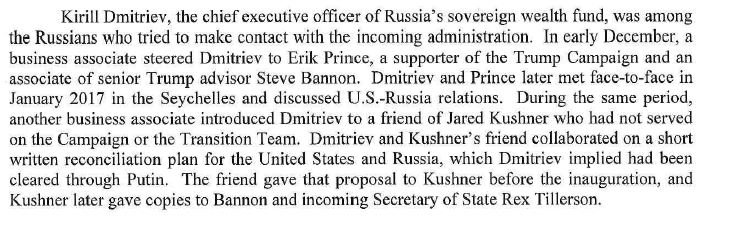
At the same time, several self-described Russian oligarchs actively reached out to establish their own contacts with the Trump administration, in part in response to discussions with Putin. Two such oligarchs—Petr Aven and Kirill Dmitriev—worked through business associates in unsuccessful attempts to arrange a meeting with Kushner, though Dmitriev was able to successfully pass a paper on U.S.-Russian relations to him. Through another associate, George Nader, Dmitriev also made contact with Erik Prince, a financial supporter and close associate of the Trump campaign, though he had no official position. The three met in Seychelles in January 2017, but redactions in the Mueller report leave substantial ambiguity regarding the subject matter of their discussions. Prince claims that he reported on his meeting with Dmitriev to Trump campaign official Steve Bannon, but Bannon disputes this—a discrepancy, the report notes, that investigators were unable to resolve.
In the end, there was clearly criminality here: criminality on the Russian side and criminality on the U.S. side in lying about interactions with Russian actors. And there was also activity that was plainly innocent. Between those two extremes, there was also a large quantity of engagement that was apparently not chargeably criminal but that did involve covert attempts to engage with a hostile foreign government for the benefit of Trump’s campaign and business.
Whether one calls it collusion or calls it something else, it isn’t pretty.
Findings on Obstruction of Justice
The second volume of the report, focusing on obstruction of justice, begins with an explanation of one of the most confusing aspects of the report: Mueller’s decision not to make a determination one way or the other as to whether to prosecute or decline to prosecute the president of the United States for obstruction of justice. As Barr indicated, this is a fundamental deviation from the traditional role of the prosecutor. But the opening pages give important context for this choice by the special counsel’s office.
The introductory section is structured around on the Office of Legal Counsel (OLC) guidance against indicting a sitting president—despite Barr’s suggestion to the contrary at a press conference just prior to the report’s release. Mueller’s analysis focuses on three main points. First, he accepts that the OLC opinion is binding on the special counsel’s office. He also writes that “a federal criminal accusation against a sitting President would place burdens on the President’s capacity to govern and potentially preempt constitutional processes for addressing presidential misconduct.” On this latter point, he cites the OLC opinion’s reasoning that a criminal prosecution of a sitting president would encroach on Congress’s constitutional duty to serve as the check on an unfit executive through impeachment proceedings. In other words, though subtly, Mueller is pretty clearly deferring—at least in part—to Congress: His office chose not to evaluate whether to bring charges against the president, he suggests, both because indictment of the president while he remains in office is off limits to him and because the decision regarding how to handle such conduct by a sitting president is, in any event, more properly left to the legislature.
At the same time, Mueller notes the OLC opinion’s conclusion that a criminal investigation of a president during his term is permissible and that the president may be prosecuted after leaving office. The special counsel’s office thus “conducted a thorough factual investigation in order to preserve the evidence when memories were fresh and documentary materials were available,” the report states, implying that this material will now be in the hands of any future Justice Department should it choose to bring charges against Trump when he leaves office.
Mueller also points to the Justice Manual, which holds that prosecutors should only assess whether a person’s conduct “constitutes a federal offense”: Given that the president cannot be indicted while in office and would not immediately have the opportunity to clear his name through a “speedy and public trial,” the manual counsels against making that initial assessment.
All this leads to Mueller’s key conclusion, quoted only in part in Barr’s initial letter: “if we had confidence after a thorough investigation of the facts that the President clearly did not commit obstruction of justice, we would so state. … Accordingly, while this report does not conclude that the President committed a crime, it also does not exonerate him.” This reasoning makes clear the disconnect between Mueller’s approach to the obstruction investigation and that of Barr, who independently chose to evaluate the evidence against Trump and determine that it was not sufficient to establish an obstruction offense.
This is not, in short, a circumstance in which Mueller summed up all the evidence for obstruction and all the evidence against it and just couldn’t make up his mind—or decided to defer to the attorney general for judgment. Mueller’s decision not to reach a traditional prosecutorial judgment in no sense indicates that the evidence of possible obstruction by the president was weak—“No Collusion, No Obstruction,” as the president tweeted. To the contrary, the more time one spends with the obstruction section of the report, the more it suggests that the Mueller team believed the evidence of obstruction to be very strong.
Support Lawfare
The special counsel describes some overarching factual issues and general conclusions that affect his entire obstruction discussion. The report notes that this case is “atypical compared to the heartland obstruction-of-justice prosecutions brought by the Department of Justice” for several reasons. First, “the conduct involved actions by the President” and any factual analysis of Trump’s conduct “would have to take into account both that the President’s acts were facially lawful and that his position as head of the Executive Branch provides him with unique and powerful means of influencing official proceedings, subordinate officers, and potential witnesses.” Second, as discussed in the first half of the report, “the evidence does not establish that the President was involved in an underlying crime related to Russian election interference,” but “does point to a range of other possible personal motives animating the President's conduct,” including “concerns that continued investigation would call into question the legitimacy of his election and potential uncertainty about whether certain events ... could be seen as criminal activity by the President, his campaign, or his family.” And third, “many of the President’s acts directed at witnesses, including discouragement of cooperation with the government and suggestions of possible future pardons, occurred in public view.” Though it’s unusual for obstructive acts to be public-facing, “if the likely effect of [Trump’s] acts is to intimidate witnesses or alter their testimony, the justice system’s integrity is equally threatened.”
Additionally, the special counsel writes that “it is important to view the President’s pattern of conduct as a whole” because it “sheds light on the nature of the President’s acts and the inferences that can be drawn about his intent.” The investigation “found multiple acts by the President that were capable of exerting undue influence over law enforcement investigations, including the Russian-interference and obstruction investigations,” but which were “mostly unsuccessful … because the persons who surrounded the President declined to carry out orders or accede to his requests.” The team viewed the obstruction investigation as looking at two distinct phases: before Trump fired FBI Director James Comey, when Trump “deemed it critically important to make public that he was not under investigation”; and after he “became aware that investigators were conducting an obstruction-of-justice inquiry into his own conduct.” During this latter period, Trump “launched public attacks on the investigation and individuals involved in it who could possess evidence adverse to the President” and, “in private, … engaged in a series of targeted efforts to control the investigation.” In the special counsel’s view, “judgments about the nature of the President’s motives during each phase would be informed by the totality of the evidence.”
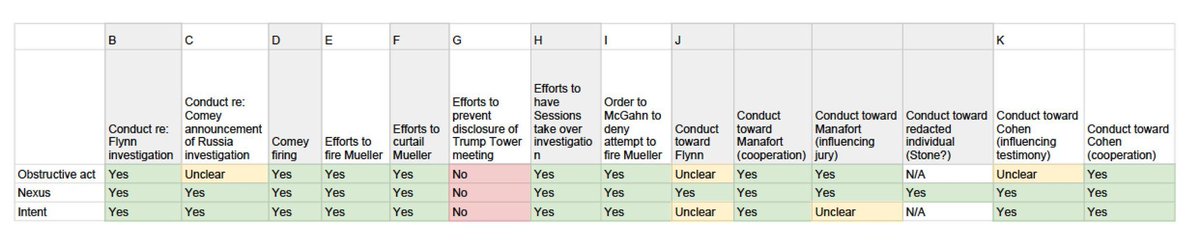
The report identifies and analyzes ten episodes of concern in the obstruction investigation.
conduct involving then-FBI Director Comey and Michael Flynn;
the president’s reaction to the continuing Russia investigation;
the president’s termination of Comey;
the appointment of a special counsel and efforts to remove him;
efforts to curtail the special counsel’s investigation;
efforts to prevent public disclosure of evidence;
further efforts to have the attorney general take control of the investigation;
efforts to have White House Counsel Don McGahn deny that the president had ordered him to have the special counsel removed;
conduct toward Flynn, Manafort, and a redacted individual (likely Roger Stone); and
conduct involving Michael Cohen.
Each episode includes a detailed set of factual findings and then analyzes how the evidence maps onto the criminal charge of obstruction, which requires (1) an obstructive act; (2) a nexus with an official proceeding; and (3) a corrupt intent. We have summarized all of the episodes and Mueller’s analysis of them under the obstruction statutes here.
For present purposes, the critical point is that in six of these episodes, the special counsel’s office suggests that all of the elements of obstruction are satisfied: Trump’s conduct regarding the investigation into Michael Flynn, his firing of Comey, his efforts to remove Mueller and then to curtail Mueller’s investigation, his campaign to have Sessions take back control over the investigation and an order he gave to White House Counsel Don McGahn to both lie to the press about Trump’s past attempt to fire Mueller and create a false record “for our files.” In the cases of Comey’s firing, Trump’s effort to fire Mueller and then push McGahn to lie about it, and Trump’s effort to curtail the scope of the investigation, Mueller describes “substantial” evidence that Trump intended to obstruct justice. Only in one instance—concerning Trump’s effort to prevent the release of emails regarding the Trump Tower meeting—does the special counsel seem to feel that none of the three elements of the obstruction offense were met. It is not entirely clear how Mueller would apply his overarching factual considerations, discussed above, to the specific cases, but he does seem to be saying that the evidence of obstruction in a number of these incidents is strong.
In addition to spelling out damaging accounts of Trump’s conduct in great detail, the report also contains a lengthy section addressing the legal arguments made in his defense. The report describes letters sent by Trump’s personal counsel to Mueller’s team detailing both statutory and constitutional defenses regarding 18 U.S.C. § 1512(c)(2), the general obstruction of justice statute. On the statutory matter, Mueller’s team responds to the suggestion that the statute should be interpreted narrowly, to cover only “acts that would impair the integrity and availability of evidence”; Mueller, rather, adheres to the Justice Department’s view that § 1512(c)(2) “states a broad, independent, and unqualified prohibition on obstruction of justice.”
More interesting is the report’s constitutional analysis: Pursuant to a separation of powers analysis and contra the president’s lawyers and Barr’s own memo on the subject, Mueller takes the view that presidential actions taken under Article II authority can constitute obstructions of justice.
The argument is complex, but it is notable that Mueller emphasizes the role of the president’s obligations under the Take Care Clause as effectively harmonizing the corrupt intent requirement under the obstruction statutes with Article II: “the concept of ‘faithful execution’ connotes the use of power in the interest of the public, not in the office holder’s personal interest.” This suggests that “corrupt” activities are incompatible with good-faith adherence to the duties of the presidency such that prohibiting them cannot violate Article II. One interesting, if subtle, implication here is that a violation of the obstruction statute by the president thus necessarily violates the Take Care Clause—which links criminality under the statute to impeachability.
Barr’s Bad Day
The devastating nature of the report makes the performance of the attorney general in characterizing it at his press conference prior to its release a particularly inappropriate spectacle.
Not content to release a document that he had—contrary to many people’s expectations—not redacted beyond readability, he characterized it in a fashion that sounded remarkably like the president’s own spin. “The bottom line,” Barr concluded, in a statement that seemed designed to vindicate the Trump campaign’s claims of innocence, “After nearly two years of investigation, thousands of subpoenas, and hundreds of warrants and witness interviews, the Special Counsel confirmed that the Russian government sponsored efforts to illegally interfere with the 2016 presidential election but did not find that the Trump campaign or other Americans colluded in those schemes.”
Barr had to elide a lot of Mueller’s actual findings in order to describe them this way. In addressing the Trump campaign’s possible involvement in the dissemination of hacked DNC materials through WikiLeaks, the attorney general concluded that the report found that no one associated with the Trump campaign had “illegally participated” in the dissemination, while noting that doing so would be criminal only if those involved in publishing them also participated in the underlying hacking conspiracy. Similarly, in discussing contacts between the Trump campaign and those connected with the Russian government, Barr observed only that Mueller “did not find any conspiracy to violate U.S. law,” without characterizing the actual interactions that the investigation uncovered. Instead, Barr focused on the narrow question of whether the Mueller investigation found that there was a criminal conspiracy.
Barr then moved on to whether President Trump had obstructed justice in his removal of former FBI Director James Comey and other interactions with law enforcement. Without elaborating, he noted areas of disagreement with the legal framework that Mueller presented in his report, but claimed that he and Deputy Attorney General Rod Rosenstein nonetheless applied it in concluding that “the evidence developed by the Special Counsel is not sufficient to establish that the President committed an obstruction-of-justice offense.”
Later, in response to a question, Barr emphasized that Mueller had avoided reaching a conclusion as to whether or not Trump had committed an obstruction crime on the basis of OLC’s view that a sitting president was not subject to indictment. Yet it’s hard to square this account with Mueller’s own description of his reasoning, which we described above. Barr went on an extended riff on his assessment of Trump’s state of mind in evaluating the potential obstructions described in the report, noting that “the President was frustrated and angered by a sincere belief that the investigation was undermining his presidency, propelled by his political opponents, and fueled by illegal leaks.” Suffice it to say these factors loom larger in Barr’s assessment of the evidence than they do in Mueller’s account.
On their face, Barr’s remarks were not a neutral recitation of the report’s principal conclusions. Instead, by drawing broad conclusions from narrow legal analysis, the attorney general provided the president’s supporters with an abundance of sound bites and talking points for the weeks to come. Trump could not have asked for a friendlier summary of a deeply unfriendly document.
Barr, however, did himself no service, despite having done a reasonable job shepherding the report itself to public release. A great many people will be more skeptical of his future actions as a result of his words.
The Political Reaction
“I’m having a good day,” said Trump in his first remarks following the report. “No collusion, no obstruction.” Trump’s victory lap actually began hours earlier in a series of triumphant tweets. The president’s most ardent congressional defenders have repeated the line.
Senate Republicans have been more muted. Majority Leader Mitch McConnell said he looked forward to reading the documents. Senate intelligence committee Chairman Richard Burr praised Barr’s commitment to publicly releasing the report and said he was carefully reviewing the material.
Meanwhile, Democratic Speaker of the House Nancy Pelosi and Senate Minority Leader Chuck Schumer said Mueller’s report painted “a disturbing picture of a president who has been weaving a web of deceit, lies and improper behavior and acting as if the law doesn’t apply to him.” The majority of their statement, however, was devoted to criticizing Barr, who they allege has “misled the public.” “It is imperative,” they said, “that the rest of the report and the underlying documents be made available to Congress and that Special Counsel Mueller testify before both chambers as soon as possible.”
For his part, House judiciary committee chairman Jerry Nadler agreed that Congress needs access to the unredacted report and underlying evidence. Nadler’s reaction to the unredacted report’s content, however, were unequivocal: “Even in its incomplete form, the Mueller report outlines disturbing evidence that President Trump engaged in obstruction of justice and other misconduct.” In noting Mueller’s decision not to exonerate the president, he added, “the responsibility now falls to Congress to hold the President accountable for his actions.” He said impeachment was “one possibility” but that it was “too early” to make that decision.
But impeachment is still a hot potato on Capitol Hill. House Majority Leader Steny Hoyer said, “Based on what we have seen to date,” impeachment is “not worthwhile at this point.” He added, “there is an election in eighteen months and the American people will make a judgment.” (Hoyer later walked back his statement, saying “all options ought to remain on the table.”)
Political judgment is precisely what the circumstances require. Whether that judgment takes the form of an impeachment inquiry, an election campaign, or both is a question with which the political system will wrestle over the coming months. But no longer can the country escape the question of the acceptability of the president’s conduct by saying that it is under investigation, that we will wait until the facts come out, or that we won’t proceed on the basis of anonymous sources in news stories.
Mueller has put on the record a remarkable litany of opprobrious behaviors by the president and the people around him. He has also determined, for a variety of different reasons—legal, factual and prudential—not to proceed criminally against any more subjects. That leaves the judgment of those behaviors in other hands.
https://www.lawfareblog.com/what-muelle ... t-analysis